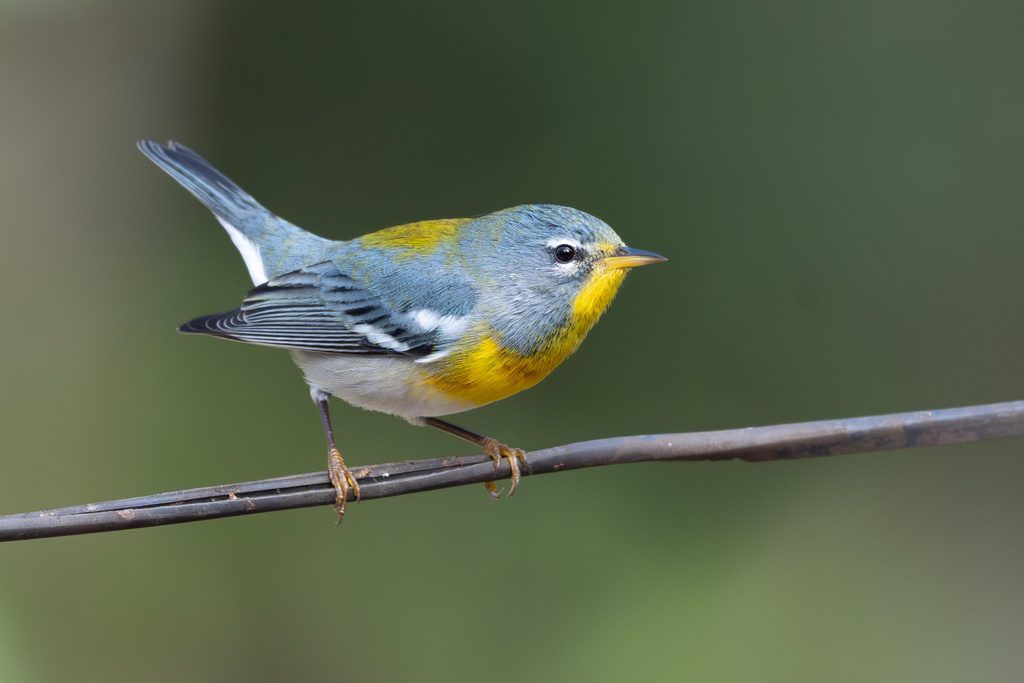
Northern Parula
Photo © Joao Quental
Photo © Joao Quental — CC BY 4.0 — Source: iNaturalist photo #625524480Identification
The Northern Parula is one of North America's smallest migratory warblers, measuring just 10.8–12.4 cm in length with a wingspan of 16–18 cm. Males are unmistakable in breeding plumage: blue-gray upperparts with a distinctive greenish back patch, two white wing bars, and a striking combination of bluish and rufous breast bands separated by white. Prominent white eye crescents frame the face. The breast is yellowish, fading to a white belly. Females are duller and typically lack the bold breast bands. After breeding season, all birds molt into a duller plumage. The song is a distinctive click-like trill or buzz—zeeeeee-yip—with a soft chip call.
Range & Habitat
This migratory warbler breeds across eastern North America from southern Canada to Florida, though its range now contains conspicuous gaps where it was historically present, particularly in the Midwest and parts of New England. Historical declines are linked to habitat loss from clear-cutting, bog drainage, and reduced epiphyte growth from air pollution. Northern populations breed in mature, moist coniferous forests, particularly spruce bogs and hemlock swamps where the species nests in hanging clumps of Old Man's Beard lichen. Southern populations favor mature, moist bottomland forests rich in Spanish moss. The species winters in southern Florida, northern Central America, the West Indies, and the Lesser Antilles, occasionally appearing as a rare vagrant to western Europe.
Behaviour & Diet
Northern Parulas are monogamous breeders that construct distinctive pendulum nests suspended in lichen and moss clumps, typically 3–7 eggs per clutch. Southern populations often raise two broods beginning as early as March, while northern birds breed later, raising only one brood. Nests are scantily lined cups averaging 7 cm in diameter, frequently positioned near water over branches. Incubation lasts 12–14 days, with fledging at 10–11 days.
These warblers forage almost entirely on arboreal invertebrates, gleaning spiders, damselflies, locusts, bugs, grasshoppers, aphids, beetles, caterpillars, flies, wasps, bees, and ants from vegetation. Caterpillars and spiders are the primary prey year-round. During winter, consumption of beetles increases and birds occasionally supplement their diet with berries, seeds, and nectar.
Best Time & Places to See It
Northern Parulas are common breeders across most of eastern North America during spring and summer. Look for them in mature forests with abundant epiphyte growth—spruce bogs and hemlock swamps in the north, Spanish moss-draped bottomland forests in the south. During migration and winter, the species becomes a habitat generalist, appearing in shrubby pastures, moist forests, and agricultural areas. Migration periods offer excellent opportunities for observation, particularly in mixed feeding flocks where their small size becomes apparent alongside kinglets and gnatcatchers.
Photography Tips
The Northern Parula's small size and active foraging behavior demand patience and quick reflexes. Photograph breeding males in spring light to capture the brilliant blue, rufous, and white contrast of their plumage and striking eye crescents. Backlit or side-lit shots emphasize the greenish back patch and white wing bars. Focus on trees with lichen and moss where birds actively forage. Early morning produces the best light and activity levels. Include habitat context—moss-draped branches or lichen-covered trees—to tell the species' ecological story. Expect fast, jerky movements through foliage; use faster shutter speeds and position yourself at eye level with feeding birds to maximize sharp, compelling images.
Nothing matches these filters.
Acadia National Park
Algonquin Provincial Park
Alligator River National Wildlife Refuge
Arrecifes de Cozumel National Park
Barra del Colorado National Wildlife Refuge
Baru Volcano National Park
Bic National Park
Big Bend National Park
Biscayne National Park
Nothing matches these filters.
No community photos yet. Log in to add the first one.
No community observations of this species yet.