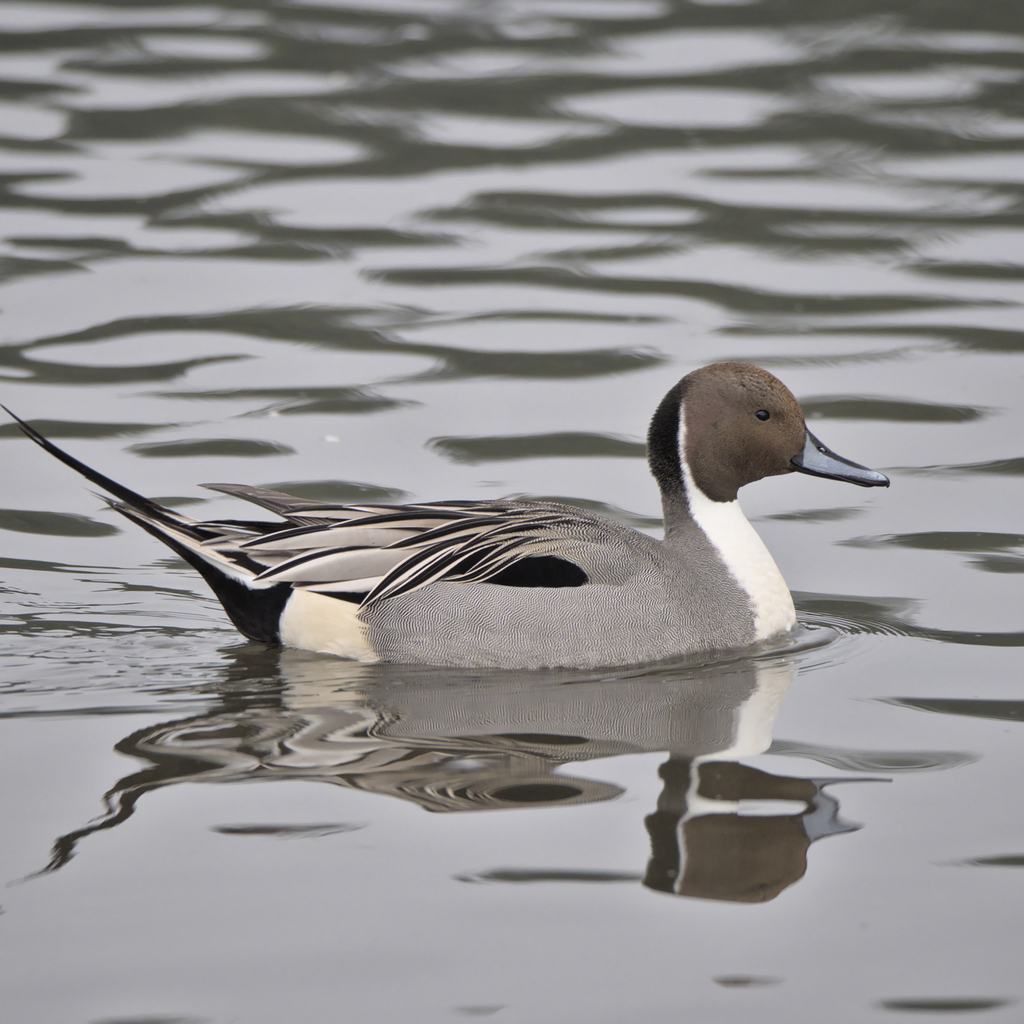
Northern Pintail
Photo © Micah Carrick
Photo © Micah Carrick — CC BY 4.0 — Source: iNaturalist #144435253Identification
The Northern Pintail is a large, elegant duck with distinctive features that make it unmistakable in the field. Males in breeding plumage are particularly striking, displaying a chocolate-brown head with a thin white stripe running down the neck to the white breast and underparts. The back and sides are grey with elegant black-marked feathers, and the elongated central tail feathers—which give the species its name—extend up to 10 centimetres. Both sexes share blue-grey bills and legs. Females are more subtly plumaged in mottled light brown with a grey-brown head, but they are still recognizable by their slender build, long neck, and pointed tail. Males are noticeably larger than females. In non-breeding plumage, males resemble females but retain distinctive upper wing patterns.
In flight, pintails display rapid, direct movement with swept-back wings. Males show a black speculum (wing patch) with white borders and pale rufous at the front, while females display a dark brown speculum with a very prominent white border at the rear. The male's call is a soft, flute-like proop-proop whistle, while females produce mallard-like quacks and a low croak when flushed.
Range & habitat
The Northern Pintail has one of the widest geographic distributions of any duck species, breeding across northern Europe and the Palearctic through to North America. Unusually for a bird with such an extensive range, it has no geographical subspecies. This highly migratory species winters south of its breeding grounds, ranging as far as the equator in search of suitable habitat.
Northern Pintails favour open wetland environments and nest on the ground, often at some distance from water. They are highly gregarious outside the breeding season, forming large mixed flocks with other duck species.
Behaviour & diet
Northern Pintails are dabbling ducks, feeding at the water's surface on aquatic plants. During the nesting season, they supplement their plant-based diet with small invertebrates. They walk and swim with ease, adopting a forward-leaning swimming position in the water with the base of the neck nearly flush with the surface.
The species' population dynamics are influenced by various natural factors including predators, parasites, and avian diseases. Human activities such as agriculture, hunting, and fishing have also significantly impacted numbers. Despite these pressures, the Northern Pintail remains abundant across its large range and is not considered globally threatened.
Best time & places to see it
As a highly migratory species, Northern Pintails can be encountered across their extensive breeding range in northern Europe and North America during breeding season, and in wintering grounds to the south during winter months. Their gregarious nature during non-breeding periods means they often gather in large flocks, making them more conspicuous at this time of year. Look for them on open wetlands and shallow water bodies.
Photography tips
The striking breeding plumage of males makes them highly photogenic subjects, particularly their distinctive chocolate head and white breast contrasts. Capture males in profile to showcase the elegant white neck stripe and pointed tail feathers. The male's rapid flight with swept-back wings offers dynamic photo opportunities. When photographing females and non-breeding males, focus on their characteristic long neck and slender profile. Their very fast flight requires quick reflexes; practice tracking moving birds. Large mixed flocks in winter provide opportunities for habitat and flock composition shots, while the long white border visible on females' wing patches at distance offers potential for action photography in flight.
Kanha Tiger Reserve
Tombstone Territorial Park
Abijata-Shalla Lakes National Park
Acadia National Park
Alaska Maritime National Wildlife Refuge
Algonquin Provincial Park
Alligator River National Wildlife Refuge
Alpilles Regional Nature Park
Alta Murgia National Park
Nothing matches these filters.
No community photos yet. Log in to add the first one.
No community observations of this species yet.