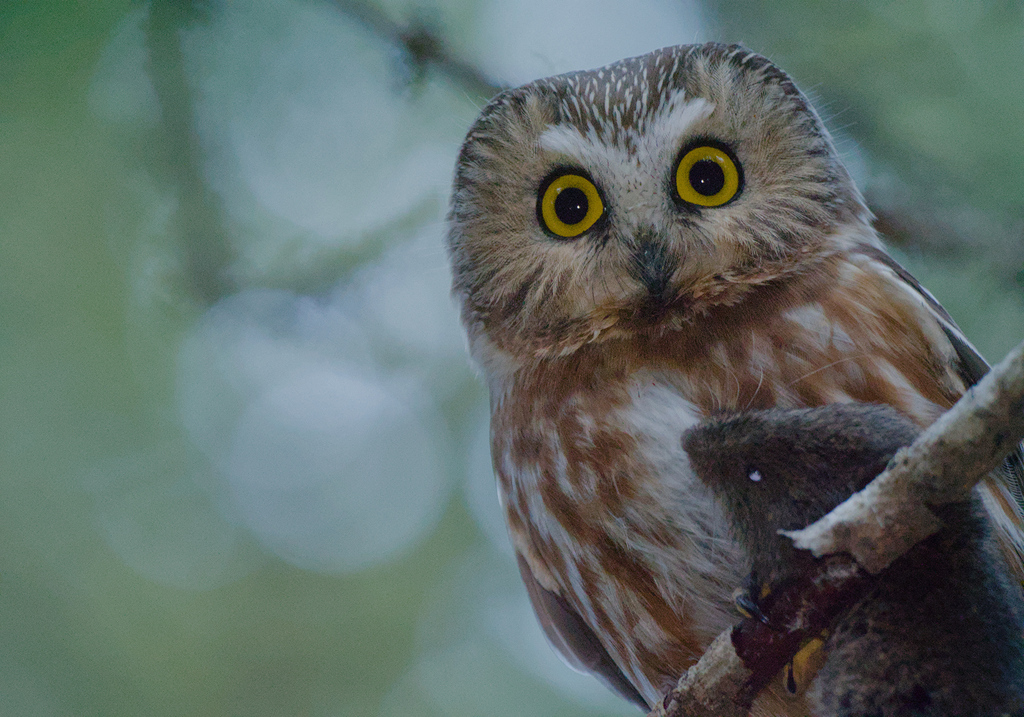
Northern Saw-whet Owl
Photo © Blake Ross
Photo © Blake Ross — CC BY 4.0 — Source: iNaturalist photo #630320457Identification
The northern saw-whet owl is among the smallest owl species in North America, measuring just 17–22 cm in length with a wingspan of 42–56.3 cm and weighing between 54 to 151 grams—comparable in size to an American robin. Adults display a distinctive round, pale white face with brown and cream streaks, dark beak, and striking yellow eyes. The upperparts are brown or reddish with white spotting, while the underparts are pale with darker shaded areas. Juveniles are notably different, featuring a dark brown head and wings contrasted with a tawny rust-colored breast and belly, along with a distinctive white Y-shaped marking between their eyes. Females are larger than males on average, though the species shows no sexual dimorphism in plumage. Remarkably, their flight feathers contain porphyrin pigments that fluoresce neon pink under ultraviolet light—a feature ornithologists use to estimate molt and age in adults.
Range & Habitat
The northern saw-whet owl inhabits coniferous forests, sometimes mixed or deciduous woods, across most of North America south of the boreal forest, including southeastern and southcentral Alaska, southern Canada, the majority of the United States, and the central mountains of Mexico. During breeding season, most birds nest in dense coniferous forests near wetlands, though they may also breed in mixed-deciduous forests at the southern edge of their range in the eastern United States. Wintering birds prefer conifer stands or shrub thickets near water but may occasionally occupy mixed-deciduous forest. As secondary cavity nesters, they depend on naturally occurring holes or cavities excavated by other animals rather than creating their own. Two semi-isolated permanent populations persist in the eastern United States—one along the West Virginia border in the Allegheny Plateau and another in the higher elevations of the southern Appalachian Mountains spanning western North Carolina, eastern Tennessee, and southwestern Virginia.
Behaviour & Diet
The northern saw-whet owl is a migratory bird without any strict pattern; some populations are permanent residents while others migrate south in winter or move down from higher elevations. The species derives its common name from the distinctive vocalizations that early Americans likened to the rhythmic rasp of sharpening a saw on a whetting stone—a comparison that earned it the "saw-whet" moniker by the early 1800s. These owls are often found in dense thickets at eye level, though they may also perch some 20 feet up in trees. Despite their tiny size, they are vulnerable to predation by larger birds of prey, making their preference for dense cover a crucial survival strategy.
Best Time & Places to See It
Northern saw-whet owls can be encountered throughout much of North America, though locating them requires patience and knowledge of their preferred habitats. Search dense coniferous or mixed forests near wetlands, particularly in early morning or evening hours when these nocturnal birds are most active. The species shows remarkable adaptability and can breed farther north than historically recorded, demonstrating resilience even in cold climates. In the eastern United States, the Allegheny Plateau and the higher elevations of the Appalachian Mountains offer reliable locations for encounters, though in some North Carolina counties the species is currently listed as threatened due to habitat loss.
Photography Tips
Photographing northern saw-whet owls presents unique opportunities for patient wildlife photographers. Their small size and preference for dense thickets at eye level can make them surprisingly accessible compared to larger owl species, though their cryptic coloring demands careful attention to detail. The distinctive white face, round head shape, and yellow eyes provide excellent focal points for portraiture. Remember that these owls are vulnerable to larger raptors, so minimize disturbance and avoid flushing them from cover. Their remarkable fluorescent wing feathers under ultraviolet light offer a creative photographic possibility for specialized equipment users, adding an unexpected dimension to documentation of this diminutive predator.
Manitoba Owls
Nothing matches these filters.
Acadia National Park
Alaska Maritime National Wildlife Refuge
Algonquin Provincial Park
Alligator River National Wildlife Refuge
Arches National Park
Banff National Park
Bear River Migratory Bird Refuge
Bic National Park
Black Canyon of the Gunnison National Park
Nothing matches these filters.
No community photos yet. Log in to add the first one.
No community observations of this species yet.