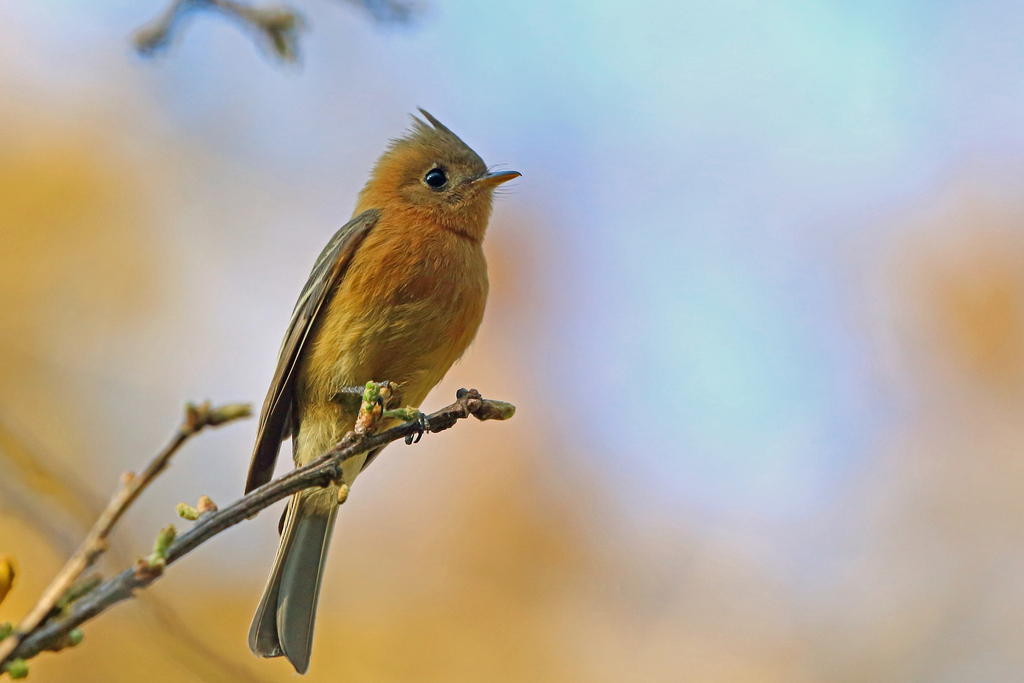
Northern Tufted Flycatcher
Photo © Nigel Voaden
Photo © Nigel Voaden — CC BY 4.0 — Source: iNaturalist photo #2334383Identification
The Northern Tufted Flycatcher is a small passerine measuring 12 to 13.5 cm long and weighing approximately 8.5 g. Its most distinctive feature is an erect, pointed crest on the crown. The nominate subspecies displays a brown-tinged olive crown with a pale spot above the lores and a thin buff-white eye-ring set against a cinnamon face. The upperparts are brownish with an olive tinge, while the wings are dusky with buff-edged coverts forming two visible wing bars. The throat and breast are bright ochre to cinnamon, contrasting with an ochre-yellow belly. Both sexes share identical plumage. Other subspecies show subtle variations: tenuirostris appears paler and duller; berlepschi has a darker olive crown and bright yellow belly; aurantiiventris is intermediate between the two.
Range & Habitat
This species is found from Mexico to Ecuador across four recognized subspecies. It inhabits a variety of wooded montane landscapes in the upper tropical to lower temperate zones, including pine, pine-oak, evergreen, and secondary forests, as well as more open areas and gallery forest. The bird shows a marked preference for forest edges, gaps, and clearings. Elevations vary by region: 1,200–3,000 m in northern Central America, 500–3,000 m in Costa Rica, near sea level to 1,200 m in Colombia, and 100–600 m in Ecuador.
Behaviour & Diet
The Northern Tufted Flycatcher is primarily an insectivore, foraging singly or in pairs at any forest level but predominantly at mid-story height. It hunts by sitting upright on a perch and capturing prey in mid-air through hawking sallies, typically returning to the same perch. A characteristic behavior involves wing and tail-shivering upon landing. The species does not participate in mixed-species feeding flocks. It is mostly a year-round resident with some elevational migration occurring in Mexico. Breeding occurs between April and June in Costa Rica and includes February in Colombia. The nest is an open cup constructed from moss, liverworts, and lichens, lined with softer material, typically placed 4–27 m above ground. Clutch size is two eggs.
Best Time & Places to See It
The Northern Tufted Flycatcher is considered fairly common in northern Central America, common in Costa Rica, and locally common in Colombia. It can be encountered in suitable montane habitat year-round, though the breeding season (April–June in most of its range) may offer increased activity and visibility. The species occurs in at least two national parks in Costa Rica, making these protected areas reliable locations for observation.
Photography Tips
Look for this bird along forest edges and in gaps and clearings within montane woodland, where it perches conspicuously. The erect crest and warm ochre underparts are distinctive field marks that photograph well in good light. Patient observers positioned near fruiting trees or flowering areas may capture the bird's characteristic hawking behavior as it launches from its perch to snatch insects in mid-air. Early morning visits to breeding territories may yield recordings of its distinctive dawn song: a rapid series of high notes described as "bip-bip-bip-dididi-up-bip-bip-bibibiseer."
Arenal Volcano National Park
Baru Volcano National Park
Big Bend National Park
Braulio Carrillo National Park
Chirripó National Park
Darién National Park
General de División Omar Torrijos Herrera National Park
La Amistad International Park
Lagunas de Montebello National Park
Nothing matches these filters.
No community photos yet. Log in to add the first one.
No community observations of this species yet.