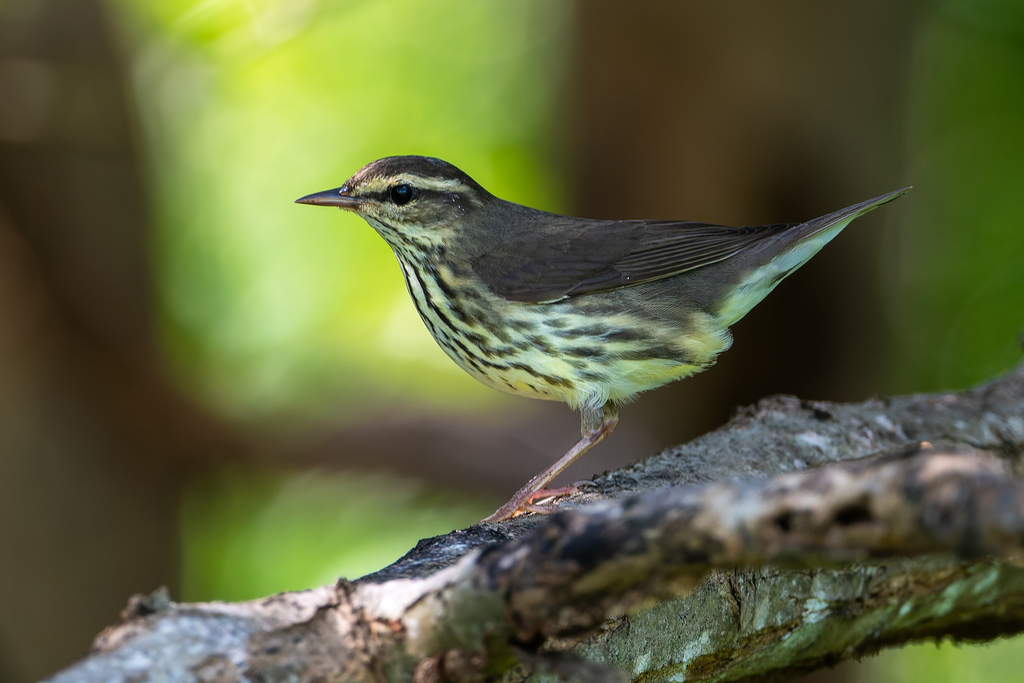
Northern Waterthrush
Photo © Adam Jackson
Photo © Adam Jackson — CC0 1.0 — Source: iNaturalist photo #459373430Identification
The northern waterthrush is a large New World warbler measuring 12–15 cm in length with a wingspan of 21–24 cm. Despite its name, it is not a thrush but a ground-feeding warbler. The bird features a brown crown with a distinctive white supercilium (eyebrow stripe), a pointed dark bill, and evenly brown back. Its most striking feature is the heavily streaked throat, breast, and flanks with brown to black markings. Young birds show buff rather than white underparts. Both sexes are morphologically similar.
The northern waterthrush can be confused with its closest relative, the Louisiana waterthrush, but several field marks help distinguish them: the Louisiana waterthrush has buff flanks, a buff undertail, bright pink legs, and a whiter throat with fewer streaks. Northern waterthrushes walk rather than hop, with a characteristic rear-end bobbing or teetering motion. Their loud, emphatic song consists of clear chirping notes that fall in pitch and accelerate, while their call is a distinctive loud, hard "spwik" with a strong K sound.
Range & Habitat
The northern waterthrush breeds across the northern part of North America, including Alaska, Canada, and the northern United States. It is a migratory species that winters in Florida, Central America, the West Indies, Venezuela, Colombia, and Ecuador. The species is a rare vagrant to other South American countries and to western Europe, with occasional records from unexpected locations.
The breeding habitat consists of wet woodlands near water, particularly along rivers and streams, though northern waterthrushes occasionally nest in upland areas among the roots of fallen trees. On wintering grounds, particularly in Puerto Rico, they occupy four main habitats: white mangrove, red mangrove, black mangrove, and scrub. Males preferentially winter in white mangrove habitats where food is more abundant, while females occupy the drier, less productive habitats. During the non-breeding period, these birds are site-faithful and solitary.
Behaviour & Diet
The northern waterthrush is a terrestrial ground feeder, foraging amongst leaf litter for insects, spiders, mollusks such as snails, worms, and crustaceans. It also wades through water to hunt for minnows. On the wintering grounds, birds face different nutritional challenges depending on habitat quality; those in red and black mangrove can maintain their body weight through winter, while those in scrub habitats tend to lose weight. Moisture availability on wintering grounds is another important determinant of body mass change.
During the non-breeding season, northern waterthrushes display interesting behavioural patterns. In Puerto Rico, they leave daytime foraging areas and fly up to 2 km to nighttime roosts, often located in red mangrove habitats. They are generally solitary birds during the non-breeding period.
Best Time & Places to See It
Northern waterthrushes are best seen during their breeding season in wet woodlands and riparian zones across northern North America, particularly near rivers and streams. In winter, look for them in Central America, the West Indies, and northern South America, where they favour mangrove habitats. Puerto Rico is a reliable wintering location. The species is a rare vagrant to western Europe, with occasional records from the UK and France.
Photography Tips
Photographing northern waterthrushes requires patience and attention to their ground-feeding habits. These birds frequent wet areas near water, making muddy banks and leaf-litter zones productive locations. Their characteristic teetering gait—with distinctive rear-end bobbing—creates dynamic photo opportunities. Look for individuals wading in shallow water hunting for minnows, or foraging amongst leaf litter. The white supercilium and streaked underparts are key field marks to capture clearly. Early morning light is ideal for revealing the subtle brown and buff tones of their plumage.
Tombstone Territorial Park
Acadia National Park
Alaska Maritime National Wildlife Refuge
Algonquin Provincial Park
Alligator River National Wildlife Refuge
Arches National Park
Arctic National Wildlife Refuge
Arenal Volcano National Park
Arrecifes de Cozumel National Park
Nothing matches these filters.
No community photos yet. Log in to add the first one.
No community observations of this species yet.