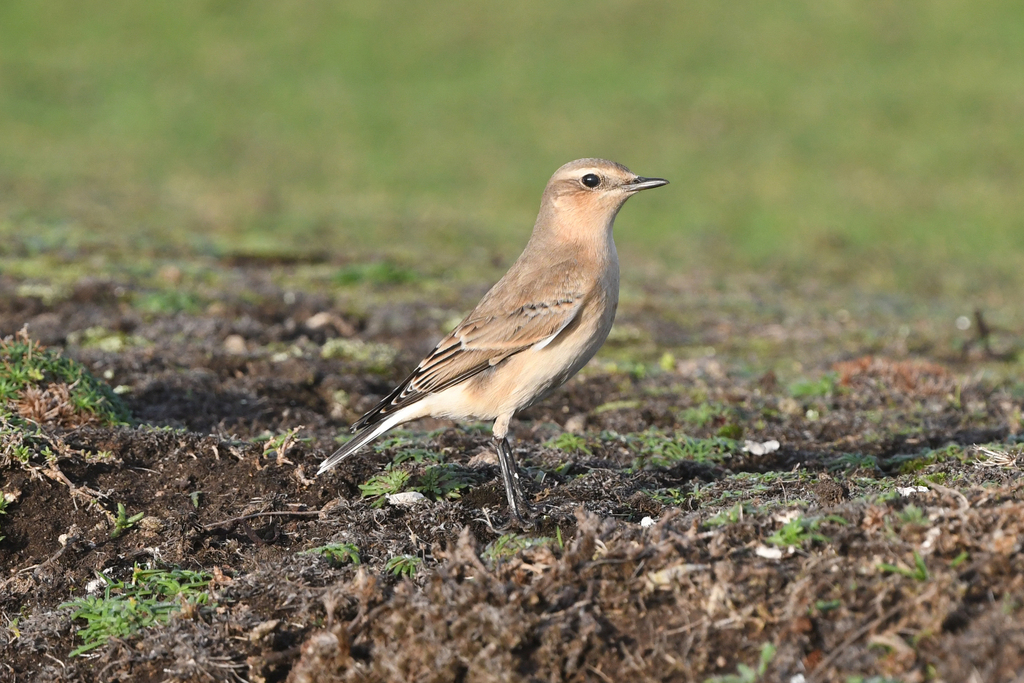
Northern Wheatear
Photo © Julien Renoult
Photo © Julien Renoult — CC BY 4.0 — Source: iNaturalist photo #242151098Identification
The northern wheatear is a small passerine bird measuring 14.5–16 cm in length with a wingspan of 26–32 cm and weighing 17–30 g, making it noticeably larger than a European robin. Both males and females share a distinctive white rump and tail featuring a black inverted T-pattern at the tail's end, a reliable field mark visible even in flight. The summer male displays striking grey upperparts, a buff throat, and bold black wings with a characteristic black face mask. Females are considerably duller, with pale brown upperparts, buff underparts, and darker brown wings. In autumn, males lose much of their contrast and resemble females more closely, though their black wings remain visible. The male's whistling, crackly song is distinctive, while both sexes produce a typical chat "chack" call.
Range & Habitat
The northern wheatear is the most widespread member of the wheatear genus in Europe and across the Palearctic, with remarkable breeding populations extending from north and central Europe through northern Asia to eastern Siberia, as well as footholds in northeastern Canada, Greenland, northwestern Canada, and Alaska. It favors open, stony country for breeding and nests in cavities such as rock crevices, rabbit burrows, and man-made structures like walls and pipes. All populations are migratory, spending the winter months in sub-Saharan Africa before returning to their breeding grounds in spring.
Behaviour & Diet
The northern wheatear is an insectivorous species renowned for undertaking one of the longest migrations of any small bird, a journey that crosses ocean, ice, and desert. Tracking studies have revealed that some populations complete migrations of approximately 30,000 km annually from sub-Saharan Africa to Arctic breeding grounds. Birds breeding in Alaska travel nearly 15,000 km each way, crossing Siberia and the Arabian Desert at an average rate of 290 km per day. The Greenland race, leucorhoa, is particularly impressive, with some individuals crossing the North Atlantic directly from Canada and Greenland to southwestern Europe, covering distances up to 3,500 km of open ocean.
On breeding grounds, northern wheatears show interesting sexual division of labor. Females construct nests entirely by themselves while males perch nearby, sing, and occasionally perform song-flights. Clutches typically contain 4–7 pale blue eggs with occasional red-brown markings, incubated almost exclusively by females. Chicks fledge after 15 days and become independent between 28 and 32 days of age, with both parents contributing to feeding duties.
Best Time & Places to See It
Northern wheatears are best observed during migration periods and on breeding grounds. Spring migrants can be encountered across Europe, the British Isles, Iceland, and continental Asia as birds return northward from Africa. Autumn sightings are possible across similar ranges as birds depart breeding territories. Breeding birds favor open, stony habitats in northern Europe, Iceland, Greenland, and across the Arctic regions of North America and Asia. The species' preference for exposed, rocky terrain makes them relatively conspicuous when present, though their small size and wariness demand patience and careful approach.
Photography Tips
Photograph northern wheatears in open habitats where they perch prominently on rocks or low vegetation, offering clear sightlines. The distinctive white rump and tail are key identifying features—capture these in flight shots when possible. Males in breeding plumage offer the most striking photographic opportunities with their gray backs and bold black face masks contrasting against buff throats. Early morning light enhances the subtle plumage details and their characteristic silhouettes. During migration, visit coastal areas and open moorlands where birds may gather. Their wariness means approaching slowly and using natural cover; patience will often be rewarded as they return to favored perches after brief flights.
Lake Mburo National Park
Murchison Falls National Park
Queen Elizabeth National Park
Tombstone Territorial Park
Aberdare National Park
Abijata-Shalla Lakes National Park
Abruzzo, Lazio and Molise National Park
Alaska Maritime National Wildlife Refuge
Algonquin Provincial Park
Nothing matches these filters.
No community photos yet. Log in to add the first one.
No community observations of this species yet.