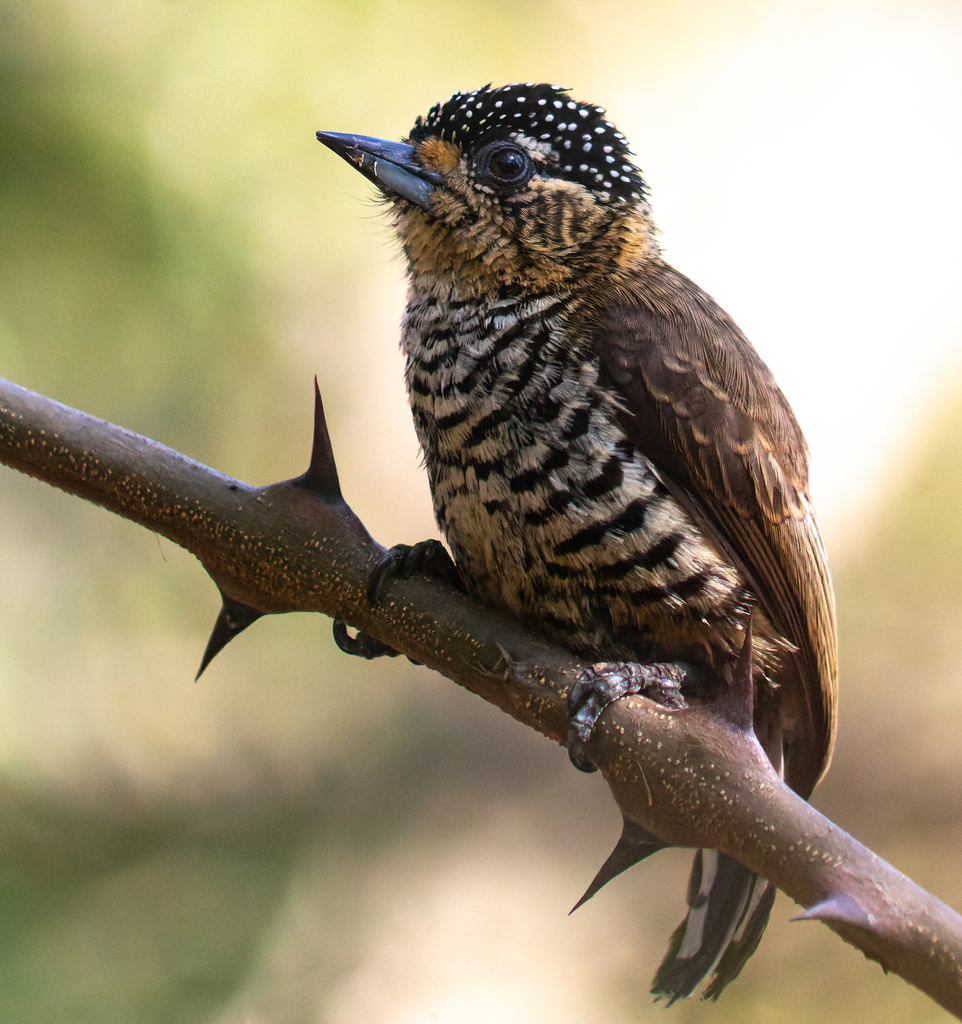
Ochre-collared Piculet
Photo © Enéas V. Gouvêa Junior
Photo © Enéas V. Gouvêa Junior — CC BY-SA 4.0 — Source: iNaturalist #166445018Identification
The ochre-collared piculet is a tiny woodpecker, measuring just 9–10 cm (3.5–3.9 in) and weighing a mere 10–12.5 g (0.35–0.44 oz). Adult males are distinctive with a black cap crowned by red-tipped forehead feathers and small white spots across the rest of the cap. The face is rich buff-brown with a striking white stripe behind the eye, while the hindneck displays the characteristic cinnamon-buff collar from which it derives its name. The upperparts are brown, sometimes with faint paler barring, and the flight feathers are dark brown with narrow buff edges. The tail is blackish with white inner webs on the innermost feathers and white patches near the ends of the outer pairs. The underparts are mostly whitish with buff coloring on the flanks and lower belly. Females lack the red forehead coloring of males, while juveniles are duller and darker with heavier, more diffuse barring on the underparts. The bill is black with a grayish base, the iris brown, and the legs grayish.
Range & Habitat
This piculet is found across southeastern Brazil, eastern Paraguay, and northeastern Argentina (Misiones Province), ranging from sea level to 800 m (2,600 ft) in elevation. It primarily inhabits lowland rainforest rich in bamboos, vines, and tangled undergrowth, though it also frequents secondary growth, thickets, tall scrub, and even parks and gardens. As a year-round resident throughout its range, the ochre-collared piculet does not migrate seasonally.
Behaviour & Diet
This diminutive woodpecker forages along thin branches, typically staying low in the forest canopy. While its diet has not been extensively studied, it is known to feed on ants and insect larvae. The breeding season appears to span at least October through December. One documented nest was a hole situated 2.5 m (8 ft) above the ground, with a male observed attending it, though much of the species' breeding biology remains poorly known. The ochre-collared piculet produces two distinct vocalizations: a high-pitched whistle with a rapid trilling quality ('tsirrrr, si-si-si...') and a dry, toneless trill ('trrrrrruh').
Best Time & Places to See It
The ochre-collared piculet is considered at least locally common throughout its range and occurs in several national parks across Argentina, Paraguay, and Brazil. The breeding season from October through December may offer the best opportunity for sightings, when birds are more active and vocal. The species' preference for lowland rainforest and secondary growth habitats makes it accessible to travelers visiting protected areas in the Atlantic Forest region of southeastern Brazil, eastern Paraguay, and northeastern Argentina.
Photography Tips
Photographing this tiny woodpecker requires patience and attention to its foraging behavior on thin branches in the lower forest strata. Early morning hours tend to be most productive, as the species is more active during cooler parts of the day. The distinctive ochre collar and male's red-capped forehead are key field marks worth capturing. Use a telephoto lens to maintain distance, as these piculets are small and easily disturbed. Listen for their characteristic high-pitched whistle or dry trill to locate individuals; once you hear the vocalization, scan the thin branches where they typically forage. The contrast between the buff-brown face and dark cap provides good photographic opportunities when lighting conditions allow.
Campos Gerais National Park
Carlos Botelho State Park
Iguaçu National Park
Iguazú National Park
Ilha do Cardoso State Park
Intervales State Park
Itatiaia National Park
Saint-Hilaire/Lange National Park
São Joaquim National Park
Nothing matches these filters.
No community photos yet. Log in to add the first one.
No community observations of this species yet.