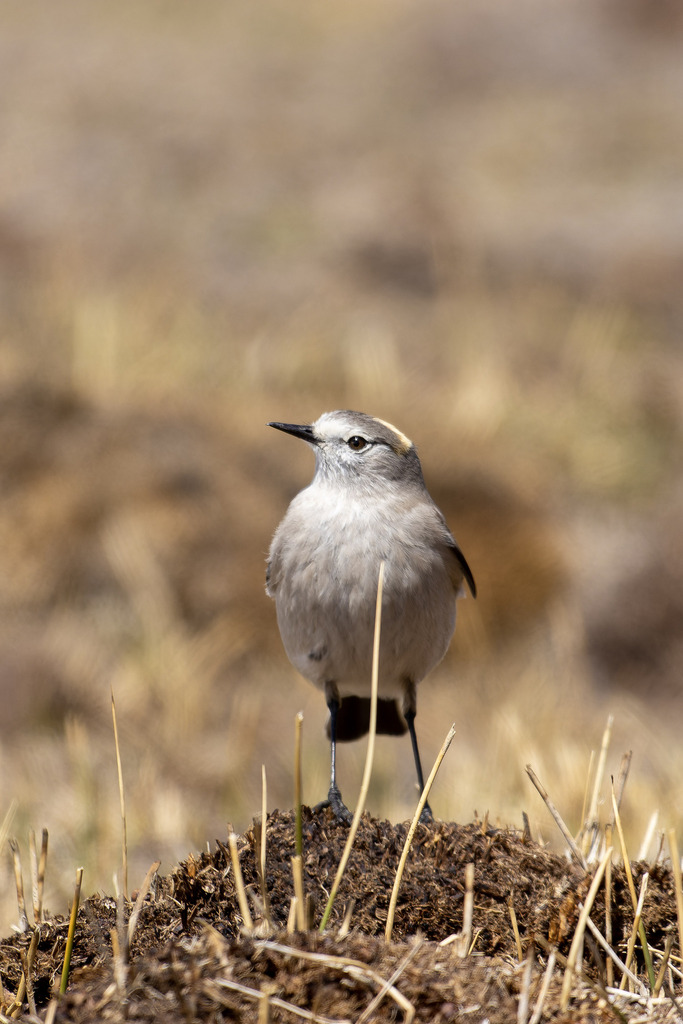
Ochre-naped Ground Tyrant
Photo © SebaArosZ
Photo © SebaArosZ — CC BY 4.0 — Source: iNaturalist photo #326514763Identification
The ochre-naped ground tyrant is a small tyrant flycatcher measuring 18.5 to 20 cm in length. Both sexes share identical plumage. The nominate subspecies is distinguished by a white forehead and supercilium contrasting with a pale ochre patch on the rear crown, set against an otherwise pale brownish-gray face. The nape and back are pale brownish-gray, while the wings are a dusky brownish-gray with thin white edges on the flight feathers. The tail is black with white edges on the outer feathers. The underparts are grayish-white on the throat, breast, and upper belly, becoming pure white on the lower belly and vent. The bird has a dark brown iris, long black bill, and black legs and feet. Juveniles show a faint or absent crown patch and buff edges on their flight feathers. The subspecies M. f. brevirostris is darker overall with a slightly smaller bill and shorter wings.
Range & Habitat
This species is primarily a bird of the southern Andes, found in Argentina, Bolivia, Chile, and Peru. The nominate subspecies breeds in northern and central Chile from the Antofagasta Region south to the O'Higgins Region and in west-central Argentina from Mendoza Province south to Santa Cruz Province. The subspecies M. f. brevirostris extends the range further south through both countries to Tierra del Fuego. Both subspecies are migratory, wintering from northern Chile and northwestern Argentina northward through western Bolivia into Peru as far as La Libertad Department.
The ochre-naped ground tyrant favors puna grassland, bogs, and rocky slopes with sparse vegetation near water sources. It typically ranges between 2,000 and 4,500 m in elevation, though it breeds as low as 500 m in northern Chile and occasionally reaches near sea level there. In Peru, it ranges between 3,800 and 4,900 m.
Behaviour & Diet
This ground-dwelling insectivore feeds by walking, running, and hopping on the ground in search of prey, searching through plants, leaf litter, and bare ground. Less frequently, it makes short sallies from the ground or a rock to catch prey in mid-air. The species breeds during the austral summer between October and February. Males perform distinctive display flights with dangling legs. Nests are open cups constructed from grass and lined with feathers, placed on the ground, in rock crevices, under rock overhangs, or in abandoned rodent burrows. Clutches typically contain two to four eggs, most commonly three.
Best Time & Places to See It
The ochre-naped ground tyrant is uncommon to locally fairly common, though considered one of the most abundant ground-tyrants in central Chile. It is a fairly common austral migrant in Peru. Breeding birds can be found in their Andean range during the austral summer (October–February). Wintering birds are present in Peru and Bolivia during the austral winter. The species occurs in several national parks within its breeding range and at least one in Bolivia, making these protected areas reliable viewing locations.
Photography Tips
Look for this bird in open puna grasslands and on rocky slopes with sparse vegetation, particularly near water sources. Its ground-dwelling habits and preference for hopping and running make it accessible to patient observers at lower angles. The subtle ochre nape patch and pale crown markings are key identification features worth capturing in good light. Males in display flight during breeding season offer dynamic photographic opportunities. Early morning activity levels are typically highest, and the bird's preference for open habitat means minimal obstruction when photographing.
Full-day Birds of the desert
Nothing matches these filters.
Cabo de Hornos National Park
Cerro Castillo National Park
Huascarán National Park
Lago Puelo National Park
Lanín National Park
Lauca National Park
Los Glaciares National Park
Nahuel Huapi National Park
Parque Provincial Península de Magallanes
Nothing matches these filters.
No community photos yet. Log in to add the first one.
No community observations of this species yet.