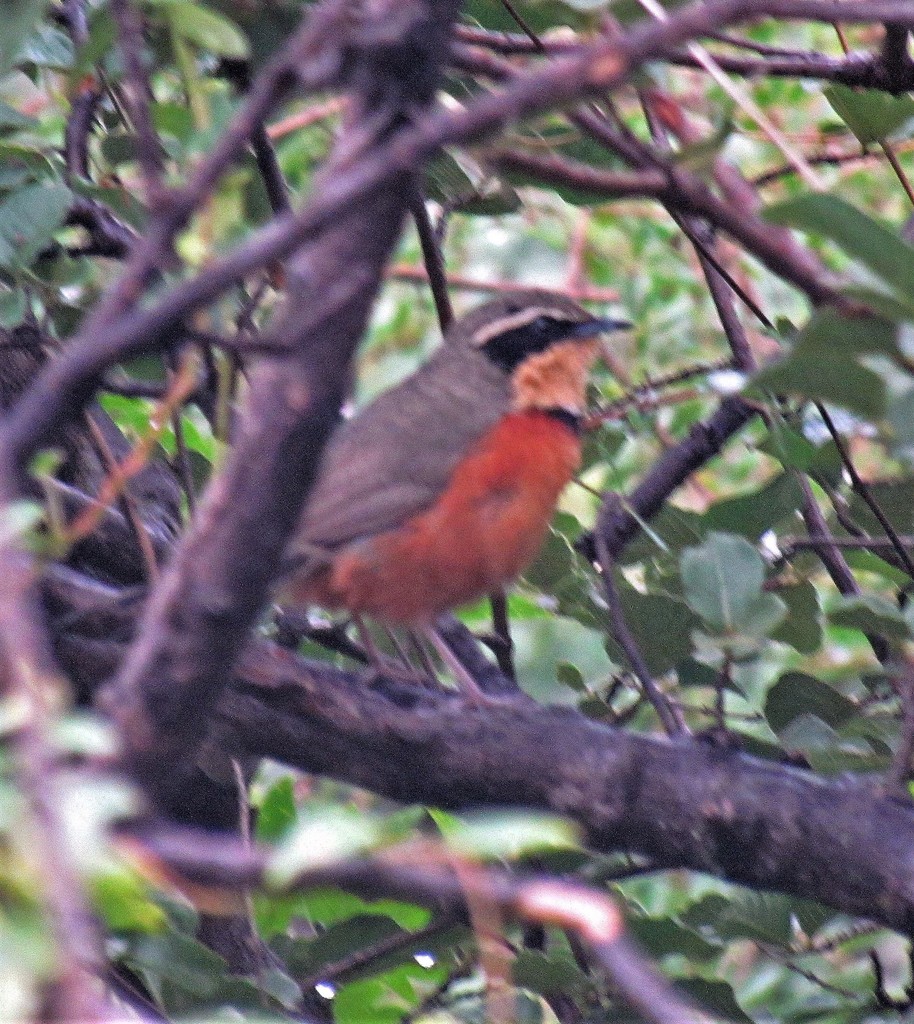
Olive-crowned Crescentchest
Photo © Hugo Hulsberg
Photo © Hugo Hulsberg — CC0 1.0 — Source: iNaturalist #115735116The olive-crowned crescentchest (Melanopareia maximiliani) is a species of bird in the family Melanopareiidae. It is found in Argentina, Bolivia, and Paraguay. == Taxonomy and systematics == The crescentchests (genus Melanopareia) were previously included in family Rhinocryptidae, the tapaculos. A 2010 publication confirmed earlier work and created their present genus. The olive-crowned crescentchest has three subspecies, the nominate Melanopareia maximiliani maximiliani, M. m. argentina, and M. m. pallida. The last has been suggested as a separate species due to vocal differences. In addition, a subpopulation of M. m. pallida might be an undescribed taxon. == Description == The olive-crowned crescentchest is 15 cm (5.9 in) long. Males weigh 17.1 to 18.0 g (0.60 to 0.63 oz), one female weighed 16.7 g (0.59 oz), and unsexed specimens weighed 16.9 to 18.2 g (0.60 to 0.64 oz). The nominate subspecies' crown and upperparts are olive-brown, the throat deep buff, and the chest and belly ochraceous. It has a narrow buff supercilium with a black mask below and a black crescent and chesnut band between the throat and chest. M. m. argentina is similar but has paler underparts. M. m. pallida is paler still, its throat is more cinnamon than buff, and the…
Los Cardones National Park
Argentina
+193 birds+6 mammals
Where the Andes descend into northwestern Argentina, Los Cardones National Park sprawls across nearly 1,200 square kilometres of one of South America's most distinctive high-altitude desert…
VIEW NATIONAL PARKEl Rey National Park
Municipio de Las Lajitas, Argentina
+317 birds+4 mammals
Where the eastern slopes of the Andes descend into northwestern Argentina's subtropical transition zone, El Rey National Park unfolds across 841 square kilometers of dramatically varied…
VIEW NATIONAL PARKCalilegua National Park
Municipio de Calilegua, Argentina
+288 birds+8 mammals
Where the eastern Andean slopes plunge into northwestern Argentina's humid subtropics, nearly 2,645 square kilometers of steep terrain and luxuriant forest compose one of South America's…
VIEW NATIONAL PARKNo community photos yet. Log in to add the first one.
No community observations of this species yet.