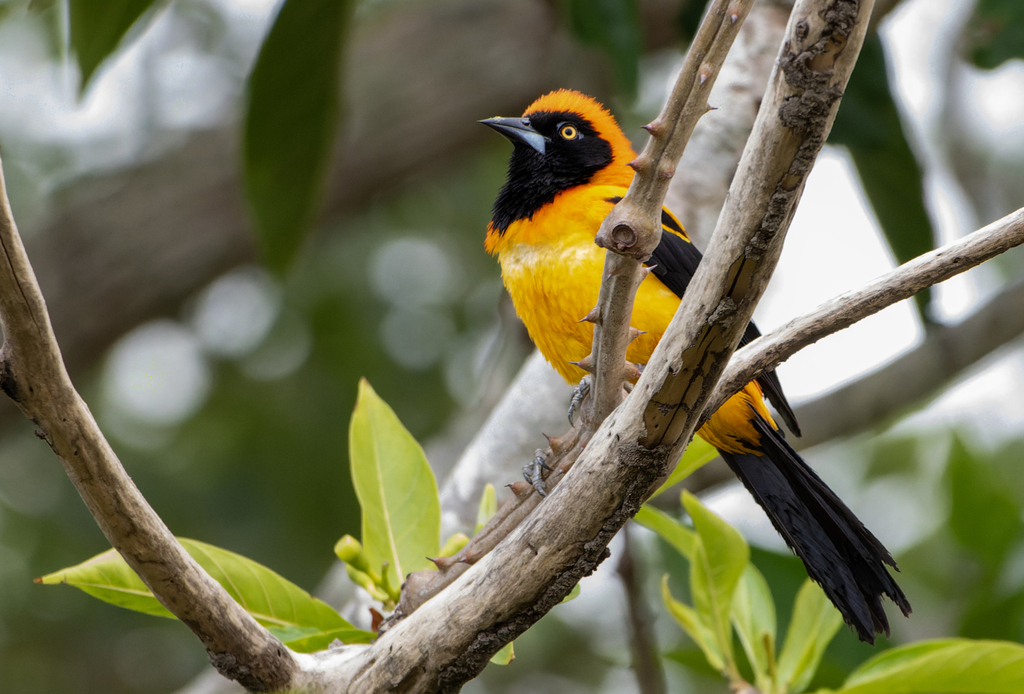
Orange-backed Troupial
Photo © David F. Belmonte
Photo © David F. Belmonte — CC BY 4.0 — Source: iNaturalist photo #587818868Identification
The orange-backed troupial is a striking 23 cm passerine with bold plumage that makes it unmistakable in the field. The bird's most distinctive feature is its bright orange back and underparts, which contrast sharply with a black face, bib, wings, and tail. A small white patch adorns the secondary wing feathers, and an orange streak marks the shoulder. The neat, well-defined lower edge of the black bib is a key field mark separating this species from the closely related Venezuelan troupial, which shows a shaggy bib base and much larger white wing patch. A small blue ring of bare skin encircles each eye, adding to the bird's ornate appearance. The song comprises loud, musical two-syllable phrases that carry well through woodland habitats.
Range & Habitat
This non-migratory species inhabits tropical South America east of the Andes, with a vast range spanning from southern Guyana and eastern Ecuador southward through Peru, central and eastern Brazil, into Bolivia and northern Paraguay. The orange-backed troupial favours forest edges, clearings, riparian woodland, secondary growth, and scrubby woodland, typically at elevations up to 750 metres. It thrives in semi-open and disturbed habitats rather than pristine forest interior, making it accessible to travellers exploring edge habitats and woodland corridors across its range.
Behaviour & Diet
Orange-backed troupials typically forage in pairs, moving through canopy levels in search of food. Their diet is remarkably varied, consisting of fruits, insects, other arthropods, and nectar from wild flowers such as Erythrina species. The species has an interesting breeding ecology: rather than building its own nest, it frequently pirates nests from the yellow-rumped cacique. Breeding occurs between July and August in Colombia, and from November through March in Bolivia and Paraguay, allowing observers multiple seasonal windows to encounter breeding birds in different parts of the range.
Best Time & Places to See It
The orange-backed troupial is common in suitable habitat throughout much of its range, though abundance varies locally. Searchers should focus on forest edges, riparian corridors, and secondary woodland up to 750 metres elevation, particularly in Guyana, eastern Ecuador, Peru, Bolivia, and Paraguay. The species' loud, musical song makes it relatively easy to locate by ear. Timing visits to coincide with breeding seasons—July to August in Colombia or November to March in Bolivia and Paraguay—increases chances of observing pairs and hearing their distinctive vocalizations.
Photography Tips
The orange-backed troupial's bold black-and-orange plumage provides excellent contrast for photography, though the bright orange back can challenge exposure metering in dappled forest light. Photograph in early morning or late afternoon when light is warm and directional. The species' habit of foraging in pairs at various canopy heights offers compositional opportunities. Use a telephoto lens to capture details of the blue eye-ring, white wing patch, and black bib edge from a distance. Look for birds perched in semi-open habitat along forest edges and riparian zones where background light is less cluttered than in dense forest interior.
Emas National Park
Brazil
+333 birds+23 mammals
Across the high plateaux of central Brazil, where the cerrado grasslands roll toward distant horizons under an immense sky, Emas National Park anchors one of South…
VIEW NATIONAL PARKYasuní National Park
Aguarico, Ecuador
+601 birds+43 mammals
Where the western Amazon basin converges with Ecuador's Orellana Province, lowland rainforest reaches toward the horizon in an unbroken canopy of staggering botanical density. Yasuní National…
VIEW NATIONAL PARKSumaco Napo-Galeras National Park
Loreto, Ecuador
+563 birds+4 mammals
Where Ecuador's Amazon transitions into cloud forest, a massive shield volcano rises from the emerald lowlands of Orellana Province, anchoring one of the continent's most biodiverse…
VIEW NATIONAL PARKAmacayacu National Park
Leticia, Colombia
+567 birds+25 mammals
Where the Rio Amazonas curves through the tri-border region where Colombia, Peru, and Brazil converge, Amacayacu National Park sprawls across more than 5,250 square kilometres of…
VIEW NATIONAL PARKIlha Grande National Park
Brazil
+233 birds
Across the subtropical plateaus and Atlantic forest remnants of southern Brazil, a vast protected landscape spanning nearly 4,600 square kilometers safeguards one of the continent's most…
VIEW NATIONAL PARKChapada dos Guimarães National Park
Brazil
+450 birds+1 mammals
Where weathered sandstone plateaus rise above the cerrado grasslands of central Brazil, Chapada dos Guimarães National Park protects 624 square kilometres of ecological transition zone that…
VIEW NATIONAL PARKPantanal Matogrossense National Park
Brazil
+322 birds+17 mammals
Where the flooded forests of central Brazil meet vast seasonally inundated grasslands, Pantanal Matogrossense National Park sprawls across nearly 2,900 square kilometers of one of the…
VIEW NATIONAL PARKJaú National Park
Brazil
+354 birds+3 mammals
Vast floodplain forests and blackwater rivers define this remote corner of western Amazonas, where the Rio Negro and its tributaries have carved an intricate mosaic of…
VIEW NATIONAL PARKAnavilhanas National Park
Brazil
+468 birds+8 mammals
Across the Rio Negro in central Amazonas, an archipelago of over a thousand islands rises from the world's largest rainforest river system, creating a labyrinth of…
VIEW NATIONAL PARKManu National Park
Manu, Peru
+892 birds+26 mammals
Across the eastern slopes of the Peruvian Andes, tropical rainforest descends into the Amazon basin with a complexity that few terrestrial ecosystems match. Manu National Park…
VIEW NATIONAL PARKBahuaja Sonene National Park
San Pedro de Putina Punco, Peru
+602 birds+8 mammals
Where the Madre de Dios and Heath rivers converge in southeastern Peru rises one of South America's most biodiverse wilderness regions: a vast protected realm of…
VIEW NATIONAL PARKTingo Maria National Park
Mariano Dámaso Beraún, Peru
+423 birds
Where the eastern slopes of the Peruvian Andes descend toward the Amazon basin, the landscape fractures into a maze of limestone ridges, humid gorges, and cloud-wrapped…
VIEW NATIONAL PARKCordillera Azul National Park
Pampa Hermosa, Peru
+322 birds+1 mammals
Where the eastern Andes descend into the western Amazon basin, Cordillera Azul National Park sprawls across nearly 38,000 square kilometres of some of Peru's most pristine…
VIEW NATIONAL PARKNo community photos yet. Log in to add the first one.
No community observations of this species yet.