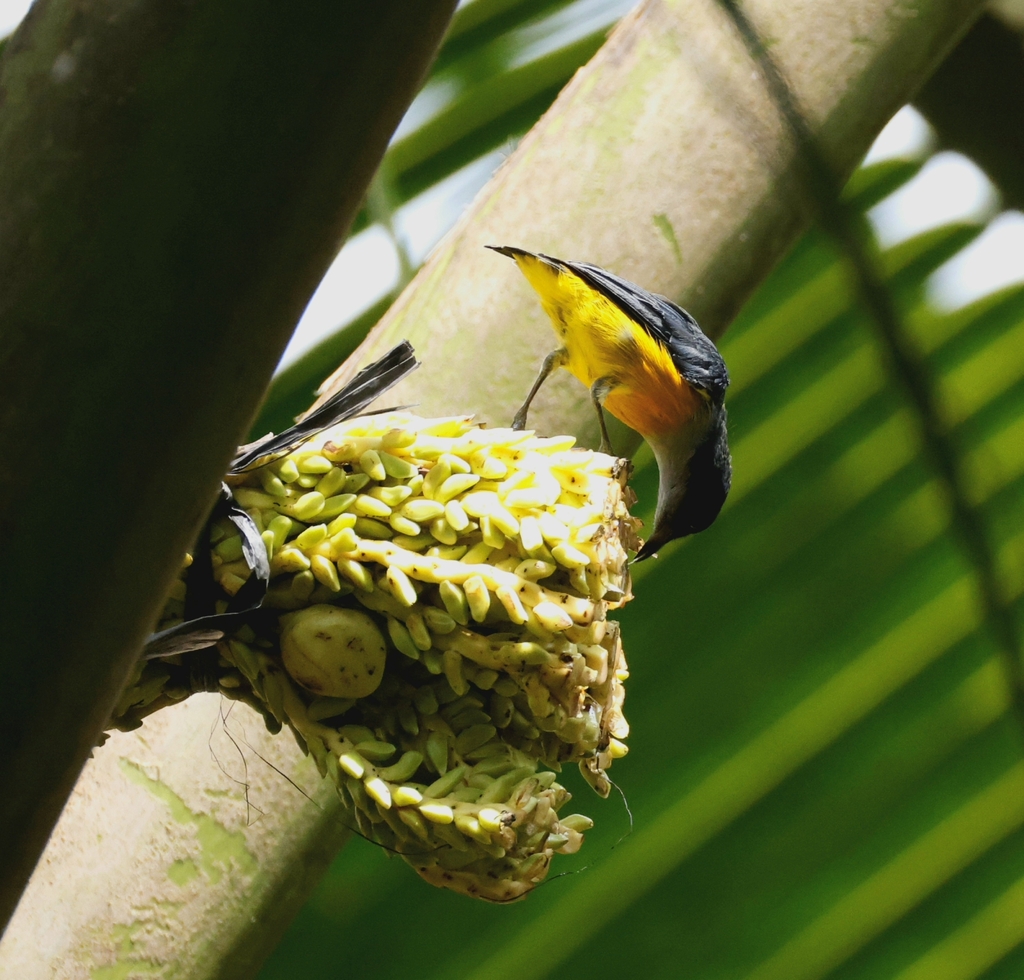
Orange-bellied Flowerpecker
Photo © pittafisher
Photo © pittafisher — CC BY 4.0 — Source: iNaturalist #219248382Identification
The orange-bellied flowerpecker is a small bird with a distinctive appearance that differs markedly between sexes. Males are striking, displaying slaty-blue upperparts across the crown, nape, wings, and tail, interrupted by a large triangular orange patch on the mantle that immediately catches the eye. The throat and upper breast are a lighter greyish blue, while the lower breast transitions from fiery orange to yellow at the vent. The bill is fairly thin, short, and slightly curved downward at the tip.
Females are considerably duller and less conspicuous, appearing mostly drab olive-brown overall. The key field marks that distinguish females are a pale orange rump and yellow belly, which provide subtle contrast against their muted plumage.
Range & Habitat
The orange-bellied flowerpecker is found across Southeast Asia, with a range including Bangladesh, Brunei, Indonesia, Malaysia, Myanmar, the Philippines, Singapore, and Thailand. This wide distribution reflects the bird's adaptation to the region's diverse forest environments.
The species inhabits subtropical and tropical moist lowland forests, mangrove forests, and moist montane forests. These humid, forested environments provide the flowering plants and fruiting trees essential to the bird's feeding ecology.
Behaviour & Diet
As a flowerpecker, this species is specialized for nectar and small fruit consumption, using its short, curved bill to access flowers and pick small fruits from trees and shrubs. Like other flowerpeckers, it is likely an active, mobile forager that moves through the canopy in search of food resources.
Best Time & Places to See It
Birders seeking this species should focus on forested areas within its Southeast Asian range, particularly in lowland and montane forests where flowering plants are abundant. The best viewing opportunities occur in protected forest reserves and national parks throughout Myanmar, Thailand, Malaysia, Indonesia, and the Philippines, where suitable habitat remains intact.
Photography Tips
The male's vibrant orange and slaty-blue plumage makes it an attractive photographic subject, though its small size and active foraging behavior demand patience and quick reflexes. Photograph males in good light to capture the brilliant orange mantle patch and the gradient coloring on the breast and belly. Females are more cryptic; look for them in the mid-story vegetation of forests, and use the pale orange rump as a field mark to locate them among olive-brown foliage.
Bako National Park
Batang Gadis National Park
Gunung Ciremai National Park
Gunung Mulu National Park
Hat Noppharat Thara-Mu Ko Phi Phi National Park
Kaeng Krachan National Park
Kerinci Seblat National Park
Khao Laem National Park
Kuching Wetlands National Park
Nothing matches these filters.
No community photos yet. Log in to add the first one.
No community observations of this species yet.