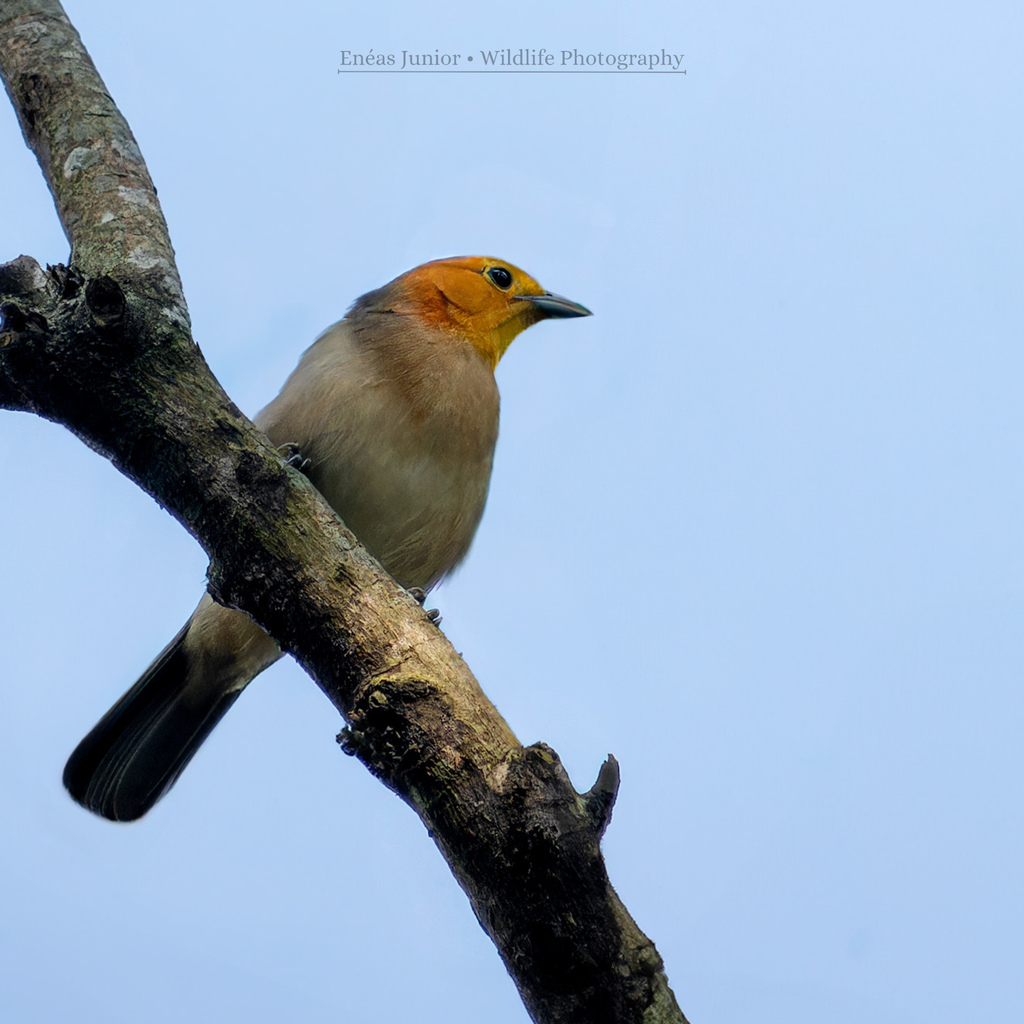
Orange-headed Tanager
Photo © Enéas V. Gouvêa Junior
Photo © Enéas V. Gouvêa Junior — CC BY-SA 4.0 — Source: iNaturalist #203979797Identification
The orange-headed tanager is a small, thin-billed tanager averaging 13 cm in length and weighing 14–19 g, with proportions similar to a New World warbler. Males of the nominate subspecies are particularly striking, featuring rufous-orange crowns and head sides that brighten to brilliant yellow on the lores, eye region, and throat. Their upperparts are sandy-gray with dusky flight feathers edged in gray, while underparts transition from buff or cinnamon to whitish on the lower breast, belly, and undertail coverts. The bill is dark, the iris dark brown, and legs gray. Females are noticeably duller than males, with less extensive and less vibrant yellow on the head. Immatures resemble females but are even duller, showing grayish-olive upperparts and paler underparts. Three subspecies are recognized, with regional variations in head coloration and underpart tones.
Range & habitat
Native to South America, the orange-headed tanager is found across Argentina, Bolivia, Brazil, Colombia, Ecuador, Paraguay, Peru, and Venezuela. It is the only member of its genus inhabiting the lowlands of the Amazon rainforest. The species occupies diverse habitats including successional vegetation, cerrado, riparian forest, shrub, brush, and open woodland. In Venezuela and western Amazon regions, it favors tall grasses, willows, and young secondary growth near rivers. Southern Amazon populations prefer dry to semi-humid cerrado and open woodland canopies, while northwestern Argentine birds frequent scrub and brush edges, seldom entering uninterrupted forest.
Elevation preferences vary geographically: the species generally inhabits up to 800 m, though populations in Bolivia reach 1,500 m, while Venezuelan and Colombian birds stay below 100 m and 400 m respectively. In Brazil and Argentina, some populations migrate seasonally from the Andes to lowlands during austral winter.
Behaviour & diet
Orange-headed tanagers are typically found in pairs or small groups of 3–4 individuals, sometimes joining mixed-species foraging flocks. They are omnivorous, feeding on orthopterans (grasshoppers, crickets, and locusts), beetles, flies, spiders, fruit, and seeds. Their foraging style is notably active and warbler-like, gleaning insects from foliage with rapid hops, or less commonly hovering or sallying to catch prey in flight. The species produces varied vocalizations including high-pitched tseet or seet calls given rapidly in succession, quick chittering, and geographically distinct song patterns that range from spasmodic phrases in Peru and Ecuador to thin, high-pitched variations in eastern Brazil.
Best time & places to see it
Breeding has been recorded in December, with nesting in cup-shaped structures built about 2 m above ground. Look for orange-headed tanagers in successional vegetation and riparian zones throughout their range, particularly in Venezuela and western Amazon regions where they favor riverside habitats and secondary growth. In southern Amazon areas, check open woodlands and cerrado edges. The species' stable population and large range make it accessible across much of its distribution, though regional migration patterns in Brazil and Argentina mean seasonal movements may affect local availability.
Photography tips
The orange-headed tanager's bright head markings—particularly the rufous-orange crown and yellow face—make males highly photogenic subjects. Their active, warbler-like foraging behavior provides dynamic shooting opportunities as they hop through foliage gleaning insects. Early morning light best showcases the vibrant head coloration. Position yourself near riparian zones and successional vegetation where the species actively forages. Since birds often move in small groups, patience and a moderate telephoto lens will help capture sharp images of these small, active tanagers as they move through their preferred habitats.
Tijuca National Park
Brazil
+317 birds+13 mammals
Where the Atlantic forest rises steeply from Rio de Janeiro's urban edge, Tijuca National Park encompasses a landscape of dramatic granite peaks, cascading waterfalls, and closed-canopy…
VIEW NATIONAL PARKSerra do Cipó National Park
Brazil
+379 birds+5 mammals
Where granite escarpments rise above the Atlantic Forest transition zone in southeastern Brazil, Serra do Cipó National Park unfolds across a landscape of dramatic ridges, cascading…
VIEW NATIONAL PARKYasuní National Park
Aguarico, Ecuador
+601 birds+43 mammals
Where the western Amazon basin converges with Ecuador's Orellana Province, lowland rainforest reaches toward the horizon in an unbroken canopy of staggering botanical density. Yasuní National…
VIEW NATIONAL PARKAmacayacu National Park
Leticia, Colombia
+567 birds+25 mammals
Where the Rio Amazonas curves through the tri-border region where Colombia, Peru, and Brazil converge, Amacayacu National Park sprawls across more than 5,250 square kilometres of…
VIEW NATIONAL PARKItatiaia National Park
Brazil
+519 birds+12 mammals
Where granite peaks pierce the Atlantic rainforest canopy in southeastern Brazil, Itatiaia National Park rises as one of the country's oldest and most ecologically vital protected…
VIEW NATIONAL PARKUbajara National Park
Brazil
+122 birds+1 mammals
Granite peaks rise sharply from the humid tropical forests of northeastern Brazil, where Ubajara's 234 square kilometres straddle the transition between Atlantic rainforest and drier cerrado…
VIEW NATIONAL PARKSuperagui National Park
Brazil
+246 birds+2 mammals
Where the Atlantic rainforest meets the subtropical coast of Paraná, Superagui National Park sprawls across more than 1,000 square kilometres of one of Brazil's most biodiverse…
VIEW NATIONAL PARKSerra da Bocaina National Park
Brazil
+441 birds+5 mammals
Where the escarpment of the Serra da Bocaina rises sharply from the Atlantic coastal plain, tropical rainforest cloaks steep mountainsides that climb toward peaks exceeding 2,000…
VIEW NATIONAL PARKSerra do Teixeira National Park
Brazil
+160 birds+5 mammals
Rugged plateaus and deep escarpments define this 3,112-square-kilometre sweep of the Brazilian Northeast, where the crystalline bedrock of the Borborema Plateau rises abruptly from the surrounding…
VIEW NATIONAL PARKChapada dos Veadeiros National Park
Brazil
+324 birds+6 mammals
Where granite plateaus rise above the cerrado savanna in central Brazil, Chapada dos Veadeiros National Park unfolds across 6,665 square kilometres of some of the world's…
VIEW NATIONAL PARKPantanal Matogrossense National Park
Brazil
+322 birds+17 mammals
Where the flooded forests of central Brazil meet vast seasonally inundated grasslands, Pantanal Matogrossense National Park sprawls across nearly 2,900 square kilometers of one of the…
VIEW NATIONAL PARKChapada Diamantina National Park
Brazil
+346 birds+5 mammals
Where granite peaks and sandstone cliffs rise abruptly from the Brazilian interior, Chapada Diamantina National Park sprawls across 4,215 square kilometers of some of Brazil's most…
VIEW NATIONAL PARKSerra do Gandarela National Park
Brazil
+333 birds+3 mammals
Where granite massifs rise through Atlantic Forest in southeastern Brazil's highlands, Serra do Gandarela National Park protects nearly 1,000 square kilometres of montane terrain that few…
VIEW NATIONAL PARKBrasília National Park
Plano Piloto, Brazil
+338 birds+15 mammals
Cerrado grassland and scattered woodland sweep across the central Brazilian plateau where this national park sprawls across more than a thousand square kilometres of the Federal…
VIEW NATIONAL PARKYanachaga–chemillén National Park
Palcazu, Peru
+639 birds+6 mammals
Where the eastern slopes of Peru's central cordillera plunge into cloud forest, Yanachaga–Chemillén National Park protects nearly three thousand square kilometres of montane wilderness that few…
VIEW NATIONAL PARKManu National Park
Manu, Peru
+892 birds+26 mammals
Across the eastern slopes of the Peruvian Andes, tropical rainforest descends into the Amazon basin with a complexity that few terrestrial ecosystems match. Manu National Park…
VIEW NATIONAL PARKSierra del Divisor National Park
Alto Tapiche, Peru
+298 birds+2 mammals
Where the western Amazon meets the Andes foothills, nearly 41,000 square kilometres of pristine rainforest rise across Peru's Alto Tapiche region in a landscape of extraordinary…
VIEW NATIONAL PARKBahuaja Sonene National Park
San Pedro de Putina Punco, Peru
+602 birds+8 mammals
Where the Madre de Dios and Heath rivers converge in southeastern Peru rises one of South America's most biodiverse wilderness regions: a vast protected realm of…
VIEW NATIONAL PARKRío Pilcomayo National Park
Argentina
+271 birds+13 mammals
Where the Río Pilcomayo cuts through northeastern Argentina's subtropical lowlands, a sprawling mosaic of wetlands, grasslands, and seasonally flooded forests creates one of South America's most…
VIEW NATIONAL PARKEl Rey National Park
Municipio de Las Lajitas, Argentina
+317 birds+4 mammals
Where the eastern slopes of the Andes descend into northwestern Argentina's subtropical transition zone, El Rey National Park unfolds across 841 square kilometers of dramatically varied…
VIEW NATIONAL PARKCalilegua National Park
Municipio de Calilegua, Argentina
+288 birds+8 mammals
Where the eastern Andean slopes plunge into northwestern Argentina's humid subtropics, nearly 2,645 square kilometers of steep terrain and luxuriant forest compose one of South America's…
VIEW NATIONAL PARKChaco National Park
Municipio de Presidencia de la Plaza, Argentina
+258 birds+7 mammals
Across the humid subtropical lowlands of northeastern Argentina, where the Paraná River basin feeds vast seasonal wetlands and gallery forests, Chaco National Park protects one of…
VIEW NATIONAL PARKNo community photos yet. Log in to add the first one.
No community observations of this species yet.