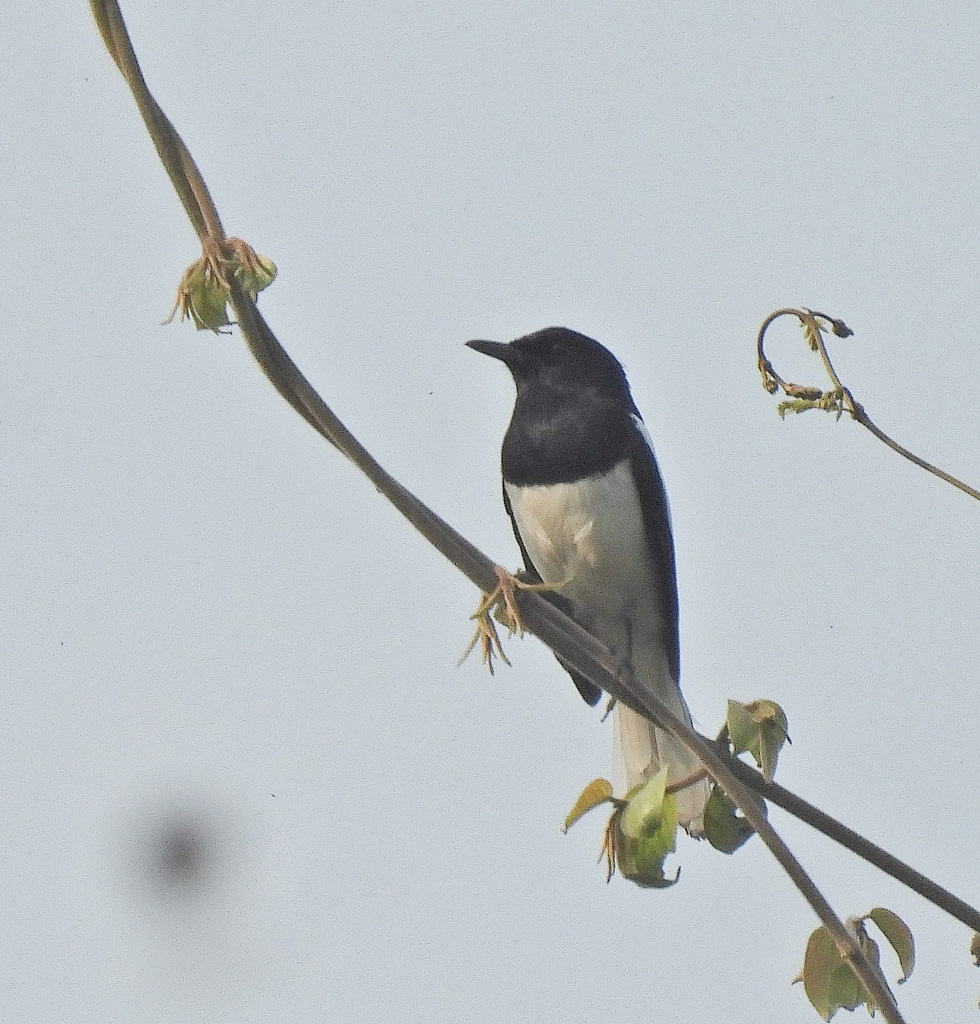
Oriental Magpie-Robin
Photo © Rejoice Gassah
Photo © Rejoice Gassah — CC BY 4.0 — Source: iNaturalist #301158340Identification
The Oriental magpie-robin is a small passerine measuring 19 centimetres in length, including its characteristically long tail. Males are striking black and white birds: they display black upperparts, head and throat offset by a distinctive white shoulder patch, while the underparts and tail sides are white. The long tail is typically held cocked upright when the bird hops on the ground, though it assumes a normal position during singing. Females are considerably duller, with greyish-black upperparts and greyish-white underparts, while young birds show scaly brown plumage. The species is similar in shape to the European robin but noticeably longer-tailed. Geographic variation across the range is considerable, particularly among females, with numerous recognized races displaying differences in plumage shade, bill size, and tail length.
Range & Habitat
The Oriental magpie-robin is a resident breeder across tropical southern Asia, occurring from Nepal, Bangladesh, and India through Sri Lanka and eastern Pakistan, extending into eastern Indonesia, Thailand, southern China, Malaysia, and Singapore. This adaptable species thrives in open woodland and cultivated areas, and has become particularly common in urban gardens and other habitats close to human habitation. Its comfort around settlements has made it one of the most familiar birds across much of its range.
Behaviour & Diet
These birds are renowned for their loud, distinctive songs, which they deliver from high perches, particularly during breeding season. Males are highly territorial and aggressive during breeding, responding vigorously to the songs of intruders and even their own reflections. They perform elaborate courtship displays involving puffed feathers, raised bills, fanned tails, and strutting movements. Breeding occurs from March to July in India and January to June in Southeast Asia. Nests are built in tree hollows, wall niches, or building cavities, with females undertaking most construction work. The species typically lays four or five pale blue-green eggs with brownish speckles.
The diet consists primarily of insects and invertebrates, though they occasionally consume flower nectar, geckos, leeches, centipedes, and fish. They are often active late at dusk and sometimes bathe in rainwater collected on tree leaves. Bird song studies have revealed fascinating dialects among neighbouring populations, and birds frequently imitate calls of other species as part of their own songs.
Best Time & Places to See It
The Oriental magpie-robin is a common year-round resident throughout its range. The breeding season—March to July in India and January to June in Southeast Asia—offers excellent opportunities to observe males singing prominently from high perches and displaying territorial behaviour. Urban gardens and parks close to human settlements provide reliable viewing locations, as this species has adapted well to cultivated areas. The bird's habit of foraging conspicuously on the ground and perching openly makes it relatively easy to locate despite its small size.
Photography Tips
The male's striking black and white plumage and upright tail posture provide excellent photographic contrast and distinctive silhouettes. Position yourself near high perches during breeding season to capture males singing—their characteristic upright posture and vocal displays make compelling images. Early morning and late dusk are productive times, as the species is particularly active during these periods. Ground-level photography can capture the bird hopping through leaf-litter with its characteristic cocked tail. The dramatic sexual dimorphism makes comparison shots of males and females especially rewarding. Look for birds near human habitations and gardens where they are most accessible and least wary of observers.
Kanha Tiger Reserve
Minneriya National Park
Angamedilla National Park
Bako National Park
Bandipur National Park
Banke National Park
Bardiya National Park
Caohai National Nature Reserve
Chitwan National Park
Nothing matches these filters.
No community photos yet. Log in to add the first one.
No community observations of this species yet.