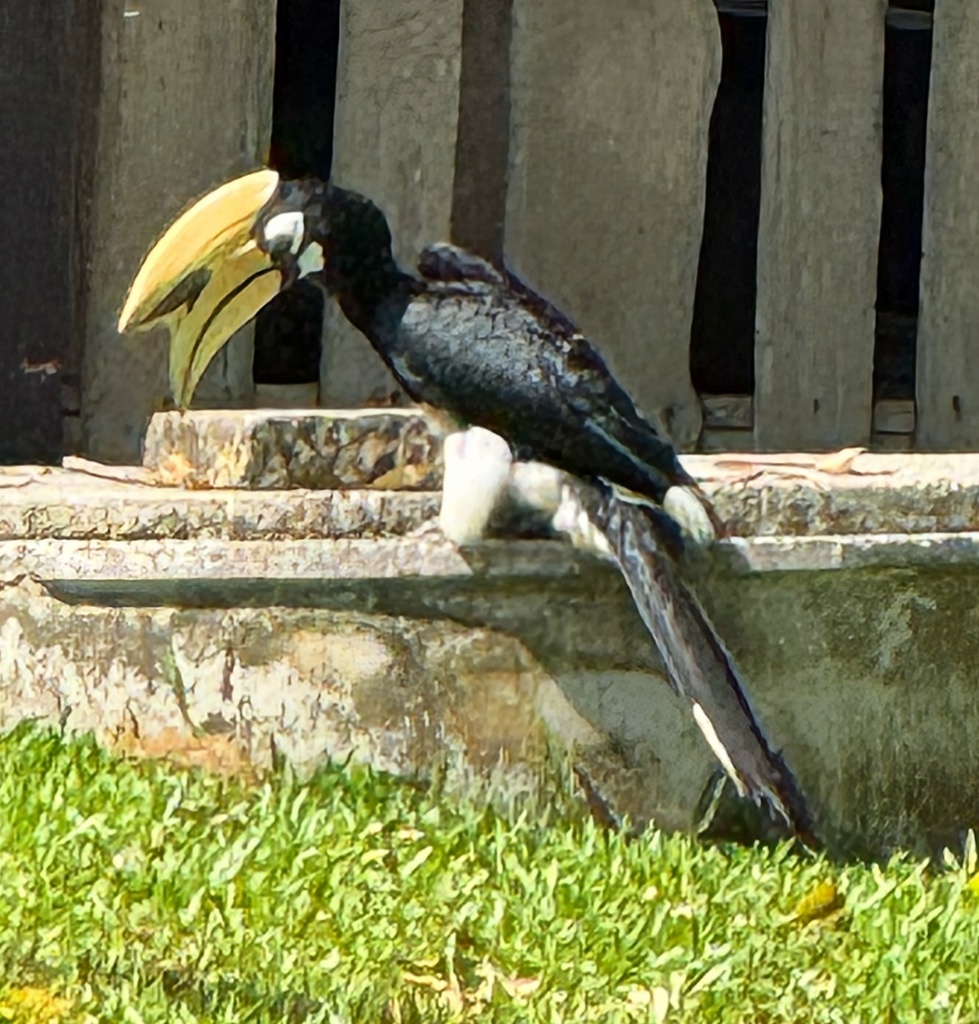
Oriental Pied Hornbill
Photo © chrisdt
Photo © chrisdt — CC BY 4.0 — Source: iNaturalist #350005370Identification
The Oriental Pied Hornbill is a medium-sized hornbill measuring 55–60 cm from head to tail, with a wingspan of 23–36 cm. It is considered one of the smallest and most common of Asian hornbills. The plumage is striking: the head, neck, back, wings and upper breast are black with a subtle green sheen, while the lower breast, abdomen, thighs and underwings are white. The tail is black with white tips on all feathers except the central ones. Males are noticeably larger than females, with a yellow bill (black at the base) and bright red eyes, while females are slightly smaller with a yellow bill and casque marked by black and brown patches, and grayish-brown eyes. Both sexes possess a laterally flattened casque that may form a protruding horn. Juveniles resemble adults but have an underdeveloped casque and lack the green gloss of adult plumage. Their calls are distinctive: crowlike sounds, braying notes, and harsh crackles and screeches.
Range & Habitat
This species has the largest distribution of any hornbill in its genus, occurring across the Indian subcontinent and throughout Southeast Asia, including eastern and northern India, Nepal, Bangladesh, Bhutan, Tibet, Myanmar, Thailand, Laos, Cambodia, Vietnam, Peninsular Malaysia, Singapore, Indonesia, Brunei and the Sunda shelf islands. It inhabits subtropical and tropical moist lowland forests, including dry and semi-evergreen forests, dry and moist deciduous forests, subtropical broadleaf forests, secondary forests, plantations and woodlands—making it adaptable to a range of forested environments.
Behaviour & Diet
Oriental Pied Hornbills are predominantly frugivorous, feeding on wild figs, melanoxylon berries, rambutans, palm fruit, papaya and fruits of liana plants. They supplement their diet with large insects such as grasshoppers, small birds including finches, small reptiles like lizards and snakes, amphibians, fish, bats, and occasionally eggs and hatchlings from other birds' nests. During the non-breeding season they feed more heavily on non-fig fruits and forage in flocks, selecting preferred trees from families including Annonaceae, Meliaceae and Myristicaceae. In breeding season, they shift toward lipid-rich fruits and invertebrates. As large seed dispersers, these hornbills play a crucial ecological role, translocating seeds to new microsites and shaping forest communities through their feeding behaviour.
Best Time & Places to See It
Oriental Pied Hornbills breed from January to June, typically commencing in February when rains arrive and fruit abundance peaks—making this an excellent time to observe breeding activity and pair behaviour. They occur across a vast range of lowland forest habitats throughout Southeast Asia and the Indian subcontinent. During the non-breeding season, look for them feeding in flocks in fruiting trees, particularly in secondary forests, plantations and moist deciduous woodlands where they select favoured fruiting trees repeatedly.
Photography Tips
The Oriental Pied Hornbill's striking black and white plumage and distinctive casque make it a rewarding photographic subject. The sexual dimorphism—particularly the males' bright red eyes and yellow bills contrasting with females' brown-patched bills—offers good opportunities for comparative shots. When photographing, focus on fruiting trees during non-breeding season flocking behaviour, and watch for their characteristic crowlike calls and harsh screeches to locate feeding birds in the canopy. The white-tipped tail feathers and white underwings create strong compositional elements in flight photographs.
Orang National Park
Rangagarapathar, India
+298 birds+1 mammals
Where the Brahmaputra's floodplains meet the foothills of Assam, Orang National Park unfolds across a mosaic of riverine grasslands, forests and wetlands that pulse with the…
VIEW NATIONAL PARKMu Ko Ang Thong National Park
Thailand
+47 birds+1 mammals
Forty-two limestone islands rise from the Gulf of Thailand, their weathered karst peaks piercing emerald waters in a landscape of stunning geological drama. Mu Ko Ang…
VIEW NATIONAL PARKHat Noppharat Thara-Mu Ko Phi Phi National Park
Ao Nang, Thailand
+253 birds+9 mammals
Where limestone karsts rise dramatically from turquoise waters, Hat Noppharat Thara-Mu Ko Phi Phi National Park unfolds across a mosaic of beach, mangrove forest, and island…
VIEW NATIONAL PARKKhao Yai National Park
Prachantakham District, Thailand
+377 birds+46 mammals
Evergreen dipterocarp forest blankets the rolling terrain of this national park in eastern Thailand, where limestone hills rise abruptly from the forest floor and seasonal streams…
VIEW NATIONAL PARKKhao Laem Ya-Mu Ko Samet National Park
Mueang Rayong District, Thailand
+159 birds+3 mammals
Where limestone hills meet the Gulf of Thailand, Khao Laem Ya–Mu Ko Samet National Park stitches together a mosaic of terrestrial and marine worlds that few…
VIEW NATIONAL PARKKhao Laem National Park
Sangkhla Buri District, Thailand
+197 birds
Where the Vajiralongkorn Reservoir sprawls across the forested valleys of Kanchanaburi's northern borderlands, Khao Laem National Park protects a landscape where limestone ridges rise dramatically from…
VIEW NATIONAL PARKPanna National Park
Badgadi Kalan, India
+271 birds+17 mammals
Where granite gorges slice through central India's Vindhyan plateau, a landscape of stark beauty unfolds across nearly six hundred square kilometers. The Ken River carves through…
VIEW NATIONAL PARKKaziranga National Park
Kohora, India
+422 birds+26 mammals
Dawn breaks over the floodplains of the Brahmaputra, where tall grasslands stretch endlessly beneath monsoon-heavy skies. This sprawling wilderness of northeastern Assam is a mosaic of…
VIEW NATIONAL PARKBako National Park
Kuching, Malaysia
+210 birds+17 mammals
Weathered sandstone cliffs rise dramatically from the South China Sea, their ochre faces sculpted by millennia of wind and tide into a landscape of extraordinary geological…
VIEW NATIONAL PARKTaman Negara National Park
Kampong Samas, Malaysia
+393 birds+48 mammals
Where ancient rainforest meets limestone peaks, one of Southeast Asia's oldest protected wilderness preserves sprawls across 4,343 square kilometers of primordial landscape. Dipterocarp giants tower overhead,…
VIEW NATIONAL PARKGunung Mulu National Park
Long Seridan, Malaysia
+280 birds+39 mammals
Where granite monoliths pierce the rainforest canopy of Sarawak, an ancient limestone karst landscape reveals one of Southeast Asia's most biodiverse strongholds. Soaring peaks cloaked in…
VIEW NATIONAL PARKTaman Nasional Baluran
Situbondo, Indonesia
+189 birds+9 mammals
Across the northeastern tip of East Java, where monsoon winds sweep down from the Bali Strait, a landscape of contrasts unfolds within 374 square kilometres of…
VIEW NATIONAL PARKTaman Nasional Meru Betiri
Jember, Indonesia
+93 birds+1 mammals
Across East Java's southeastern coast, where the Indian Ocean meets a landscape of volcanic soils and monsoon-fed forests, sprawls a national park that epitomizes the ecological…
VIEW NATIONAL PARKWest Bali National Park
Gerokgak, Indonesia
+240 birds+8 mammals
Across West Bali's northwestern reaches, where the Indian Ocean meets volcanic slopes and limestone cliffs plunge toward turquoise shallows, sprawls a protected realm of roughly 325…
VIEW NATIONAL PARKWay Kambas National Park
Lampung Timur, Indonesia
+237 birds+20 mammals
Across the low swamplands of eastern Lampung, where freshwater wetlands merge into tidal mangrove forests along the Sunda Strait, sprawls one of Sumatra's most vital sanctuaries.…
VIEW NATIONAL PARKNo community photos yet. Log in to add the first one.
No community observations of this species yet.