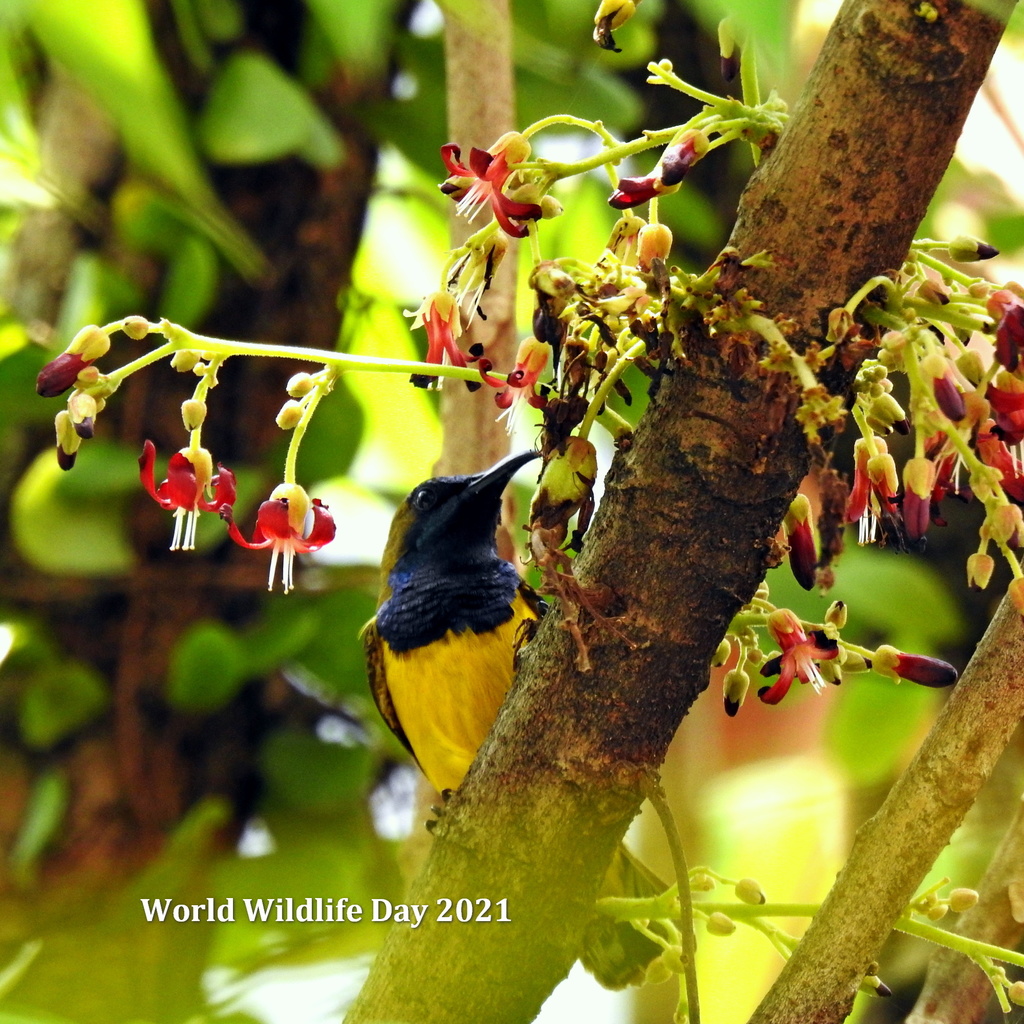
Ornate Sunbird
Photo © Abu Hamas
Photo © Abu Hamas — CC BY-SA 4.0 — Source: iNaturalist #70489206Identification
The ornate sunbird is a tiny, sexually dimorphic species measuring 10–11.4 cm in length. Males of the nominate subspecies are striking: olive above with black remiges edged in green, and a black tail with a white tip. The most distinctive feature is the iridescent blue-black throat, side of neck, and breast, contrasting sharply with bright yellow underparts. The bill and legs are black, with dark brown eyes. Females are far more subdued, lacking the male's iridescent throat patch. They are greenish-olive above with a yellow supercilium and yellowish underparts, making them easily overlooked among foliage.
The ornate sunbird differs from the closely related garden sunbird primarily in the male's paler yellow plumage below and subtle purple-black gloss on the forehead. Eight subspecies are recognized across the species' range, with subtle plumage variations between populations.
Range & Habitat
This species is endemic to mainland Southeast Asia and the Indonesian archipelago, with populations distributed across Myanmar, southern China, Thailand, Cambodia, Vietnam, Malaysia, Sumatra, Java, Borneo, and the Lesser Sunda Islands. Eight distinct subspecies occupy different regions, from the Andaman and Nicobar Islands in the Indian Ocean to the Lesser Sunda Islands east of Java.
Ornate sunbirds are highly adaptable, thriving in mangroves, forest edges, open scrub, parks, and gardens. They favor areas with flowering plants and adequate insect life, making them common visitors to human-modified landscapes throughout their range.
Behaviour & Diet
These active birds forage singly or in small groups, constantly searching for food among flowers and foliage. Their diet is diverse: they take small insects and spiders by gleaning from vegetation, supplement with nectar from flowering plants, and occasionally feed on small fruits. Like other sunbirds, they are attracted to flowering trees and shrubs, making them predictable subjects for observation.
The ornate sunbird is a prolific breeder, typically raising several broods per year. Females construct remarkable hanging nests measuring 30–60 cm in length, woven from grass, bark, moss, lichens, leaf fragments, vegetable fibers, and spider webs. These nests are suspended 0.5–1.5 m above ground, though occasionally much higher. A clutch of 1–3 eggs is incubated by the female alone; eggs hatch after 11–16 days, and chicks fledge after a further 13–16 days, with both parents feeding the young.
Best Time & Places to See It
The ornate sunbird is resident throughout its range, so timing is less critical than habitat selection. Focus on flowering areas in parks, gardens, forest edges, and scrubland where nectar sources are abundant. Early morning is most productive, when sunbirds are actively feeding. In Southeast Asia, gardens with native flowering plants and ornamental flowers consistently attract them.
Look for small flocks moving rapidly through vegetation, or listen for their high, energetic calls. Males often perch conspicuously while feeding, making them easier to locate than the camouflaged females.
Photography Tips
The male's iridescent plumage is this bird's greatest photographic asset—but it's also a challenge. Blue-black iridescence changes dramatically with light angle, requiring careful positioning to capture the full color range. Shoot with side or backlighting to reveal the brilliant blue sheen of the throat and breast. Fast shutter speeds (1/1000th or faster) are essential for these active, fast-moving birds. A telephoto lens of at least 400mm is recommended to fill the frame with such small subjects.
Garden and park settings often provide perches and flowers that frame sunbirds beautifully. Early morning light is ideal for rendering iridescence. Patience is rewarded: males often return to favored feeding spots repeatedly, allowing you to anticipate behavior and composition. Focus on the eye and head to ensure critical sharpness on these diminutive subjects.
Hat Noppharat Thara-Mu Ko Phi Phi National Park
Ao Nang, Thailand
+253 birds+9 mammals
Where limestone karsts rise dramatically from turquoise waters, Hat Noppharat Thara-Mu Ko Phi Phi National Park unfolds across a mosaic of beach, mangrove forest, and island…
VIEW NATIONAL PARKKhao Laem Ya-Mu Ko Samet National Park
Mueang Rayong District, Thailand
+159 birds+3 mammals
Where limestone hills meet the Gulf of Thailand, Khao Laem Ya–Mu Ko Samet National Park stitches together a mosaic of terrestrial and marine worlds that few…
VIEW NATIONAL PARKBako National Park
Kuching, Malaysia
+210 birds+17 mammals
Weathered sandstone cliffs rise dramatically from the South China Sea, their ochre faces sculpted by millennia of wind and tide into a landscape of extraordinary geological…
VIEW NATIONAL PARKWest Bali National Park
Gerokgak, Indonesia
+240 birds+8 mammals
Across West Bali's northwestern reaches, where the Indian Ocean meets volcanic slopes and limestone cliffs plunge toward turquoise shallows, sprawls a protected realm of roughly 325…
VIEW NATIONAL PARKMount Merapi National Park
Hargobinangun, Indonesia
+150 birds+3 mammals
Where the volcanic slopes of central Java rise into mist and montane forest, Mount Merapi National Park guards one of Indonesia's most dynamic landscapes. Spanning roughly…
VIEW NATIONAL PARKKomodo National Park
Komodo, Indonesia
+155 birds+14 mammals
Where volcanic peaks rise dramatically from turquoise waters, a primordial landscape unfolds across three main islands and countless smaller ones scattered throughout the Lesser Sunda archipelago.…
VIEW NATIONAL PARKNo community photos yet. Log in to add the first one.
No community observations of this species yet.