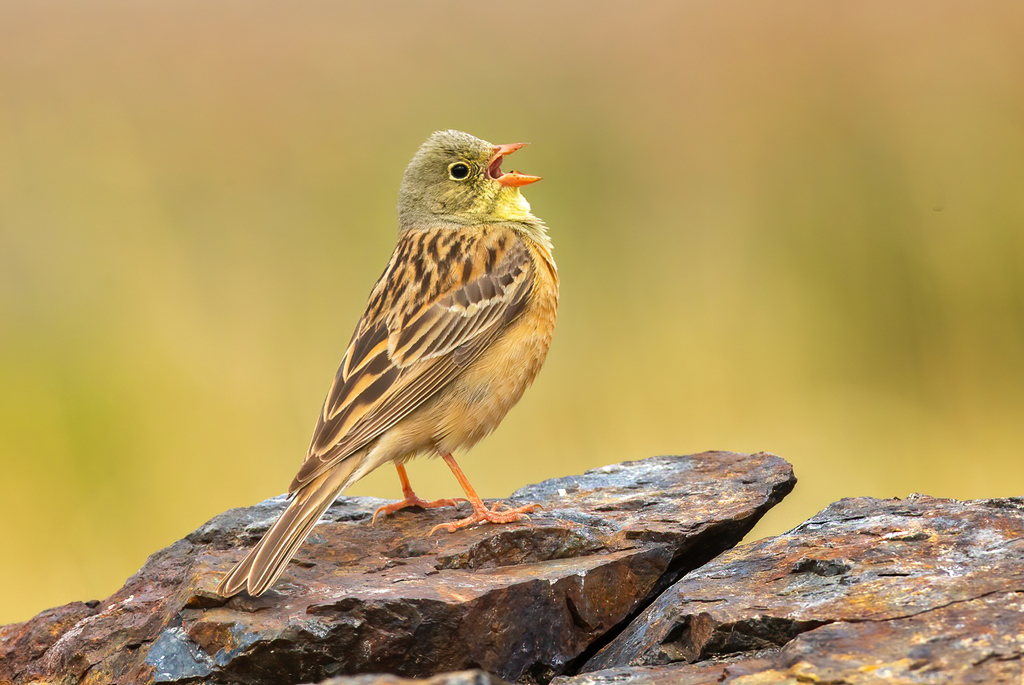
Ortolan Bunting
Photo © egorbirder
Photo © egorbirder — CC BY 4.0 — Source: iNaturalist photo #205729189Identification
The ortolan bunting is a small Eurasian passerine measuring 16–17 centimetres in length, with a wingspan of 23–29 cm. In appearance and habits it closely resembles the yellowhammer, though it lacks that species' bright colouring. Most distinctively, the ortolan's head is greenish-grey rather than bright yellow. The male's song similarly resembles the yellowhammer's song, making aural identification useful in the field.
Range & Habitat
Native to most European countries and West Asia, the ortolan bunting's range extends as far north as Scandinavia and beyond the Arctic Circle. It frequents cornfields and their neighbourhoods, preferring agricultural landscapes. The species is an uncommon vagrant to the British Isles during spring migration, and particularly during autumn migration, though sightings in the UK have become less common in recent decades due to population decline.
The ortolan's range occasionally extends far beyond its usual distribution. In November 2018, an individual was spotted and photographed at Kenjar Coastal in Karnataka, India—a sighting noted by birdwatchers as the first photographic record of an ortolan bunting in that country.
Behaviour & Diet
Ortolan nests are placed on or near the ground, providing camouflage in their preferred open habitats. The species' natural diet consists primarily of seeds, though during the breeding season when feeding young, adults supplement this with beetles and other insects. The maximum recorded lifespan is six years and ten months, based on a bird found dead in Switzerland.
Best Time & Places to See It
Spring and autumn migrations offer the best opportunities to observe ortolans, particularly during their passage through cornfields and agricultural regions across Europe. The species is most frequently encountered during autumn migration as it travels southward to Africa. Birders in the British Isles should watch for vagrants during these periods, though sightings have become increasingly scarce. Continental Europe, particularly areas with extensive grain cultivation, offers the most reliable viewing opportunities.
Photography Tips
The ortolan's subtle greenish-grey head coloration requires careful exposure management to capture accurately. Photographing birds in cornfield habitats demands patience, as they often remain close to ground level. Early morning light during migration periods will best reveal the bird's plumage details and distinguish it from the similar yellowhammer. Focus on the head markings and overall muted colouration as key identification features to capture in your images.
Alpilles Regional Nature Park
Altai Tavan Bogd National Park
Awash National Park
Bale Mountains National Park
Bardenas Reales
Baronnies Provençales Regional Nature Park
Białowieża National Park
Biebrza National Park
Bosc de Virós
Nothing matches these filters.
No community photos yet. Log in to add the first one.
No community observations of this species yet.