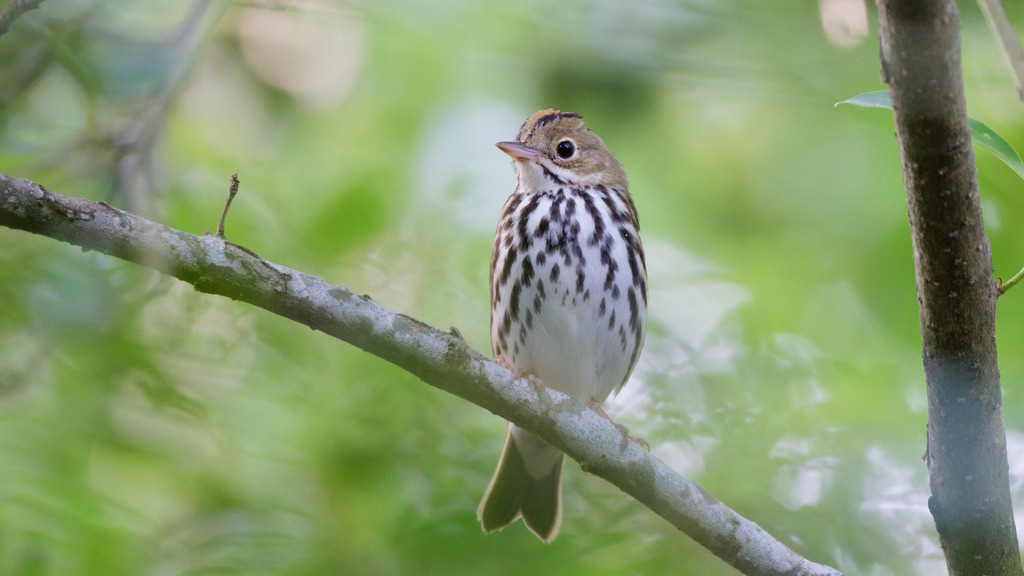
Ovenbird
Photo © Brent Cox
Photo © Brent Cox — CC BY 4.0 — Source: iNaturalist photo #657367796Identification
The Ovenbird is a large wood warbler measuring 11–16 cm in length with a wingspan of 19–26 cm. Adults are distinctive with olive-brown upperparts and white underparts heavily streaked with black, olive-hued flanks, and a white eye-ring with a black cheek stripe. The most striking feature is a line of orange feathers running along the crown, bordered by blackish-brown and tipped with olive-green. Males and females look identical. Immature birds show larger olive-green crown tips that largely conceal the orange stripe, along with tawny fringes on flight feathers.
Range & Habitat
This migratory warbler breeds in mature deciduous and mixed forests across eastern Canada and the eastern United States, preferring sites with minimal undergrowth. It winters from the southeastern United States, Caribbean islands, and Mexico south to northern South America, typically in lowlands but occasionally ascending to 1,500 m in places like Costa Rica. Ovenbirds are territorial year-round, occurring singly or as pairs, though they travel in larger groups during migration. First migrants depart breeding grounds in late August, arriving on wintering grounds by September through late October, with return migration occurring between late March and early May.
Behaviour & Diet
Ovenbirds forage on the ground among dead leaves, picking through leaf litter for terrestrial arthropods and snails, sometimes hovering or catching insects in flight. They are highly mobile foragers, frequently tilting their tail upward and bobbing their head while walking; at rest, they periodically flick the tail upward and slowly lower it. During winter, they supplement their arthropod diet with fruit. The bird's common name derives from its remarkable domed, ground-placed nest woven from vegetation with a side entrance. Females typically lay 4–5 brown or gray-speckled eggs and alone incubate them for 11–14 days. Young fledge at 8–11 days old, fed by both parents.
Best Time & Places to See It
On breeding grounds, Ovenbirds are present from April through August across eastern North American forests. Winter observers should visit the Caribbean, Central America, or northern South America from September through March. During spring and fall migration (late August through May), they may be encountered in larger numbers along migration corridors. The species is a rare vagrant to western North America, particularly California, and infrequently appears in Europe, with occasional records from the Azores, British Isles, and Scandinavia.
Photography Tips
The Ovenbird's ground-foraging behavior and leaf-litter preference make photography challenging but rewarding. Early morning light on breeding grounds works best when birds are most active. A patient approach is essential, as these birds are wary and will perform distraction displays if you approach their ground nests. The erectable orange crown is most visible when birds are alarmed or displaying, so waiting for natural excitement often reveals this key field mark. Their distinctive tail-flicking and head-bobbing provide recognizable postures for composition; capture these diagnostic behaviors to document the species definitively.
Acadia National Park
Algonquin Provincial Park
Alligator River National Wildlife Refuge
Arenal Volcano National Park
Arrecifes de Cozumel National Park
Badlands National Park
Banff National Park
Barra del Colorado National Wildlife Refuge
Baru Volcano National Park
Nothing matches these filters.
No community photos yet. Log in to add the first one.
No community observations of this species yet.