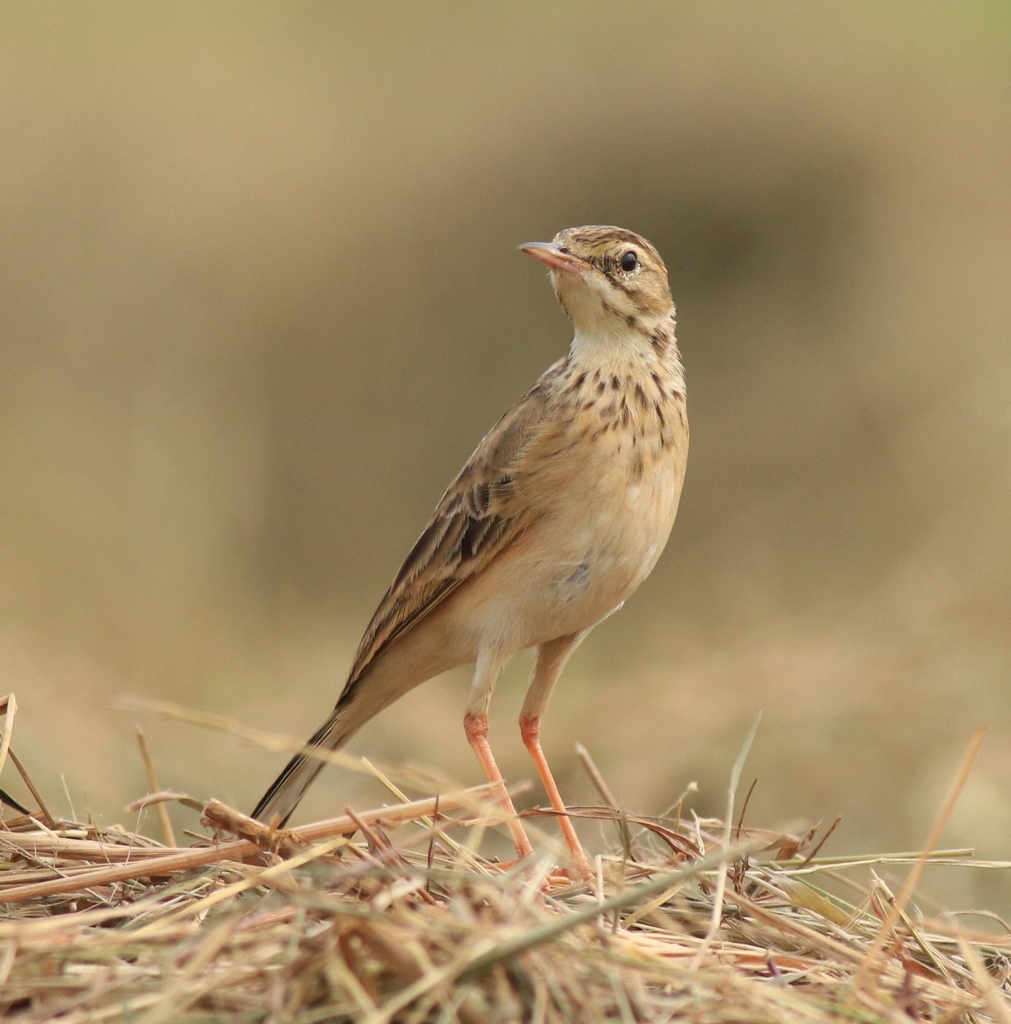
Paddyfield Pipit
Photo © Afsar Nayakkan
Photo © Afsar Nayakkan — CC BY 4.0 — Source: iNaturalist photo #355785132Identification
The Paddyfield Pipit is a large pipit at 15 cm, though undistinguished in appearance with mainly streaked grey-brown upperparts and pale underparts with breast streaking. It is long-legged with a long tail and long dark bill, and the sexes are similar. Summer and winter plumages are also similar, though young birds are more richly coloured below with more conspicuous pale edges to feathers and prominent spotting on the breast. Geographic variation exists across its range: the population from north-western India and Pakistan is pale, the Western Ghats population is larger, darker and more heavily streaked, while the nominate form is intermediate.
Winter identification requires care, as several other pipit species migrate into the region. The Paddyfield Pipit is smaller and dumpier than Richard's Pipit and Blyth's Pipit, with a shorter-looking tail and weaker fluttering flight. Its characteristic chip-chip-chip call distinguishes it clearly from Richard's Pipit's explosive shreep and Blyth's Pipit's nasal pschreen. The Tawny Pipit shows less streaking on the mantle, a black loreal stripe and longer tail, while the Western Ghats population can appear very similar to the Nilgiri Pipit.
Range & Habitat
The Paddyfield Pipit is a resident, non-migratory breeder found across southern Asia east to the Philippines. The nominate subspecies is found throughout most of the Indian Subcontinent (except the north-west, north and extreme south-west) extending east to southern China, south to southern Thailand and Indochina. Additional subspecies occur across the Western Ghats and Sri Lanka, the Philippines, Sulawesi, Bali, the Lesser Sundas, and other Southeast Asian regions.
The species favours open habitats, particularly short grassland and cultivation with open bare ground, making it well-suited to paddyfield environments. It is widespread in open scrub and grassland throughout its range, though it becomes more difficult to identify in winter when other pipit species migrate into the area.
Behaviour & Diet
The Paddyfield Pipit is an active ground-dweller that runs rapidly across open ground. When flushed, it does not fly far, preferring to remain within its open habitat. It breeds throughout the year but mainly in the dry season, often raising two or more broods annually. During breeding season, it sings by repeating a note during descent from a short fluttery flight just a few feet above ground level. The bird builds its nest on the ground under slight prominences, grass tufts, or at bush edges, constructing cup-shaped structures of woven grass and leaves, sometimes with domed or semi-domed tops in exposed locations. Nests are lined with fine grass, roots, and occasionally dry moss or bracken. The typical clutch consists of three or four eggs with greenish ground colour and numerous small brown specks concentrated at the larger end.
The species feeds principally on small insects, walking on the ground to find larger beetles, tiny snails, and worms. It also pursues insects like mosquitoes and termites in the air. When disturbed near the nest, parent birds flutter nearby with weak tsip-tsip-tsip calls and may feign injury to distract predators.
Best Time & Places to See It
Year-round, the Paddyfield Pipit can be found in open grasslands, cultivated areas, and scrubland throughout southern Asia. As a resident species, it is not migratory, making it accessible in its preferred habitats during any season. However, identification becomes more challenging in winter, when multiple pipit species converge in the region, so birders should be prepared with field marks and call identification skills.
Photography Tips
The Paddyfield Pipit's ground-dwelling habits and reluctance to fly far make it approachable for patient photographers. Its preference for short grassland and cultivation with open bare ground means you should scan open areas carefully, watching for rapid ground movements. The bird's characteristic chip-chip-chip call can help locate it. Its long tail, long legs, and streaked plumage are key features to capture, and photographing it from low angles will emphasize its ground-hugging behaviour. During breeding season, watching for short fluttery flights above ground may provide opportunities to photograph its display behaviour.
Kanha Tiger Reserve
Minneriya National Park
Angamedilla National Park
Bandhavgarh National Park
Bandipur National Park
Banke National Park
Bardiya National Park
Chitwan National Park
Doi Inthanon National Park
Nothing matches these filters.
No community photos yet. Log in to add the first one.
No community observations of this species yet.