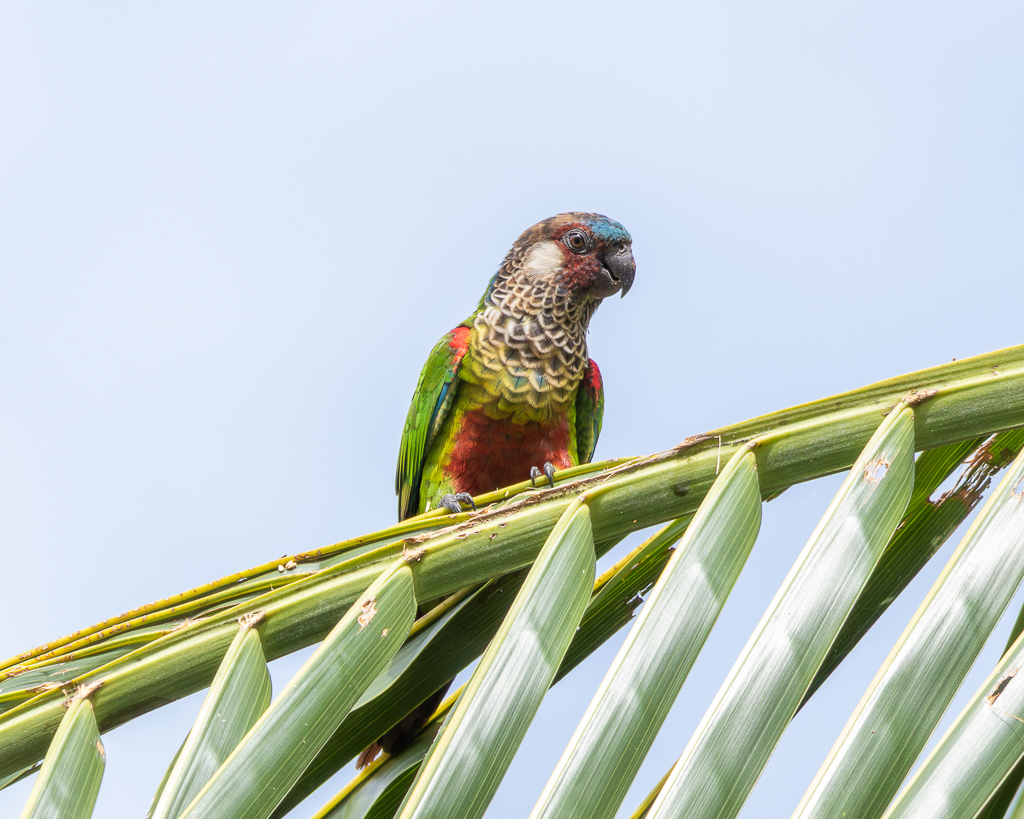
Painted Parakeet
Photo © NINA WENÓLI
Photo © NINA WENÓLI — CC0 1.0 — Source: iNaturalist photo #617290398Identification
The Painted Parakeet is a small parrot measuring 20 to 23 cm in length, with distinctive plumage that lives up to its name. Adults display blue coloring from the forehead to the hindcrown, transitioning to deep maroon on the nape. The face is maroon with a characteristic bare grayish eye-ring, and whitish ear coverts. A narrow blue collar sits below the nape. The upperparts are predominantly green with a dull red lower back and rump, while the sides of the neck and breast show buff coloring with reddish-brown scalloping. The belly center is dull red with green underparts, the wings are mostly green with red carpal areas and blue primaries, and the tail is maroon with a green base. Immatures lack the red carpal patch and have a whitish eye-ring. The species shows no sexual dimorphism.
Range & Habitat
This parakeet inhabits northeastern South America, ranging from southeastern Venezuela through the Guianas to northern Amazonian Brazil. It occupies terra firme and várzea forests, forested savanna, and coastal sand-ridge forest across elevations from the lowlands up to 1,800 meters. The species shows no documented migratory patterns, though some subspecies may make minor elevational movements seasonally.
Behaviour & Diet
Painted Parakeets are highly social birds, typically foraging in flocks of up to 30 individuals. They feed on a wide variety of fruits, seeds, and flowers from numerous plant and tree species. Breeding biology remains largely understudied in the wild; the nominate subspecies breeds December to February in the Guianas, nesting in tree cavities with clutches of four to five eggs. Their vocalizations are loud and piercing—the nominate gives high-pitched "kyeek kyeek kyeek" calls both perched and in flight, along with rolling "kurrek" notes. Flocking birds produce harsh, piercing chattering in flight, while perched individuals are often silent.
Best Time & Places to See It
The Painted Parakeet is most readily encountered in forested habitats throughout its range in Venezuela, Guyana, Suriname, French Guiana, and northern Brazil. They are most active and vocal during early morning and late afternoon hours. The nominate subspecies breeds December to February in the Guianas, making this an ideal time for observation. Look for them in forest canopy and mid-story levels, listening for their distinctive harsh calls to locate flocks.
Photography Tips
The Painted Parakeet's compact size and fast, erratic movements present a challenge for photographers. Early morning light is ideal when birds are most active in the canopy. Fast shutter speeds (1/1000s or faster) are essential to freeze motion. The bird's vibrant blue, green, and maroon plumage photographs well in diffused light—harsh midday sun can create unflattering shadows. Position yourself at eye level or slightly below when possible to capture the beautiful facial markings and eye-ring detail. Photographing foraging flocks offers dynamic composition opportunities, though individual portraits best showcase the species' distinctive painted appearance.
No community photos yet. Log in to add the first one.
No community observations of this species yet.