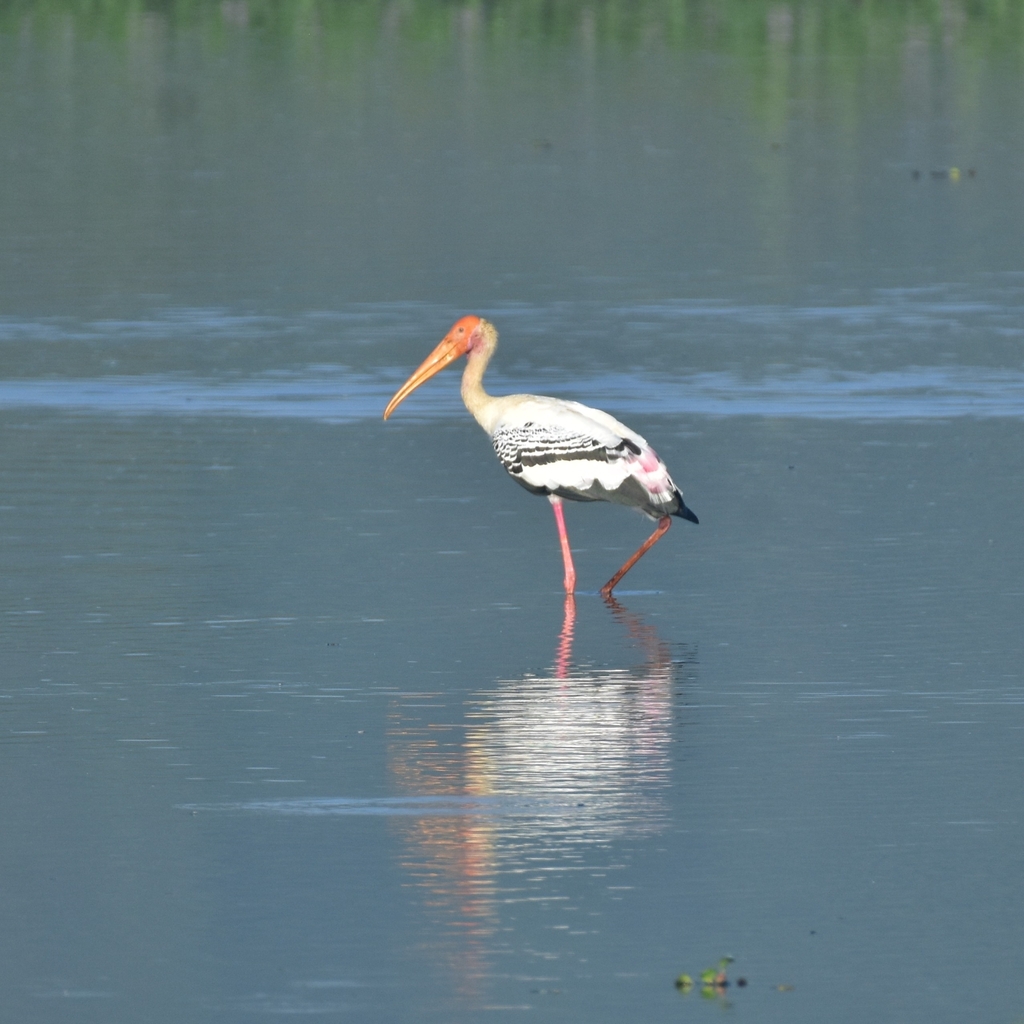
Painted Stork
Photo © Renjith Jacob Mathews
Photo © Renjith Jacob Mathews — CC BY 4.0 — Source: iNaturalist #198228796Identification
The painted stork is a large, striking wader standing 93–102 cm tall with a wingspan of 150–160 cm. Its most distinctive feature is the bright pink coloring of its long tertial feathers, which extend over the back and rump when at rest, giving the bird its evocative name. Adults have a bare, orange or reddish head and a heavy yellow beak with a characteristic downward curve that lends them a superficial resemblance to an ibis. A bold black breast band with white scaly markings extends into the underwing coverts, creating distinctive white stripes across the underwing lining.
The body plumage is predominantly whitish, while the primaries, secondaries, and tail are black with a greenish gloss. The legs are yellowish to red but often appear whitish due to the bird's habit of defecating on them, especially when resting. Males and females look alike, though males are typically larger than their mates. Juveniles show brownish plumage and reach breeding condition after two to three years. Like all storks, painted storks fly with their necks outstretched and soar on thermals during their search for foraging areas.
Range & Habitat
This species is widely distributed across the wetlands of tropical Asia, found south of the Himalayas throughout the Indian subcontinent and extending into Southeast Asia. Its range is bounded to the west by the Indus River system, where they are rare, and extends eastward across the region. They are absent from very dry or desert areas, dense forests, and higher hill regions. The species appears to have expanded into Kerala only in the 1990s, where it remains uncommon.
Painted storks prefer freshwater wetlands year-round but readily adapt to irrigation canals and flooded rice fields during the monsoon season. They are resident in most regions but make seasonal movements in response to changes in weather, food availability, or breeding requirements. Young birds may disperse considerable distances from their natal sites. They breed colonially in large trees in protected locations, including wetland reserves, village ponds and lakes, urban zoos, and islands in urban wetlands.
Behaviour & Diet
These gregarious storks feed in flocks in shallow wetlands, crop fields, and irrigation canals, using a distinctive feeding technique. They wade slowly with their long bills half-open and submerged, sweeping them side to side through the water to sense and capture small fish by touch. They also stir the water with their feet to flush hiding prey. Maximum feeding success occurs in water approximately 7 cm deep. Beyond fish, they also consume frogs, occasional snakes, and in some regions crabs, large insects, and grasshoppers.
Painted storks are mostly silent birds, producing only weak moans and bill clattering sounds at the nest. Flocks vary in size from fewer than five birds in agricultural areas to over 50 in favorable locations, with higher densities observed in winter after young have fledged. They breed colonially in trees, often alongside other waterbirds, with breeding season timing varying geographically—beginning in mid-August in northern India and from October to April in southern regions.
Best Time & Places to See It
Painted storks can be encountered in suitable wetland habitats throughout their range in the Indian subcontinent and Southeast Asia. Key locations include wetland reserves, community-managed village ponds, and lakes where protection is afforded to nesting birds. Urban wetlands and protected tree patches in cities also host populations. The species is present year-round in most regions, though densities increase in winter after the breeding season concludes.
Visit during daylight hours when these birds are actively foraging in shallow waters. Breeding season offers opportunities to observe them at their colonial nesting sites in trees, particularly from mid-August through April depending on your location. Their habit of soaring on thermals, especially during late morning hours, makes them visible even from a distance in suitable habitats.
Photography Tips
The painted stork's striking plumage—particularly the brilliant pink tertials and black-and-white patterning—makes it a rewarding photographic subject. Capture them in shallow wetlands during their characteristic feeding behavior, where their elegant feeding posture and graceful wading can be framed against reflective water. The bare, colorful head and distinctive curved bill are key identifying features worth highlighting in close-up shots.
The morning hours are ideal for photography when storks soar on thermals, offering opportunities for dynamic flight shots with outstretched necks. If photographing at breeding colonies, exercise patience and respect for nesting birds. The contrast between their white body, black wing markings, and pink tertials is striking, so position yourself to capture this color pattern clearly. Colonial nesting scenes with multiple birds at trees provide impressive habitat and behavioral documentation opportunities.
Lunugamvehera National Park
Sri Lanka
+204 birds+14 mammals
Dry scrubland and shallow wetlands converge in Sri Lanka's southeastern lowlands, where Lunugamvehera National Park anchors one of the island's most ecologically vital landscapes. The park's…
VIEW NATIONAL PARKMinneriya National Park
Sri Lanka
+158 birds+9 mammals
Across the dry zone of Sri Lanka's North Central Province spreads a landscape of shallow tanks, grassland margins, and scattered dry forest—a mosaic of water and…
VIEW NATIONAL PARKWasgamuwa National Park
Sri Lanka
+156 birds+8 mammals
Dry deciduous forest and open grassland sweep across the North Central lowlands where Wasgamuwa National Park protects one of Sri Lanka's largest remaining tracts of this…
VIEW NATIONAL PARKAngamedilla National Park
Polonnaruwa, Sri Lanka
+40 birds+2 mammals
Ancient tanks and sal forests define this water-rich sanctuary in Sri Lanka's North Central heartland, where seasonal wetlands and dry deciduous woodland create a mosaic of…
VIEW NATIONAL PARKMaduru Oya National Park
Sri Lanka
+74 birds+1 mammals
Granite ridges rise abruptly from the humid lowlands of Sri Lanka's Uva Province, their weathered slopes clothed in dry monsoon forest and scattered woodland where deciduous…
VIEW NATIONAL PARKRanthambhore National Park
Sawai Madhopur, India
+294 birds+20 mammals
Granite ridges and ravines carved through the Aravalli Range frame this protected landscape in eastern Rajasthan, where deciduous forest mingles with open scrubland and seasonal water…
VIEW NATIONAL PARKKhao Yai National Park
Prachantakham District, Thailand
+377 birds+46 mammals
Evergreen dipterocarp forest blankets the rolling terrain of this national park in eastern Thailand, where limestone hills rise abruptly from the forest floor and seasonal streams…
VIEW NATIONAL PARKKanha Tiger Reserve
Kanha Kisli F.V., India
+321 birds+23 mammals
Where sal forests give way to emerald meadows and crystalline streams carve through ancient valleys, one of India's finest wilderness reserves unfolds across the Maikal Range.…
VIEW NATIONAL PARKTadoba National Park
Palasgaon Singru, India
+270 birds+20 mammals
Where sal forests meet open grasslands and rocky outcrops rise from red laterite soil, central India's landscape unfolds in raw, untamed beauty. Ancient teak woodlands and…
VIEW NATIONAL PARKBandhavgarh National Park
Garhpuri, India
+285 birds+17 mammals
Where granite ridges rise dramatically above sal and bamboo forests, one of India's most pristine tiger reserves unfolds across the Vindhyan plateau. Ancient rock formations tower…
VIEW NATIONAL PARKPanna National Park
Badgadi Kalan, India
+271 birds+17 mammals
Where granite gorges slice through central India's Vindhyan plateau, a landscape of stark beauty unfolds across nearly six hundred square kilometers. The Ken River carves through…
VIEW NATIONAL PARKKaziranga National Park
Kohora, India
+422 birds+26 mammals
Dawn breaks over the floodplains of the Brahmaputra, where tall grasslands stretch endlessly beneath monsoon-heavy skies. This sprawling wilderness of northeastern Assam is a mosaic of…
VIEW NATIONAL PARKKeoladeo National Park
Shreenagar Rural, India
+326 birds+14 mammals
Where shallow wetlands shimmer beneath vast Rajasthani skies, one of Asia's finest bird sanctuaries pulses with extraordinary life. This former maharaja's hunting reserve, now spanning 29…
VIEW NATIONAL PARKBandipur National Park
Hirehalli, India
+302 birds+19 mammals
Where the Western Ghats descend into the Deccan plateau, ancient deciduous forests blanket a landscape carved by the Nugu River. Bandipur unfolds across 880 square kilometres…
VIEW NATIONAL PARKNagarahole Tiger Reserve
Nalkeri Forest, India
+323 birds+23 mammals
Where granite escarpments rise above dense deciduous forests and the Kabini River carves through pristine wilderness, one of India's most biodiverse landscapes unfolds across the Western…
VIEW NATIONAL PARKGir National Park
Asundrali, India
+258 birds+13 mammals
Dry deciduous forests cloak the rolling hills of western Gujarat where the Gir landscape rises as a final sanctuary for one of the world's rarest felids:…
VIEW NATIONAL PARK