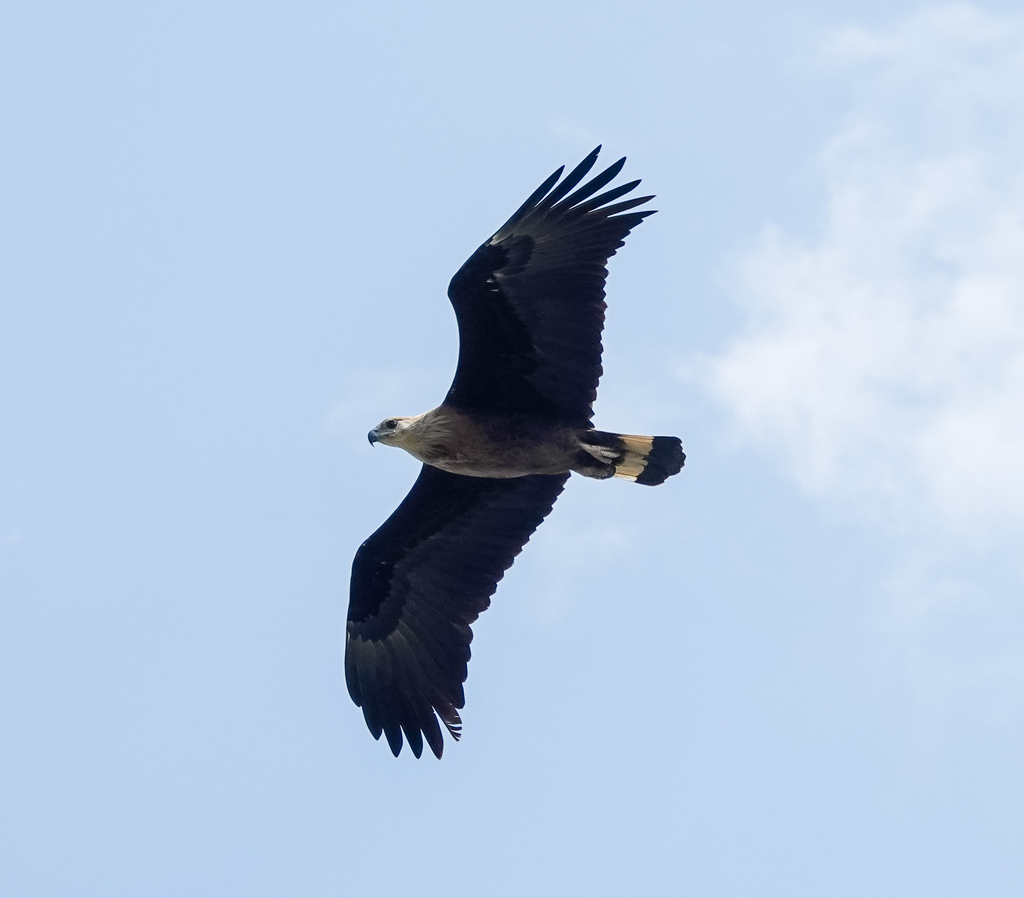
Pallas’s Fish Eagle
Photo © Rejoice Gassah
Photo © Rejoice Gassah — CC BY 4.0 — Source: iNaturalist #70597468Identification
Pallas's fish eagle is a large, distinctive brownish sea eagle measuring 72 to 85 cm in length with a wingspan of 180–215 cm. The adult bird is characterized by a light sandy-brown hood, whitish face, darker brown wings, and rufous back. Most striking is its black tail marked by a wide, distinctive white stripe. The long, slender wings—unusually slender for a sea eagle—appear rather dark brown underneath. Females are slightly larger than males, with females weighing 2.1 to 3.7 kg and males 2.03 to 3.3 kg, though some individuals have been recorded at considerably heavier weights.
Juveniles are overall darker, cooler brown without the distinctive tail band but displaying several pale areas on the wings, including white bands on the underwings and inner primaries. The species takes approximately four years to acquire full adult plumage. Among related species, Pallas's fish eagle overlaps in range with the much shorter-winged grey-headed fish eagle and scarcely with the larger, bulkier white-tailed eagle, neither of which shares its characteristic coloring.
Range & Habitat
Pallas's fish eagle breeds across the east Palearctic, with populations found in Kazakhstan, Russia, Tajikistan, Turkmenistan, Uzbekistan, Mongolia, China, India, Nepal, Bangladesh, Myanmar, and Bhutan. The species is partially migratory, with Central Asian birds wintering among their southern Asian counterparts in northern India and further west to the Persian Gulf, creating a broad but fragmented distribution across Asia.
Behaviour & Diet
The diet of Pallas's fish eagle consists primarily of large freshwater fish, but the species is broadly opportunistic, much like other sea eagles. Beyond fish, they regularly prey upon water birds including pheasant-tailed jacanas, whistling ducks, pochards, and grebes. The species is also known to attack large adult water birds such as greylag geese, bar-headed geese, and Demoiselle cranes by assaulting them on the water's surface. Other recorded prey includes mammals, frogs, reptiles including snakes and terrapins, insects, and carrion.
Pallas's fish eagles are renowned for remarkable feats of prey capture. They have been documented lifting adult greylag geese—birds equal to or exceeding the eagle's own weight—from the water. One documented case involved an eagle capturing a 6.5 kg carp at the Yamuna River and flying with the struggling fish low over water, demonstrating extraordinary lifting capacity. Observations at Bharatpur suggest that wintering birds dominate other eagle species, selecting the highest perches and maintaining higher daily food intake than similarly-sized eagles.
Best Time & Places to See It
Northern India, particularly around Bharatpur, represents a key wintering location where Pallas's fish eagles congregate alongside other eagle species. The species's preference for large freshwater bodies makes river systems and lakes throughout its range the most productive areas for observation. The partial migratory nature of the population means that sightings are most reliable during winter months in southern Asia, when Central Asian breeding birds migrate south.
Photography Tips
The species's distinctive white-banded black tail and contrasting plumage make it visually striking when perched. Its characteristic slender, long wings are particularly prominent in flight. Patience is essential, as the species is listed as Endangered with fewer than 2,500 individuals remaining globally. Early morning light at major wetland sites will best highlight the bird's sandy-brown hood and pale face. Capturing the bird in hunting posture near water, where it displays its remarkable prey-capture behavior, offers compelling photographic opportunities for those patient enough to observe it.
Orang National Park
Rangagarapathar, India
+298 birds+1 mammals
Where the Brahmaputra's floodplains meet the foothills of Assam, Orang National Park unfolds across a mosaic of riverine grasslands, forests and wetlands that pulse with the…
VIEW NATIONAL PARKKaziranga National Park
Kohora, India
+422 birds+26 mammals
Dawn breaks over the floodplains of the Brahmaputra, where tall grasslands stretch endlessly beneath monsoon-heavy skies. This sprawling wilderness of northeastern Assam is a mosaic of…
VIEW NATIONAL PARKKeoladeo National Park
Shreenagar Rural, India
+326 birds+14 mammals
Where shallow wetlands shimmer beneath vast Rajasthani skies, one of Asia's finest bird sanctuaries pulses with extraordinary life. This former maharaja's hunting reserve, now spanning 29…
VIEW NATIONAL PARKKhangai Nuruu National Park
Erdenetsogt, Mongolia
+136 birds+7 mammals
Where granite ridges pierce Mongolia's central steppe, alpine meadows give way to dense coniferous forests that climb toward windswept summits. Khangai Nuruu sweeps across 1.2 million…
VIEW NATIONAL PARKQinghai Lake National Nature Reserve
Hainan Tibetan Autonomous Prefecture, China
+243 birds+11 mammals
At 3,200 metres above sea level on the Tibetan plateau, where winter temperatures plunge far below freezing and snow blankets the landscape for half the year,…
VIEW NATURE RESERVENo community photos yet. Log in to add the first one.
No community observations of this species yet.