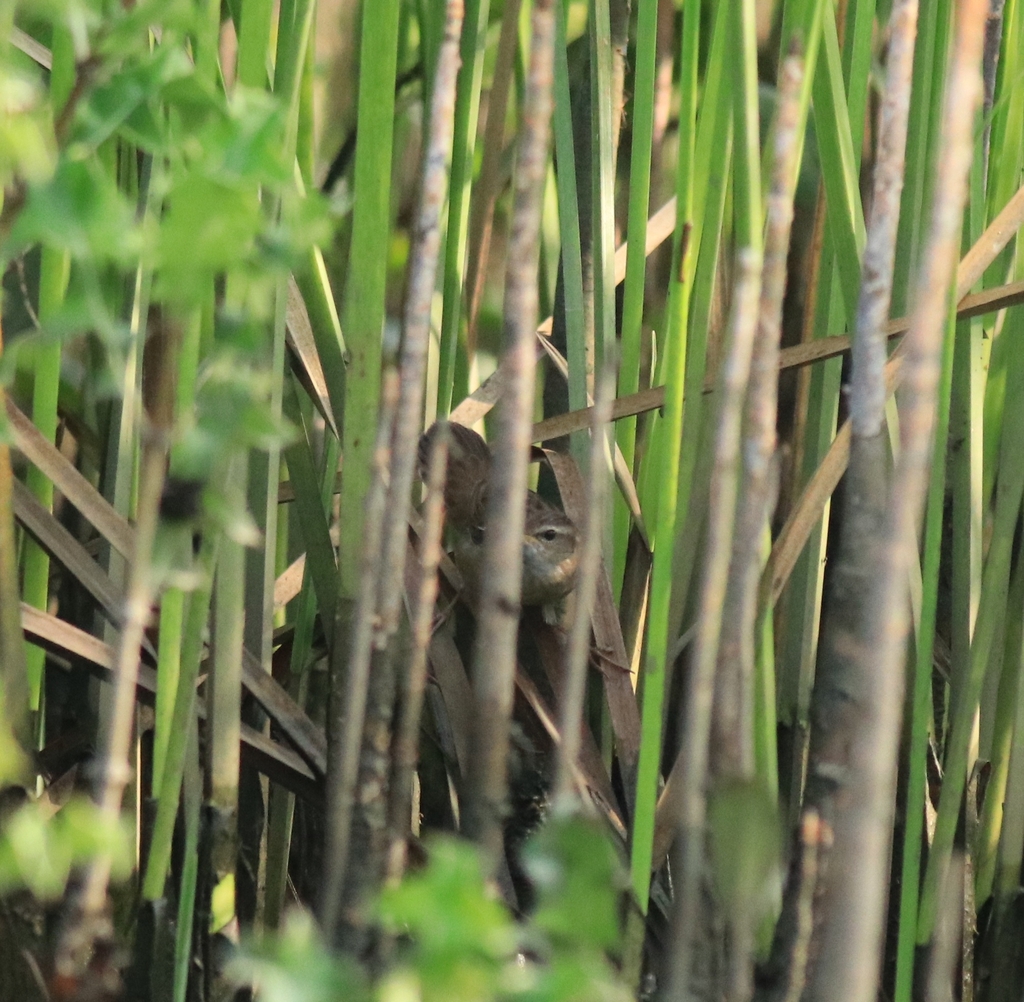
Pallas’s Grasshopper Warbler
Photo © Afsar Nayakkan
Photo © Afsar Nayakkan — CC BY 4.0 — Source: iNaturalist #258277154Identification
Pallas's Grasshopper Warbler is a medium-sized warbler with a streaked brown back and whitish-grey underparts, unstreaked except on the undertail. The sexes are identical in plumage, though young birds are noticeably yellower below. It closely resembles the Common Grasshopper Warbler but is slightly larger, with distinctive white tips to the tail and tertial feathers, and a warmer brown rump. These white tail tips have earned it the colloquial, mnemonic name "PG Tips"—a helpful memory aid for field identification.
Range & Habitat
This Old World warbler breeds across the eastern Palearctic, from the Altai Mountains, Mongolia, and Transbaikalia through northeastern China, the Korean Peninsula, and into islands of the Sea of Okhotsk including Sakhalin and the Kuril Islands. It is strongly migratory, wintering from India eastward to Indonesia, making it a rare visitor to western Europe during migration periods.
The species favours tall grass with thicker vegetation, typically in proximity to water in bogs or wet meadows. It nests on the ground in grass, laying between four and seven eggs. This is an exceptionally skulking bird, extremely difficult to observe outside of singing periods.
Behaviour & Diet
Like most warblers, Pallas's Grasshopper Warbler is insectivorous, gleaning small invertebrates from vegetation. It is a secretive species that creeps deliberately through grass and low foliage, staying well hidden from view. The bird's highly cryptic habits make observation challenging for birders and photographers alike.
Its song sets it apart from many congeners: unlike the mechanical, insect-like reeling produced by the Common Grasshopper Warbler and other Locustella warblers, Pallas's delivers an inventive, melodic song reminiscent of Acrocephalus warblers. Song output is often the most reliable way to detect and locate this otherwise elusive species.
Best Time & Places to See It
Within its breeding range across eastern Asia, the species is most active during the breeding season. For those in western Europe, this is an exceptionally rare vagrant, though Fair Isle in Shetland represents one of the best locations to encounter it, where it can be found with some regularity relative to its scarcity elsewhere in western Europe. It is also a rare migrant in Sri Lanka.
Your best chance of locating this species involves listening for song, as visual observation is otherwise improbable. Early morning surveys in appropriate habitat during the breeding season offer the highest probability of detection.
Photography Tips
Photographing Pallas's Grasshopper Warbler presents considerable challenges due to its secretive nature and preference for remaining concealed within dense grass and low vegetation. Patience and a good knowledge of its song are essential. Position yourself downwind of singing birds and move slowly and deliberately to avoid flushing the bird deeper into cover.
The bird's distinctive white tail tips and warm brown rump provide useful field marks to confirm identification in photographs. Use a telephoto lens to maintain distance and minimize disturbance, and shoot during early morning light when birds are most vocal and active. Expect many unsuccessful attempts—successful photographs of this species are genuinely challenging trophies.
Wasgamuwa National Park
Sri Lanka
+156 birds+8 mammals
Dry deciduous forest and open grassland sweep across the North Central lowlands where Wasgamuwa National Park protects one of Sri Lanka's largest remaining tracts of this…
VIEW NATIONAL PARKOrang National Park
Rangagarapathar, India
+298 birds+1 mammals
Where the Brahmaputra's floodplains meet the foothills of Assam, Orang National Park unfolds across a mosaic of riverine grasslands, forests and wetlands that pulse with the…
VIEW NATIONAL PARKHat Noppharat Thara-Mu Ko Phi Phi National Park
Ao Nang, Thailand
+253 birds+9 mammals
Where limestone karsts rise dramatically from turquoise waters, Hat Noppharat Thara-Mu Ko Phi Phi National Park unfolds across a mosaic of beach, mangrove forest, and island…
VIEW NATIONAL PARKKhao Yai National Park
Prachantakham District, Thailand
+377 birds+46 mammals
Evergreen dipterocarp forest blankets the rolling terrain of this national park in eastern Thailand, where limestone hills rise abruptly from the forest floor and seasonal streams…
VIEW NATIONAL PARKKhao Laem Ya-Mu Ko Samet National Park
Mueang Rayong District, Thailand
+159 birds+3 mammals
Where limestone hills meet the Gulf of Thailand, Khao Laem Ya–Mu Ko Samet National Park stitches together a mosaic of terrestrial and marine worlds that few…
VIEW NATIONAL PARKBaikal National Park
Ольхонский район, Russia
+184 birds+11 mammals
Where the world's deepest freshwater lake meets ancient Siberian taiga, Baikal National Park sprawls across 66,203 square kilometers of one of Earth's most singular ecosystems. The…
VIEW NATIONAL PARKKaziranga National Park
Kohora, India
+422 birds+26 mammals
Dawn breaks over the floodplains of the Brahmaputra, where tall grasslands stretch endlessly beneath monsoon-heavy skies. This sprawling wilderness of northeastern Assam is a mosaic of…
VIEW NATIONAL PARKKerinci Seblat National Park
Kerinci, Indonesia
+228 birds+16 mammals
Across nearly 67,000 square kilometres of Sumatra's spine, a mountainous realm of equatorial rainforest rises from steaming lowlands to volcanic peaks shrouded in cloud. Kerinci Seblat…
VIEW NATIONAL PARKHustai National Park
Altanbulag, Mongolia
+198 birds+16 mammals
Where the steppe rolls endlessly beneath vast Mongolian skies, Hustai National Park preserves one of Central Asia's most dynamic grassland ecosystems. Rolling hills and open prairie…
VIEW NATIONAL PARKGobi Gurvan Saikhan National Park
Tsagaan Subarga Hural, Mongolia
+183 birds+23 mammals
Where rust-coloured badlands rise from the southern Gobi steppe, the terrain transforms into a landscape of geological drama that few visitors expect to find in Mongolia's…
VIEW NATIONAL PARKNortheast China Tiger and Leopard National Park
Mu Dan Jiang Shi, China
+202 birds+19 mammals
Across the temperate forests of northeastern China, where winters grip the landscape in subzero silence and summers remain cool and brief, the Mudanjiang region supports a…
VIEW NATIONAL PARKHermaness National Nature Reserve
Shetland, United Kingdom
+86 birds+3 mammals
At the northern tip of Unst, the northernmost inhabited island of Shetland, sea cliffs of weathered sandstone and basalt rise dramatically from the North Sea, their…
VIEW NATURE RESERVENo community photos yet. Log in to add the first one.
No community observations of this species yet.