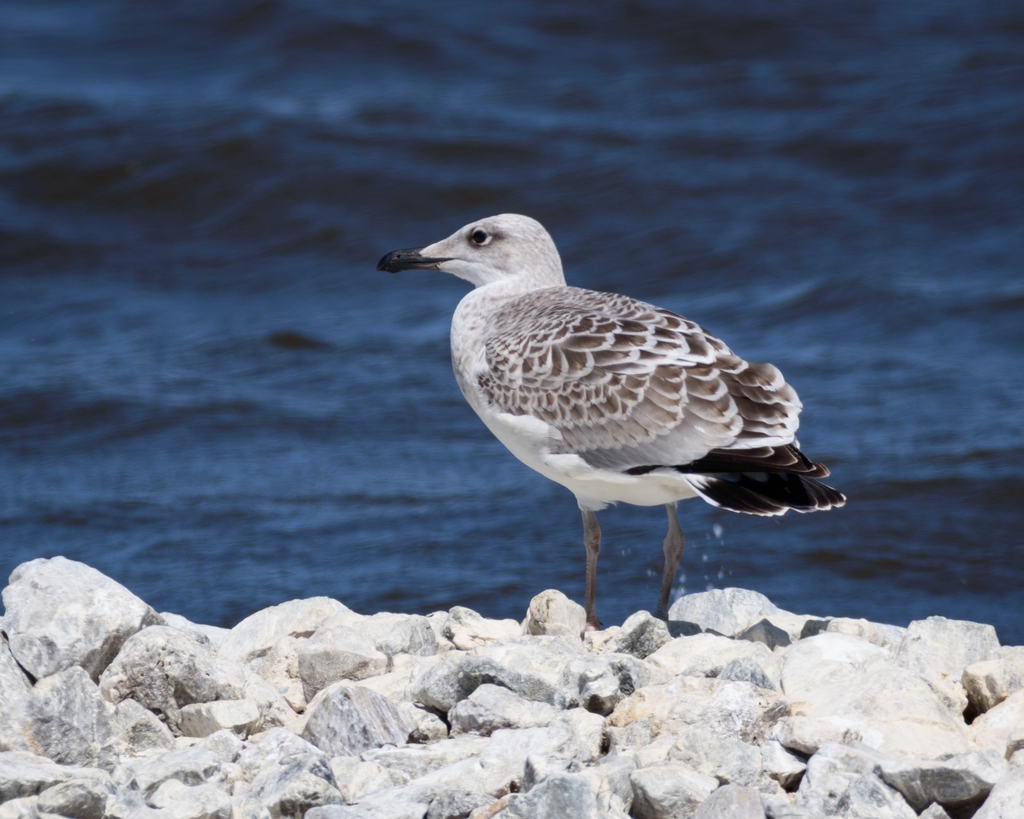
Pallas’s Gull
Photo © София Хохлачёва
Photo © София Хохлачёва — CC BY 4.0 — Source: iNaturalist #227836386Identification
Pallas's gull, also known as the great black-headed gull, is a massive waterbird and the world's largest black-headed gull—the third largest gull species overall. Adults measure 55–72 cm in length with a wingspan of 142–170 cm, and typically weigh around 1.6 kg in males and 1.22 kg in females. Summer plumage is unmistakable: a striking black hood contrasts sharply with grey wings and back, white "mirrors" at the wing tips, yellow legs, and an orangey-yellow bill tipped with red. In all other plumages, a dark eye-mask reveals vestiges of the distinctive hood. Young birds develop grey upperparts relatively quickly but require four years to reach full maturity.
Range & Habitat
This species breeds in colonies across marshes and islands stretching from southern Russia to Mongolia. It is highly migratory, wintering in the eastern Mediterranean, Arabia, and India. Pallas's gull occurs irregularly as a vagrant across much of western Europe and along the northern and eastern coasts of Africa, visiting these regions annually but unpredictably. The bird is exceptionally rare in Great Britain, with only a single accepted record from 1859.
Behaviour & Diet
Pallas's gulls are predatory birds with a deep, rather nasal flight-call that resembles that of the lesser black-backed gull. Paradoxically, while they are notably noisy at breeding colonies, they remain largely silent during the breeding season itself. These opportunistic hunters feed on fish, crustaceans, insects, and even small mammals. Ground-nesting birds, females lay between two and four eggs per clutch.
Best Time & Places to See It
Your best chances of observing this impressive gull lie in its wintering grounds around the eastern Mediterranean, Arabia, and India during winter months. Those in Africa may encounter them irregularly along northern and eastern coasts on an annual basis. Breeding colonies in southern Russia and Mongolia during the breeding season offer opportunities for dedicated birders, though access may be challenging. Western European sightings are extremely rare and unpredictable.
Photography Tips
The bold black hood and large size of breeding adults make them relatively straightforward photographic subjects in good light. Capture the striking contrast between the black head and grey upperparts, and aim to include the distinctive white wing-mirrors and colourful bill and legs. Non-breeding birds and immatures present greater challenges, so focus on the diagnostic dark eye-mask. The bird's deep calls provide audio confirmation when visibility is limited. Early morning light at breeding colonies will best reveal the plumage details that distinguish this impressive species.
L’Albufera Natural Park
València, Spain
+321 birds+18 mammals
Where shallow lagoons meet Mediterranean coastal marshland, L'Albufera Nature Park unfolds as one of Spain's most vital wetland complexes. This protected landscape, designated under IUCN Category…
VIEW NATURAL PARKRanthambhore National Park
Sawai Madhopur, India
+294 birds+20 mammals
Granite ridges and ravines carved through the Aravalli Range frame this protected landscape in eastern Rajasthan, where deciduous forest mingles with open scrubland and seasonal water…
VIEW NATIONAL PARKDanube Delta Biosphere Reserve
Tulcea, Romania
+277 birds+27 mammals
Where the Danube surrenders to the Black Sea, a vast labyrinth of channels, reed beds, and freshwater lakes sprawls across nearly 13,400 square kilometers of eastern…
VIEW NATIONAL PARKHortobágy National Park
Hortobágy, Hungary
+260 birds+17 mammals
Across the North Great Plain of Hungary stretches one of Europe's most expansive semi-natural grassland systems, where horizon-wide vistas of steppe and wetland create a landscape…
VIEW NATIONAL PARKStrandzha Nature Park
Kondolovo, Bulgaria
+215 birds+19 mammals
Where the Rhodope Mountains descend toward the Black Sea coast, ancient forests rise above limestone plateaus in a tapestry of ecological richness rarely found elsewhere in…
VIEW NATURAL PARKNizhnyaya Kama National Park
Yelabuzhsky District, Russia
+92 birds+7 mammals
Where the Kama River carves through the eastern margins of European Russia, a sprawling mosaic of floodplain forests, oxbow lakes, and riparian grasslands protects one of…
VIEW NATIONAL PARKKaziranga National Park
Kohora, India
+422 birds+26 mammals
Dawn breaks over the floodplains of the Brahmaputra, where tall grasslands stretch endlessly beneath monsoon-heavy skies. This sprawling wilderness of northeastern Assam is a mosaic of…
VIEW NATIONAL PARKKeoladeo National Park
Shreenagar Rural, India
+326 birds+14 mammals
Where shallow wetlands shimmer beneath vast Rajasthani skies, one of Asia's finest bird sanctuaries pulses with extraordinary life. This former maharaja's hunting reserve, now spanning 29…
VIEW NATIONAL PARKNagarahole Tiger Reserve
Nalkeri Forest, India
+323 birds+23 mammals
Where granite escarpments rise above dense deciduous forests and the Kabini River carves through pristine wilderness, one of India's most biodiverse landscapes unfolds across the Western…
VIEW NATIONAL PARKAbijata-Shalla Lakes National Park
Ethiopia
+438 birds+7 mammals
Two crater lakes of contrasting chemistry define this remote corner of Ethiopia's Rift Valley, where soda lakes and freshwater basins create a mosaic of distinct aquatic…
VIEW NATIONAL PARKWolin National Park
Kamień County, Poland
+232 birds+21 mammals
Where the Baltic shoreline meets vast wetland complexes and Pleistocene woodlands, Wolin National Park unfolds across nearly 440 square kilometres of northwestern Poland's most biodiverse terrain.…
VIEW NATIONAL PARKAltai Tavan Bogd National Park
Tsengel, Mongolia
+146 birds+3 mammals
Where the Altai Mountains rise in jagged defiance along Mongolia's western frontier, the terrain transforms into a realm of alpine tundra, rocky plateaus, and glacier-carved valleys…
VIEW NATIONAL PARKKerkini Lake National Park
Serres, Greece
+291 birds+18 mammals
Where the Strymon River widens into a sprawling freshwater lake hemmed by the Rhodope Mountains, Kerkini National Park unfolds across northern Greece as one of southeastern…
VIEW NATIONAL PARKGir National Park
Asundrali, India
+258 birds+13 mammals
Dry deciduous forests cloak the rolling hills of western Gujarat where the Gir landscape rises as a final sanctuary for one of the world's rarest felids:…
VIEW NATIONAL PARKSanjiangyuan National Park
Nagqu, China
+187 birds+25 mammals
Where the headwaters of three great Asian rivers emerge from a high alpine plateau, the landscape unfolds in tundra and dwarf shrubland—a world of austere beauty…
VIEW NATIONAL PARKYancheng National Nature Reserve
Yancheng, China
+208 birds+4 mammals
Where the East China Sea's tidal rhythms sculpt the Jiangsu coast, Yancheng National Nature Reserve sprawls across one of Asia's most dynamic wetland complexes. This vast…
VIEW NATURE RESERVEQiangtang National Nature Reserve
Ngari Prefecture, China
+34 birds+5 mammals
Across the high Tibetan plateau north of Nagqu sprawls one of Earth's most extreme alpine tundra ecosystems, where vast expanses of sparse grassland and barren terrain…
VIEW NATURE RESERVEQinghai Lake National Nature Reserve
Hainan Tibetan Autonomous Prefecture, China
+243 birds+11 mammals
At 3,200 metres above sea level on the Tibetan plateau, where winter temperatures plunge far below freezing and snow blankets the landscape for half the year,…
VIEW NATURE RESERVENo community photos yet. Log in to add the first one.
No community observations of this species yet.