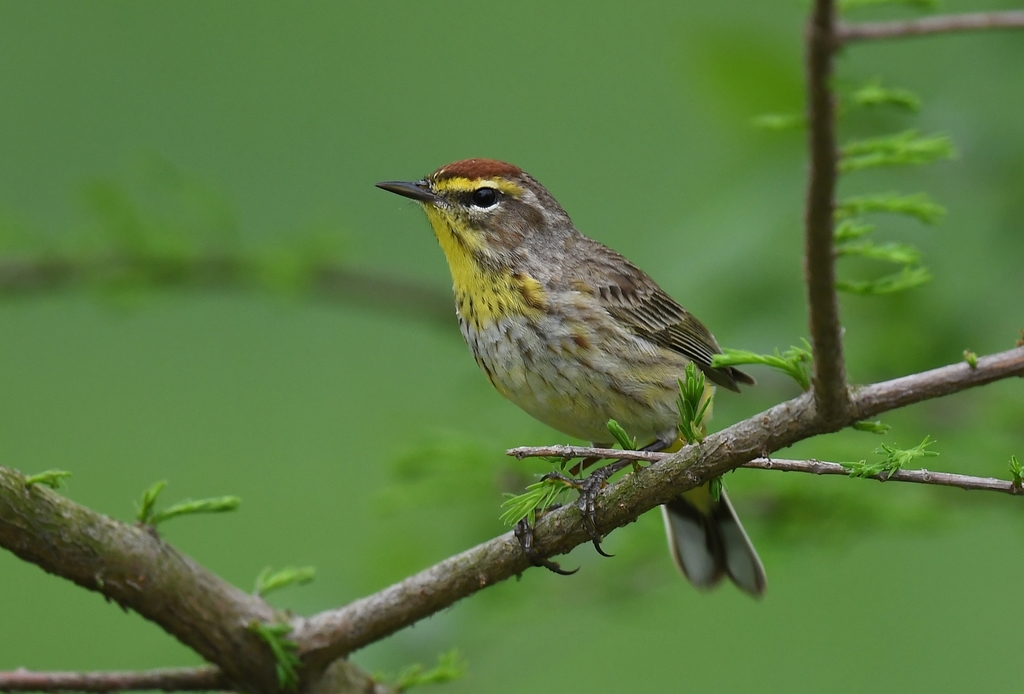
Palm Warbler
Photo © Chrissy McClarren and Andy Reago
Photo © Chrissy McClarren and Andy Reago — CC0 1.0 — Source: iNaturalist photo #190780240Identification
The palm warbler is a small songbird measuring 12–14 cm in length with a wingspan of 20–21 cm and weighing just 8.5–14.2 grams. Two subspecies show distinct plumage differences. The western subspecies (S. p. palmarum), known as the "brown palm warbler," has cold grayish-brown upper parts and much less yellow below with less colorful streaking. The eastern subspecies (S. p. hypochrysea), or "yellow palm warbler," displays brownish-olive upper parts and thoroughly yellow underparts with bold rufous streaking on the breast and flanks. One of the most distinctive and reliable field marks is the bird's constant tail bobbing—a behavior shared only with Kirtland's and prairie warblers among Setophaga species.
Range & Habitat
Palm warblers breed in open coniferous bogs and edges east of the Continental Divide, ranging across Canada and the northeastern United States, with populations also recorded in Saint Pierre and Miquelon. The western subspecies winters on the Atlantic coast from Delaware to Florida, with a few reaching the Gulf coast west to Louisiana, while the eastern subspecies winters from western Florida to Texas along the Gulf coast. During migration and winter, the species is found throughout eastern North America, Central America, and the Caribbean south to Panama. The palm warbler's year-round habitats include shrublands, forests, grasslands, wetlands, and human-modified environments, making it adaptable to various landscape types.
Behaviour & Diet
Unlike most other warblers, palm warblers forage extensively on the ground, occasionally flying to catch insects in mid-air. They feed primarily on insects and berries. The species is renowned for its incessant tail bobbing, an identifying characteristic visible in both perched and ground-foraging birds. Breeding birds construct open-cup nests, typically situated on or near the ground in open areas. The male's song is a monotonous buzzy trill, while the call note is a sharp "chek."
Best Time & Places to See It
Palm warblers are notable for being among the earliest spring migrants, often returning to their breeding grounds almost two months before most other warbler species. They are exceptionally hardy winter residents compared to other warblers—the winter range includes much of the Atlantic coast of North America, extending as far north as southern Nova Scotia. This makes them regular sightings in Massachusetts throughout winter, with consistent observations documented in Nova Scotia since 1958. For reliable viewing, visit breeding habitats in Canada and the northeastern United States during spring and summer, or search coastal areas and Gulf regions during fall and winter months.
Photography Tips
The palm warbler's constant tail-bobbing behavior provides excellent photographic opportunities, as the distinctive motion makes the bird easier to track and identify in the field. Ground-foraging behavior offers chances for low-angle shots that can capture the bird's interactions with its habitat. Early spring migrants appearing in open areas can be photographed against clear backgrounds. The plumage differences between subspecies make comparative photography rewarding—capture both the duller western form and the vibrant yellow eastern form when possible. Overcast days are ideal for photographing the more subdued coloration of the western subspecies, while bright conditions enhance the yellow tones of the eastern bird.
Acadia National Park
Alaska Maritime National Wildlife Refuge
Algonquin Provincial Park
Arenal Volcano National Park
Arrecifes de Cozumel National Park
Badlands National Park
Banff National Park
Barra del Colorado National Wildlife Refuge
Bic National Park
Nothing matches these filters.
No community photos yet. Log in to add the first one.
No community observations of this species yet.