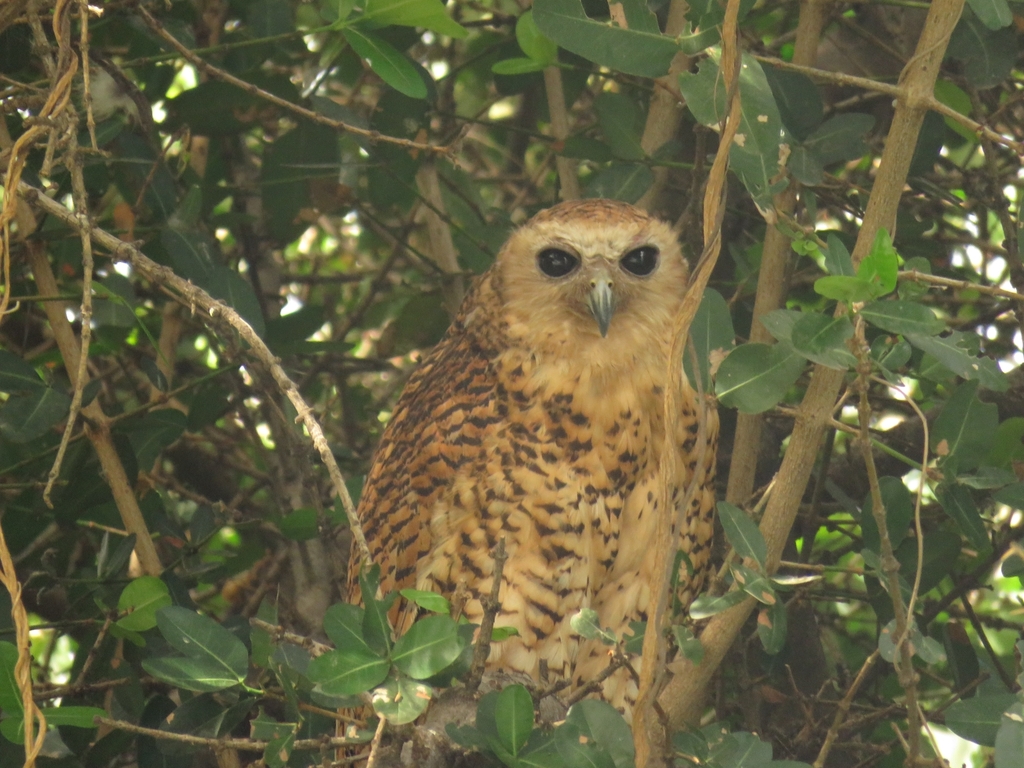
Pel’s Fishing Owl
Photo © Christiaan Viljoen
Photo © Christiaan Viljoen — CC BY 4.0 — Source: iNaturalist #35924299Identification
Pel's fishing owl is one of the world's largest owl species, ranking fifth-heaviest among all owls. It measures 51–63 cm in length with a wingspan around 153 cm and weighs up to 2.35 kg. This imposing raptor is unmistakably adapted for aquatic hunting: its toes and tarsi are largely unfeathered and straw-colored, minimizing water absorption, while its feet feature spiky scales that grip slippery prey—a feature more typical of diurnal fishing raptors. Adults display rich ginger-rufous plumage with dense dark barring on the upperparts and scaling below. The head appears distinctly shaggy due to long, loose feathers, and the dark, often blackish eyes are striking. Unlike eagle-owls, ear tufts are barely visible, creating a very round-headed silhouette. Females are generally less rufous and have a more indistinct facial disc. Juveniles are more uniformly buff than adults.
Range & Habitat
Pel's fishing owl is found throughout much of sub-Saharan Africa, though it is generally local and uncommon. Its patchily distributed range includes Nigeria, Senegal, the Gambia, Guinea, Sierra Leone, and central Africa from the coast to eastern Zaire and discontinuously to South Sudan, Somalia, Kenya, and Tanzania, extending southward to Zambia, Zimbabwe, Botswana, and eastern South Africa. The species is absent from drier regions.
This owl favours riverine forests with large, overhanging trees and can be found in swamps, estuaries, and on islands within larger water bodies, from sea level up to around 1,700 m elevation. It prefers slow-moving rivers and lakes where large, old trees provide suitable roosting and foraging sites. Most populations are largely residential with no seasonal movement, though young, nonbreeding birds may wander before establishing territories.
Behaviour & Diet
Pel's fishing owl is predominantly nocturnal and most vocally active on moonlit nights, especially near dawn, though it may hunt during the day when prey is scarce. During daylight, it roosts on large tree branches, often alongside its mate. At dusk, it relocates to perches extending over the water to hunt. The male produces a distinctive deep, sonorous, horn-like boom followed by a higher-pitched huhuhu, and also utters a ringed hoot followed by a deep, soft grunt. These calls can be heard from up to 3 km away and are repeated every 10 to 20 seconds. The female's vocalizations are similar but higher-pitched.
Fish form the primary diet, with this species taking fish weighing 100–200 g typically, though capable of handling fish up to 2 kg. Unlike some related fishing owls, Pel's fishing owl is highly specialized and rarely varies from fish, though it occasionally takes frogs, crabs, mussels, and large insects. It nests in hollows and tree forks; despite laying two eggs, typically only one chick is raised.
Best Time & Places to See It
Pel's fishing owl is most active and vocal on moonlit nights, particularly near dawn, making these optimal times for observation and listening. The species is nocturnal, so night-time excursions along riverine forests and swamp margins offer the best chances of encounter. Look for this owl perched on branches or stumps extending over slow-moving rivers, lakes, and swamp water. Its large size and preference for prominent perches near water increase the likelihood of sightings compared to smaller, more cryptic owl species. Patient observation along suitable river systems throughout its sub-Saharan range, avoiding drier regions, provides the most rewarding opportunities.
Photography Tips
Photographing Pel's fishing owl demands nocturnal fieldwork and patience. Its impressive size and distinctive silhouette—round-headed with a shaggy appearance—make it recognizable in low-light conditions. Position yourself along riverbanks or lakeshores where the owl perches over water at dusk and through the night. Moonlit nights offer better lighting than completely dark conditions while still respecting the bird's nocturnal activity. Use a high-ISO capable camera and a powerful headlamp or spotlight to locate perched birds without excessive disturbance. The contrast between its rich ginger-rufous plumage and dark barring, combined with its large, distinctive dark eyes, makes for striking images even in challenging light. Early morning hours, when the owl is most vocally active, may provide extended shooting opportunities before it returns to daytime roosts.
Mapungubwe National Park
Musina Local Municipality, South Africa
+358 birds+29 mammals
Where the Limpopo River cuts through sandstone ridges at the convergence of South Africa, Botswana, and Zimbabwe, Mapungubwe National Park preserves a landscape of profound ecological…
VIEW NATIONAL PARKChobe National Park
Botswana
+446 birds+45 mammals
Where the Chobe River cuts a sinuous path through northern Botswana, the landscape transforms into one of Africa's most dynamic wetland-savanna mosaics. This national park encompasses…
VIEW NATIONAL PARKMurchison Falls National Park
Uganda
+608 birds+33 mammals
Where the Victoria Nile compresses through a narrow gorge and explodes across a 45-meter precipice, the landscape speaks in thunder. Murchison Falls National Park sprawls across…
VIEW NATIONAL PARKKruger National Park
Ba-Phalaborwa Local Municipality, South Africa
+540 birds+91 mammals
Across the low-lying savanna of northeastern South Africa unfolds one of Africa's largest and most ecologically intact protected areas, where acacia woodlands merge into mopane scrub…
VIEW NATIONAL PARKBwabwata National Park
Namibia
+377 birds+35 mammals
Where the Kavango River winds through northeastern Namibia, vast floodplains and dense riparian woodland create one of southern Africa's most ecologically dynamic protected landscapes. Spanning 14,249…
VIEW NATIONAL PARKMeru National Park
Igembe Central, Kenya
+408 birds+38 mammals
Granite outcrops and acacia woodland rise across the northern reaches of Meru, where semi-arid savanna transitions into drier scrubland under the fierce equatorial sun. The park's…
VIEW NATIONAL PARKNo community photos yet. Log in to add the first one.
No community observations of this species yet.