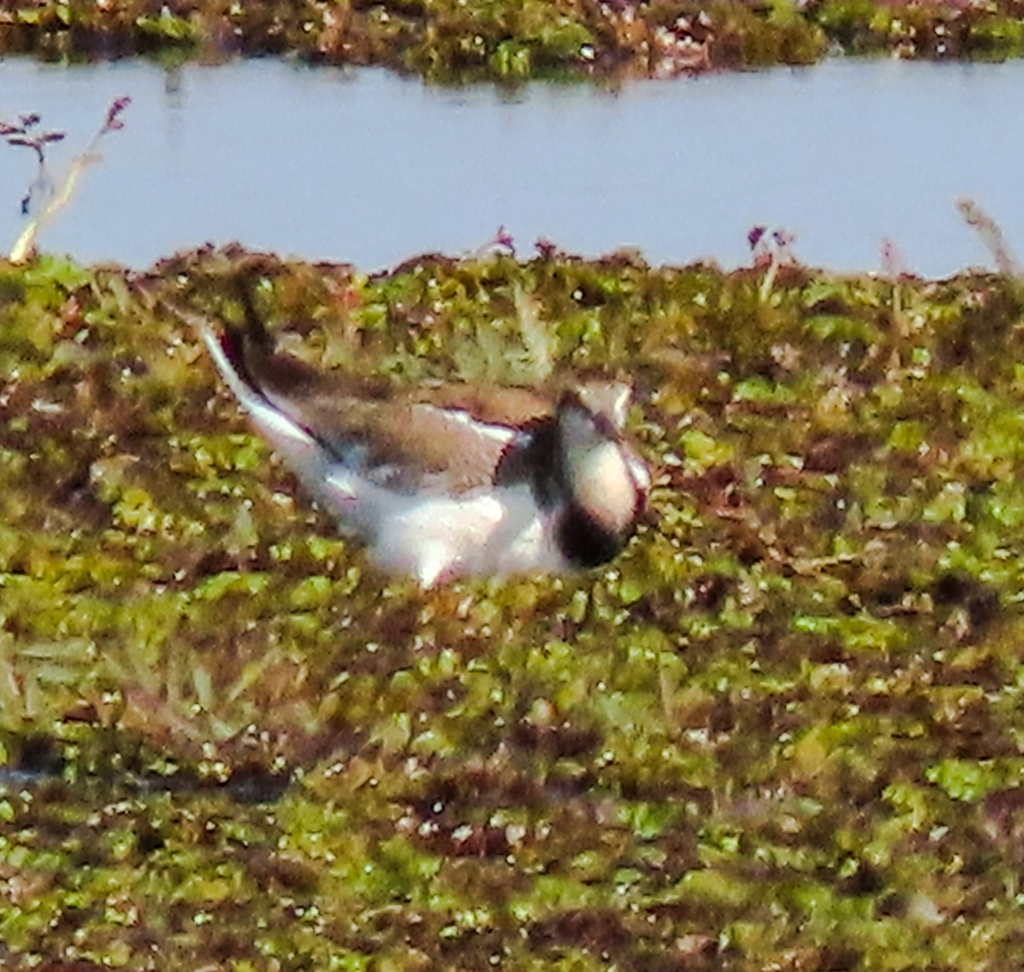
Pheasant-tailed Jacana
Photo © Sevin Dee
Photo © Sevin Dee — CC BY 4.0 — Source: iNaturalist #145099668Identification
The pheasant-tailed jacana is conspicuous and unmistakable, ranking as the longest species in the jacana family when its distinctive tail streamers are included. In breeding plumage, the bird is unmissable: chocolate-brown body with a white face, black crown with white neck stripes, silky golden-yellow nape, and predominantly white wings edged in black. The elongated central tail feathers are responsible for the bird's evocative name. In non-breeding plumage, the transformation is dramatic—the head and back become dark brown, the golden nape fades to a mere trace, and a dark eyestripe forms an inconspicuous necklace across the white breast. Young birds display brown upper parts with a broken necklace marking. Both sexes possess sharp white carpal spurs, noticeably longer in females. The slender bluish-black bill with a yellow tip in breeding season becomes dull brown with a yellowish base when not breeding.
Range & Habitat
This remarkable jacana is found across tropical Asia from Yemen in the west to the Philippines in the east, inhabiting small to large lakes with abundant floating vegetation. The species is a resident breeder throughout much of tropical India, Southeast Asia, and Indonesia, overlapping considerably with the bronze-winged jacana but uniquely extending its range to Sri Lanka. However, northern populations breeding in south China and the Himalayas undertake impressive long-distance migrations—the only jacanas known to do so—moving south to Southeast Asia and peninsular India for winter. In Nanking, birds depart in November and return in the third week of April. The species generally prefers lower elevations but climbs remarkably high in summer, with records from altitudes reaching 3,650 metres in Kashmir and 3,800 metres in Lahul.
Behaviour & Diet
The pheasant-tailed jacana forages by swimming or walking on floating aquatic vegetation, using its famously elongated toes and nails—adaptations shared with all jacanas—to traverse shallow water with remarkable grace. The species feeds primarily on invertebrate prey found in these aquatic environments. A striking aspect of their biology is their unusual breeding system: females are notably larger than males and are polyandrous, laying several clutches that are each raised by different males within their harem. This unconventional reproductive strategy sets them apart within the jacana family.
Best Time & Places to See It
For viewing pheasant-tailed jacanas, timing depends on your location. Resident populations in Sri Lanka, peninsular India, Southeast Asia, and Indonesia can be encountered year-round in suitable habitat. However, northern populations show marked seasonality: breeding season in south China and the Himalayas occurs in summer months, with birds present from April through October, before they depart for winter grounds. The species tends to favour lower elevations for accessibility, though patient observers may find them at higher altitudes during summer breeding season.
Photography Tips
The pheasant-tailed jacana's dramatic seasonal plumage changes offer photographers two completely different subjects in the same species. Breeding birds with their elongated tail streamers and striking white wings against chocolate bodies present spectacular opportunities, particularly when captured in flight showing the distinctive black-edged white wing pattern. Non-breeding birds, though subtler, offer equally rewarding challenges with their elegant, understated brown and white coloration. Position yourself quietly near floating vegetation where these birds forage, and watch for their swimming or walking behaviour on aquatic plants. The sharp white carpal spurs and long toes are distinctive details worth capturing, and the slender bill's colour shift between seasons provides an additional identification feature to document.
Lunugamvehera National Park
Sri Lanka
+204 birds+14 mammals
Dry scrubland and shallow wetlands converge in Sri Lanka's southeastern lowlands, where Lunugamvehera National Park anchors one of the island's most ecologically vital landscapes. The park's…
VIEW NATIONAL PARKMinneriya National Park
Sri Lanka
+158 birds+9 mammals
Across the dry zone of Sri Lanka's North Central Province spreads a landscape of shallow tanks, grassland margins, and scattered dry forest—a mosaic of water and…
VIEW NATIONAL PARKWasgamuwa National Park
Sri Lanka
+156 birds+8 mammals
Dry deciduous forest and open grassland sweep across the North Central lowlands where Wasgamuwa National Park protects one of Sri Lanka's largest remaining tracts of this…
VIEW NATIONAL PARKOrang National Park
Rangagarapathar, India
+298 birds+1 mammals
Where the Brahmaputra's floodplains meet the foothills of Assam, Orang National Park unfolds across a mosaic of riverine grasslands, forests and wetlands that pulse with the…
VIEW NATIONAL PARKRanthambhore National Park
Sawai Madhopur, India
+294 birds+20 mammals
Granite ridges and ravines carved through the Aravalli Range frame this protected landscape in eastern Rajasthan, where deciduous forest mingles with open scrubland and seasonal water…
VIEW NATIONAL PARKKhao Yai National Park
Prachantakham District, Thailand
+377 birds+46 mammals
Evergreen dipterocarp forest blankets the rolling terrain of this national park in eastern Thailand, where limestone hills rise abruptly from the forest floor and seasonal streams…
VIEW NATIONAL PARKKanha Tiger Reserve
Kanha Kisli F.V., India
+321 birds+23 mammals
Where sal forests give way to emerald meadows and crystalline streams carve through ancient valleys, one of India's finest wilderness reserves unfolds across the Maikal Range.…
VIEW NATIONAL PARKTadoba National Park
Palasgaon Singru, India
+270 birds+20 mammals
Where sal forests meet open grasslands and rocky outcrops rise from red laterite soil, central India's landscape unfolds in raw, untamed beauty. Ancient teak woodlands and…
VIEW NATIONAL PARKBandhavgarh National Park
Garhpuri, India
+285 birds+17 mammals
Where granite ridges rise dramatically above sal and bamboo forests, one of India's most pristine tiger reserves unfolds across the Vindhyan plateau. Ancient rock formations tower…
VIEW NATIONAL PARKPanna National Park
Badgadi Kalan, India
+271 birds+17 mammals
Where granite gorges slice through central India's Vindhyan plateau, a landscape of stark beauty unfolds across nearly six hundred square kilometers. The Ken River carves through…
VIEW NATIONAL PARKKaziranga National Park
Kohora, India
+422 birds+26 mammals
Dawn breaks over the floodplains of the Brahmaputra, where tall grasslands stretch endlessly beneath monsoon-heavy skies. This sprawling wilderness of northeastern Assam is a mosaic of…
VIEW NATIONAL PARKKeoladeo National Park
Shreenagar Rural, India
+326 birds+14 mammals
Where shallow wetlands shimmer beneath vast Rajasthani skies, one of Asia's finest bird sanctuaries pulses with extraordinary life. This former maharaja's hunting reserve, now spanning 29…
VIEW NATIONAL PARKBandipur National Park
Hirehalli, India
+302 birds+19 mammals
Where the Western Ghats descend into the Deccan plateau, ancient deciduous forests blanket a landscape carved by the Nugu River. Bandipur unfolds across 880 square kilometres…
VIEW NATIONAL PARKNagarahole Tiger Reserve
Nalkeri Forest, India
+323 birds+23 mammals
Where granite escarpments rise above dense deciduous forests and the Kabini River carves through pristine wilderness, one of India's most biodiverse landscapes unfolds across the Western…
VIEW NATIONAL PARKGir National Park
Asundrali, India
+258 birds+13 mammals
Dry deciduous forests cloak the rolling hills of western Gujarat where the Gir landscape rises as a final sanctuary for one of the world's rarest felids:…
VIEW NATIONAL PARKPoyang Lake National Nature Reserve
Shangrao, China
+270 birds+7 mammals
Where the Yangtze River's massive floodplain spreads across central China, Poyang Lake National Nature Reserve encompasses one of the continent's most dynamic and water-rich wetland systems.…
VIEW NATURE RESERVENo community photos yet. Log in to add the first one.
No community observations of this species yet.