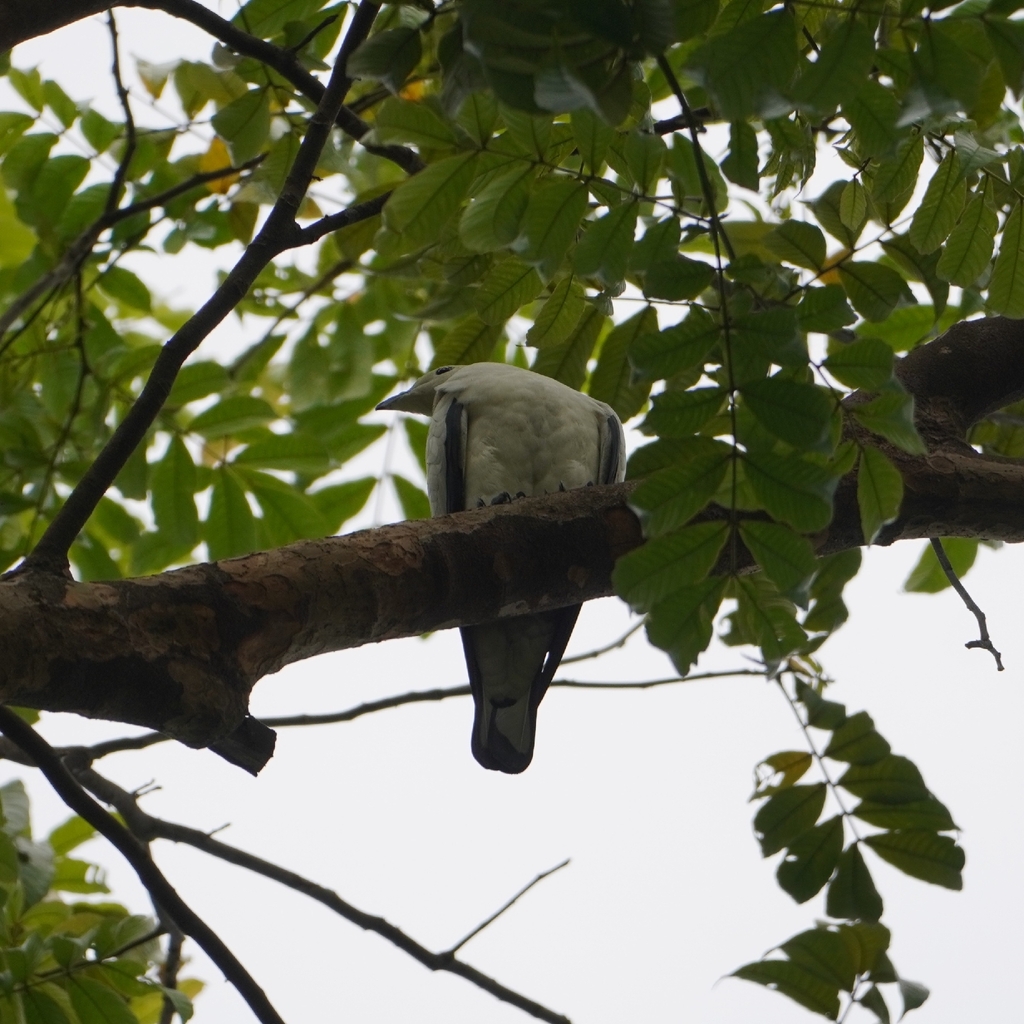
Pied Imperial Pigeon
Photo © Ben Costamagna
Photo © Ben Costamagna — CC BY 4.0 — Source: iNaturalist #330313873Identification
The Pied Imperial Pigeon is a relatively large pigeon with distinctive pied (black and white) plumage. The nominate subspecies can be identified by its plain white thighs and undertail coverts, often with only a dark spot at the very tip. Its bill is narrowly dark-tipped and bluish in colour. These field marks help distinguish it from related imperial pigeon species, which have black-spotted thighs and undertail coverts, or yellowish and greenish bill colouration. Taxonomy within this group remains complex, with some regional populations showing intermediate characteristics.
Range & Habitat
This species is found across Southeast Asia, ranging from Myanmar and Thailand through Indonesia, extending east to the Philippines—where it is known locally as camasu and balud-puti—and reaching the Bird's Head Peninsula in New Guinea. The Pied Imperial Pigeon is mainly found on small islands and in coastal regions, showing a preference for maritime habitats. It inhabits forest, woodland, mangrove, plantations and scrub, making it adaptable to a variety of wooded environments.
Behaviour & Diet
Like other imperial pigeons, this species is primarily frugivorous, feeding on fruits and seeds from forest and woodland vegetation. The bird's relatively large size allows it to exploit food sources unavailable to smaller pigeon species. Beyond these general characteristics, the Pied Imperial Pigeon remains understudied in terms of specific behavioural details, though its presence in diverse wooded habitats suggests it is adaptable in its ecological requirements.
Best Time & Places to See It
The Pied Imperial Pigeon remains locally common throughout its range and is considered of least concern by both BirdLife International and the IUCN. The best opportunities to observe this species lie in coastal regions and small island habitats across Southeast Asia, particularly in Indonesia and the Philippines. Its preference for island and coastal settings, combined with its stable population status, makes it a reliable species for wildlife travellers visiting forested coastal areas and mangrove systems in this region.
Photography Tips
The bold pied plumage of this pigeon provides excellent contrast for photography, particularly in woodland and mangrove settings. The white markings on the thighs and undertail coverts are key identifying features worth capturing. Early morning light in coastal forests and mangrove habitats will best reveal the bird's distinctive plumage patterns and bluish bill. Since the species frequents fruiting trees, observing feeding behaviour in plantations and woodland can provide rewarding photographic opportunities of natural behaviour.
Mu Ko Ang Thong National Park
Thailand
+47 birds+1 mammals
Forty-two limestone islands rise from the Gulf of Thailand, their weathered karst peaks piercing emerald waters in a landscape of stunning geological drama. Mu Ko Ang…
VIEW NATIONAL PARKHat Noppharat Thara-Mu Ko Phi Phi National Park
Ao Nang, Thailand
+253 birds+9 mammals
Where limestone karsts rise dramatically from turquoise waters, Hat Noppharat Thara-Mu Ko Phi Phi National Park unfolds across a mosaic of beach, mangrove forest, and island…
VIEW NATIONAL PARKMu Ko Similan National Park
Lam Kaen, Thailand
+82 birds+1 mammals
Granite islands rise from the Andaman Sea in a scattered archipelago where limestone cliffs meet turquoise shallows, their steep faces weathered into caves and overhangs that…
VIEW NATIONAL PARKKhao Laem Ya-Mu Ko Samet National Park
Mueang Rayong District, Thailand
+159 birds+3 mammals
Where limestone hills meet the Gulf of Thailand, Khao Laem Ya–Mu Ko Samet National Park stitches together a mosaic of terrestrial and marine worlds that few…
VIEW NATIONAL PARKKuching Wetlands National Park
Kuching, Malaysia
+103 birds+4 mammals
Where brackish waters meet mangrove stilts and freshwater swamps blend into coastal mudflats, one of Southeast Asia's most dynamic wetland ecosystems unfolds across Sarawak's northwestern coast.…
VIEW NATIONAL PARKTaman Negara National Park
Kampong Samas, Malaysia
+393 birds+48 mammals
Where ancient rainforest meets limestone peaks, one of Southeast Asia's oldest protected wilderness preserves sprawls across 4,343 square kilometers of primordial landscape. Dipterocarp giants tower overhead,…
VIEW NATIONAL PARKTaman Nasional Baluran
Situbondo, Indonesia
+189 birds+9 mammals
Across the northeastern tip of East Java, where monsoon winds sweep down from the Bali Strait, a landscape of contrasts unfolds within 374 square kilometres of…
VIEW NATIONAL PARKWest Bali National Park
Gerokgak, Indonesia
+240 birds+8 mammals
Across West Bali's northwestern reaches, where the Indian Ocean meets volcanic slopes and limestone cliffs plunge toward turquoise shallows, sprawls a protected realm of roughly 325…
VIEW NATIONAL PARKAketajawe Lolobata National Park
Oba Tengah, Indonesia
+123 birds+2 mammals
Across the northeastern arm of Halmahera, where the Wallace Line once marked the boundary between Asian and Australasian fauna, lies a sprawling wilderness of over 13,800…
VIEW NATIONAL PARKManusela National Park
Maluku Tengah, Indonesia
+112 birds+3 mammals
Across the Maluku Tengah district of Indonesia's eastern archipelago, a sprawling expanse of 4,175 square kilometers of largely intact tropical forest rises from coastal lowlands toward…
VIEW NATIONAL PARKBogani Nani Wartabone National Park
Bolaang Mongondow, Indonesia
+154 birds+4 mammals
Across North Sulawesi's rugged interior, where tectonic uplift has carved steep ridges and deep valleys through ancient volcanic terrain, Bogani Nani Wartabone National Park sprawls across…
VIEW NATIONAL PARKKomodo National Park
Komodo, Indonesia
+155 birds+14 mammals
Where volcanic peaks rise dramatically from turquoise waters, a primordial landscape unfolds across three main islands and countless smaller ones scattered throughout the Lesser Sunda archipelago.…
VIEW NATIONAL PARKNo community photos yet. Log in to add the first one.
No community observations of this species yet.