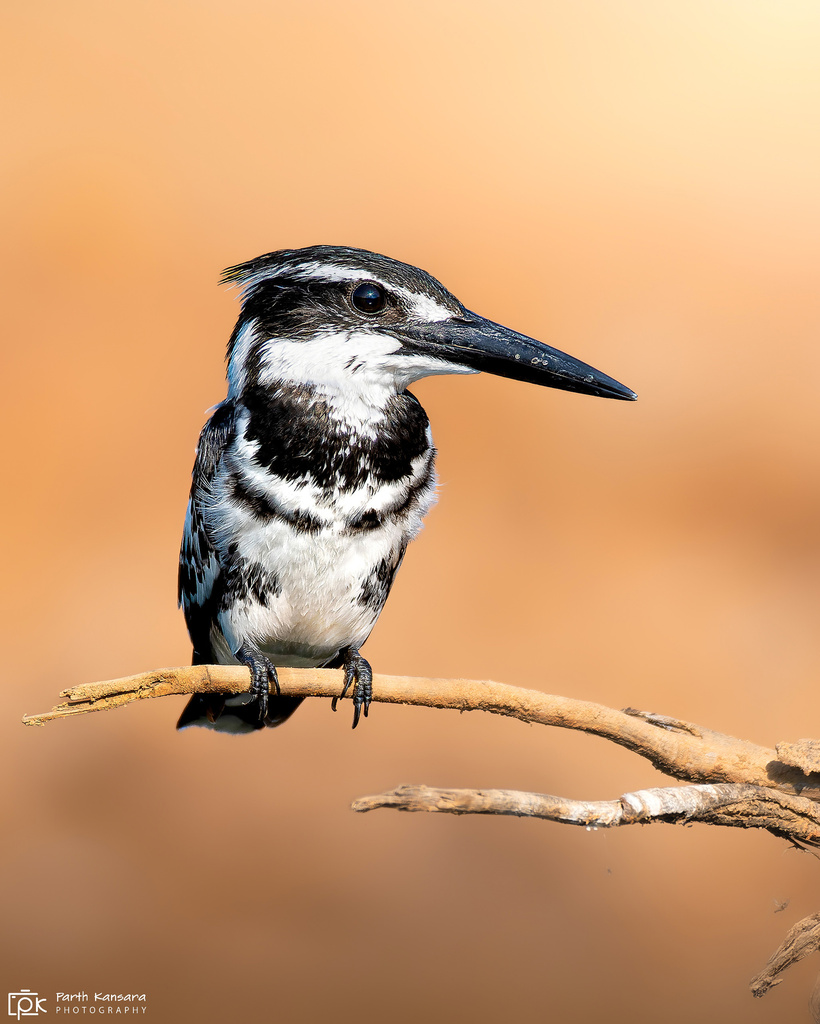
Pied Kingfisher
Photo © Parth Kansara
Photo © Parth Kansara — CC BY 4.0 — Source: iNaturalist photo #327195847Identification
The pied kingfisher is a medium-sized kingfisher, about 25 cm long, instantly recognizable by its striking black and white plumage. It features a white face with a distinctive black mask, a white supercilium (eyebrow stripe), and black barring across its upperparts. The bird sports a neat crest and characteristic breast bands that differ between the sexes: males display a narrow double band across the breast, while females have a single broken band. This bold patterning, combined with its habit of hovering conspicuously over water, makes it one of the most distinctive kingfishers across its range.
Range & Habitat
The pied kingfisher is widely distributed across Africa and Asia, from Turkey and the Middle East through India and China. It is common throughout sub-Saharan Africa and southern Asia, with five recognized subspecies adapted to different regions. The birds are resident throughout most of their range, with only short-distance seasonal movements rather than true migration. In India, the species occupies the plains but is replaced in the higher Himalayan hills by the crested kingfisher.
One of the three most numerous kingfisher species in the world, the pied kingfisher is estimated to be abundant wherever suitable freshwater habitat exists. It is a notably noisy bird, making it difficult to overlook in the field.
Behaviour & Diet
The pied kingfisher feeds primarily on fish but will also take crustaceans and large aquatic insects such as dragonfly larvae. Its hunting technique is distinctive: it hovers over clear water to locate prey, then dives vertically bill-first to capture fish. Remarkably, it can consume prey without returning to a perch, manipulating and swallowing prey in flight—an adaptation that allows it to hunt over large water bodies and estuaries lacking the perches other kingfishers require. When not hunting, the bird flies rapidly and has been observed reaching speeds approaching 50 km/h.
Unlike many kingfishers, the pied kingfisher is quite gregarious and forms large communal roosts at night. When perched, it characteristically bobs its head up and down and will flick its tail downwards. The bird calls frequently with sharp chirruk chirruk notes, making it an audible as well as visual presence.
Best Time & Places to See It
The pied kingfisher is common and widespread throughout its African and Asian range, particularly in lowland regions with clear freshwater lakes and rivers. Its abundant population and vocal, active nature make it relatively easy to encounter. In India, the breeding season runs from February to April, a period when birds are particularly active and visible as they establish territories and tend nests.
Photography Tips
Photographing the pied kingfisher presents excellent opportunities due to its conspicuous behavior and striking plumage. The bird's hovering technique offers moments of relative stillness before its dramatic vertical dive—a rewarding action sequence to capture. Look for birds over clear water in good light, where their black and white patterning will be most striking. The bird's head-bobbing and tail-flicking behavior when perched provides additional photographic opportunities. Its gregarious nature and use of prominent perches make it more accessible than many kingfisher species, especially near communal roost sites during evening hours.

Chambal River Safari
Nothing matches these filters.
Nothing matches these filters.
Queen Elizabeth National Park
Bwindi Impenetrable National Park
Kanha Tiger Reserve
Lake Mburo National Park
Mabamba Swamp
Minneriya National Park
Murchison Falls National Park
Aberdare National Park
Abijata-Shalla Lakes National Park
Nothing matches these filters.
No community photos yet. Log in to add the first one.