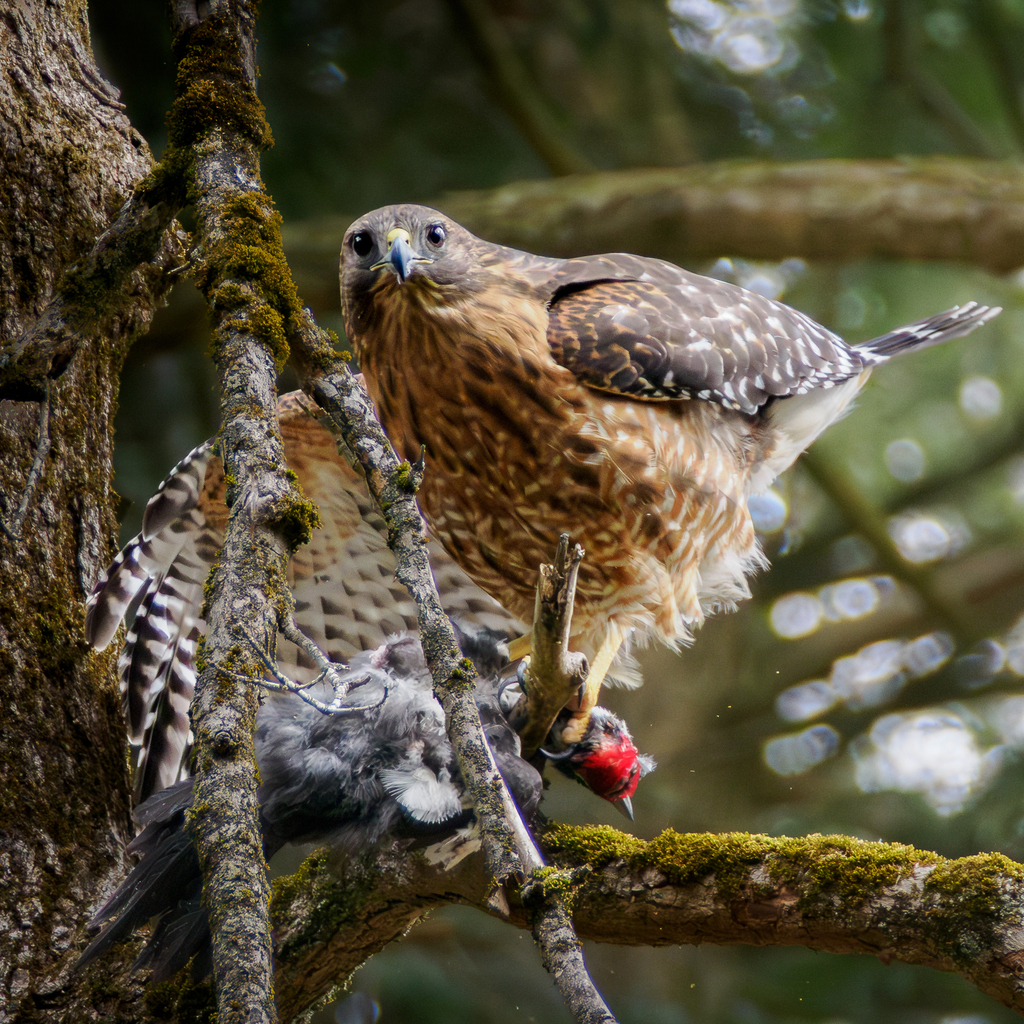
Pileated Woodpecker
Photo © Michael
Photo © Michael — CC BY 4.0 — Source: iNaturalist #341031755Identification
The pileated woodpecker is a large, crow-sized bird and the largest confirmed extant woodpecker species in North America. Its most distinctive features are a prominent red crest, a white neck stripe running down the sides of the throat, and a mostly black body. Adult males display a red line extending from the bill to the throat, while females have black markings in this same area. In flight, white wing feathers become visible. Adults measure 40 to 49 centimetres in length with a wingspan of 66 to 75 centimetres, weighing between 225 and 400 grams on average. Two subspecies exist: the northern pileated woodpecker is larger overall with lighter black feathers tinged with brown and gray, while the southern subspecies is smaller with ebony feathers and less white on the wing feathers. Juvenile birds tend to have less curved crests than adults.
Range & Habitat
The pileated woodpecker inhabits deciduous forests throughout eastern North America, the Great Lakes region, the boreal forests of Canada, and parts of the Pacific Coast. The species favours mature forests and heavily wooded parks, particularly mesic habitats containing large, mature hardwood trees. They thrive in large forest tracts but also occupy smaller woodlots provided they contain a scattering of tall trees, known as late-successional forests. After a drastic population decline during the 1700s and 1800s due to habitat loss, pileated woodpeckers have made a notable recovery and now have an increasing population across their range.
Behaviour & Diet
Pileated woodpeckers are primarily insectivores, with carpenter ants and wood-boring beetle larvae forming their staple diet. They are famous for carving large, nearly rectangular holes into trees—a characteristic behaviour used both to extract prey from within the wood and to create nesting cavities. These birds often chip out holes while searching for ant colonies and can lap up ants using their long tongues to reach into crevices. Beyond insects, they also consume fruits, nuts, and berries, including those of poison ivy. While self-assured foragers on vertical tree surfaces, they can appear awkward when feeding on fruits and berries on small branches. They may also forage on or near the ground, particularly around fallen, dead trees rich in insect life.
Best Time & Places to See It
Pileated woodpeckers are year-round residents across their range, making them accessible to observers throughout the year. Look for them in mature deciduous and mixed forests, particularly in large forest tracts with old-growth timber. The Great Lakes region, eastern North America, boreal Canada, and Pacific coastal forests offer excellent opportunities. Listen for their distinctive loud calls and watch for the characteristic rectangular cavities they create in tree trunks, which often indicate an active territory. Early morning hours typically offer the best viewing conditions when birds are most active.
Photography Tips
Photographing pileated woodpeckers requires patience and positioning near mature forest habitat where they forage. The bird's large size and striking red crest provide excellent compositional opportunities, particularly when capturing the white wing feathers during flight. The bird's strong, direct but undulating flight pattern typical of woodpeckers offers dynamic shooting possibilities. Focus on areas with visible tree cavities and fallen wood where birds forage, and maintain distance to avoid disturbing their natural behaviour. The contrast between their black plumage and white neck stripe, combined with the vibrant red crest, translates well to photography in dappled forest light.
Acadia National Park
Alaska Maritime National Wildlife Refuge
Algonquin Provincial Park
Alligator River National Wildlife Refuge
Banff National Park
Bic National Park
Biscayne National Park
Blackwater National Wildlife Refuge
Bombay Hook National Wildlife Refuge
Nothing matches these filters.
No community photos yet. Log in to add the first one.
No community observations of this species yet.