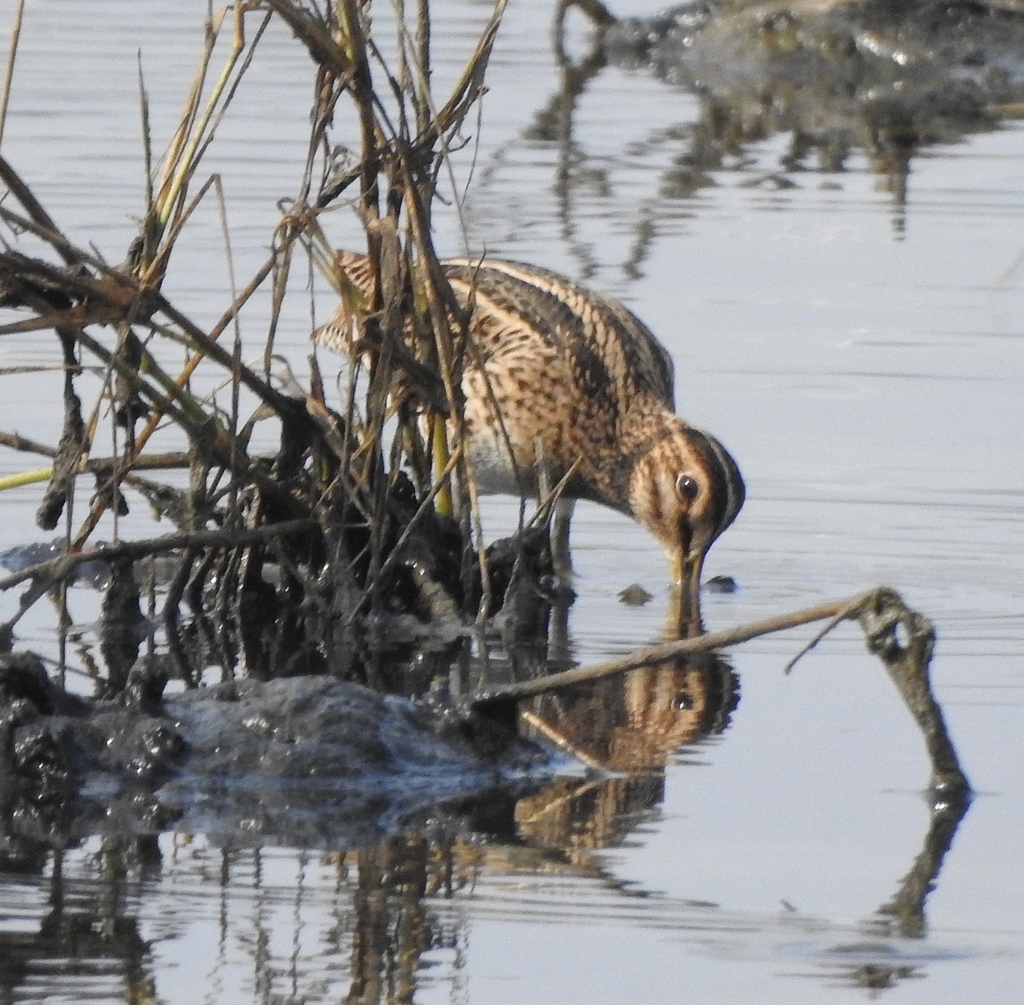
Pin-tailed Snipe
Photo © Afsar Nayakkan
Photo © Afsar Nayakkan — CC BY 4.0 — Source: iNaturalist #152927741Identification
The pin-tailed snipe is a compact wading bird, measuring 25–27 cm in length. It bears a close resemblance to the common snipe but is noticeably shorter-billed and shorter-tailed. Adults display mottled brown upperparts with distinctive cream lines running down the back, contrasting with pale underparts featuring a streaked buff breast and white belly. A dark eye-stripe, bordered by lighter stripes above and below, is a key facial marking. The legs are short and greenish-grey, while the bill is long, straight, and dark.
In flight, the pin-tailed snipe can be distinguished from its common snipe relative by its less pointed wings, which lack the white trailing edge characteristic of common snipe. The shorter tail and notably flatter flight path make separation relatively straightforward for experienced birders. Males produce distinctive vocalizations—a loud, repetitive "tcheka" song with crescendoing fizzes, buzzes, and whistles, plus characteristic whistling sounds created in flight by the pin-like outer tail feathers that inspire the bird's common name. The normal call is a weak squik.
Range & Habitat
This snipe breeds across northern Russia, specifically in damp marshes and tundra of Arctic and boreal regions. It is a long-distance migrant, moving south to spend the non-breeding season throughout southern Asia, with a range extending from Pakistan to Indonesia. It has become the most common migrant snipe across southern India, Sri Lanka, and much of Southeast Asia, making it a familiar sight to birders throughout these regions. The species is occasionally recorded as a vagrant to north-western and northern Australia, and has also appeared in Kenya in East Africa.
Outside the breeding season, pin-tailed snipes exploit a variety of wetland habitats and often associate with common snipes. Notably, they may occupy drier habitats than their common snipe relatives, demonstrating greater habitat flexibility. They nest in well-hidden locations on the ground during the breeding season.
Behaviour & Diet
Pin-tailed snipes are ground feeders that forage in mud and soft soil, either probing deep into substrate or picking up food items by sight. Their diet consists mainly of insects and earthworms, supplemented with some plant material. Males are notably vocal, especially during the breeding season when they often display in groups, producing their characteristic loud songs and flight calls.
Best Time & Places to See It
For travellers and birders, the non-breeding season offers the best opportunities to encounter pin-tailed snipes. Southern India, Sri Lanka, and Southeast Asia are prime locations where this species is common and predictable. The bird's preference for accessible wetland habitats makes it relatively approachable compared to some snipe species, though patience and early morning visits typically yield better sightings.
Photography Tips
Photographing pin-tailed snipes requires attention to subtle plumage details, particularly the cream lines down the back and facial stripe pattern that aid identification. Capture images in flight when possible to document the characteristic flatter flight path and shorter tail relative to common snipes. Early morning light at wetland margins often provides optimal conditions. During the breeding season, listening for the loud "tcheka" song and flight whistles can help locate displaying males in their Russian breeding grounds.
Lunugamvehera National Park
Sri Lanka
+204 birds+14 mammals
Dry scrubland and shallow wetlands converge in Sri Lanka's southeastern lowlands, where Lunugamvehera National Park anchors one of the island's most ecologically vital landscapes. The park's…
VIEW NATIONAL PARKMinneriya National Park
Sri Lanka
+158 birds+9 mammals
Across the dry zone of Sri Lanka's North Central Province spreads a landscape of shallow tanks, grassland margins, and scattered dry forest—a mosaic of water and…
VIEW NATIONAL PARKWasgamuwa National Park
Sri Lanka
+156 birds+8 mammals
Dry deciduous forest and open grassland sweep across the North Central lowlands where Wasgamuwa National Park protects one of Sri Lanka's largest remaining tracts of this…
VIEW NATIONAL PARKRanthambhore National Park
Sawai Madhopur, India
+294 birds+20 mammals
Granite ridges and ravines carved through the Aravalli Range frame this protected landscape in eastern Rajasthan, where deciduous forest mingles with open scrubland and seasonal water…
VIEW NATIONAL PARKHat Noppharat Thara-Mu Ko Phi Phi National Park
Ao Nang, Thailand
+253 birds+9 mammals
Where limestone karsts rise dramatically from turquoise waters, Hat Noppharat Thara-Mu Ko Phi Phi National Park unfolds across a mosaic of beach, mangrove forest, and island…
VIEW NATIONAL PARKKhao Yai National Park
Prachantakham District, Thailand
+377 birds+46 mammals
Evergreen dipterocarp forest blankets the rolling terrain of this national park in eastern Thailand, where limestone hills rise abruptly from the forest floor and seasonal streams…
VIEW NATIONAL PARKSt. Paul Island
Saint Paul, United States
+255 birds+8 mammals
Windswept tundra rolls across this remote Pribilof island, where volcanic basalt cliffs plunge into the Bering Sea and fog rolls in thick enough to erase the…
VIEW PROTECTED LANDSCAPEBaikal National Park
Ольхонский район, Russia
+184 birds+11 mammals
Where the world's deepest freshwater lake meets ancient Siberian taiga, Baikal National Park sprawls across 66,203 square kilometers of one of Earth's most singular ecosystems. The…
VIEW NATIONAL PARKKanha Tiger Reserve
Kanha Kisli F.V., India
+321 birds+23 mammals
Where sal forests give way to emerald meadows and crystalline streams carve through ancient valleys, one of India's finest wilderness reserves unfolds across the Maikal Range.…
VIEW NATIONAL PARKKaziranga National Park
Kohora, India
+422 birds+26 mammals
Dawn breaks over the floodplains of the Brahmaputra, where tall grasslands stretch endlessly beneath monsoon-heavy skies. This sprawling wilderness of northeastern Assam is a mosaic of…
VIEW NATIONAL PARKKeoladeo National Park
Shreenagar Rural, India
+326 birds+14 mammals
Where shallow wetlands shimmer beneath vast Rajasthani skies, one of Asia's finest bird sanctuaries pulses with extraordinary life. This former maharaja's hunting reserve, now spanning 29…
VIEW NATIONAL PARKPeriyar National Park
Mlappara, India
+232 birds+4 mammals
Dawn breaks over mist-shrouded ridges where the Western Ghats tumble toward Kerala's spice-scented lowlands. Here, ancient tropical forests envelope a glittering artificial lake, creating a mosaic…
VIEW NATIONAL PARKPampadum Shola National Park
Vattavada, India
+258 birds+14 mammals
Where misty shola forests cling to the high plateaus of the Nilgiri Mountains, ancient evergreen remnants create a world apart. This 2,316-hectare reserve protects one of…
VIEW NATIONAL PARKBandipur National Park
Hirehalli, India
+302 birds+19 mammals
Where the Western Ghats descend into the Deccan plateau, ancient deciduous forests blanket a landscape carved by the Nugu River. Bandipur unfolds across 880 square kilometres…
VIEW NATIONAL PARKNagarahole Tiger Reserve
Nalkeri Forest, India
+323 birds+23 mammals
Where granite escarpments rise above dense deciduous forests and the Kabini River carves through pristine wilderness, one of India's most biodiverse landscapes unfolds across the Western…
VIEW NATIONAL PARKHustai National Park
Altanbulag, Mongolia
+198 birds+16 mammals
Where the steppe rolls endlessly beneath vast Mongolian skies, Hustai National Park preserves one of Central Asia's most dynamic grassland ecosystems. Rolling hills and open prairie…
VIEW NATIONAL PARKGobi Gurvan Saikhan National Park
Tsagaan Subarga Hural, Mongolia
+183 birds+23 mammals
Where rust-coloured badlands rise from the southern Gobi steppe, the terrain transforms into a landscape of geological drama that few visitors expect to find in Mongolia's…
VIEW NATIONAL PARKKhoridol Saridag National Park
Khatgal, Mongolia
+164 birds+6 mammals
Where granite peaks thrust skyward across Mongolia's remote southeastern reaches, a landscape of raw geological drama unfolds. Deep river gorges carved through ancient stone create a…
VIEW NATIONAL PARKNortheast China Tiger and Leopard National Park
Mu Dan Jiang Shi, China
+202 birds+19 mammals
Across the temperate forests of northeastern China, where winters grip the landscape in subzero silence and summers remain cool and brief, the Mudanjiang region supports a…
VIEW NATIONAL PARKNo community photos yet. Log in to add the first one.
No community observations of this species yet.