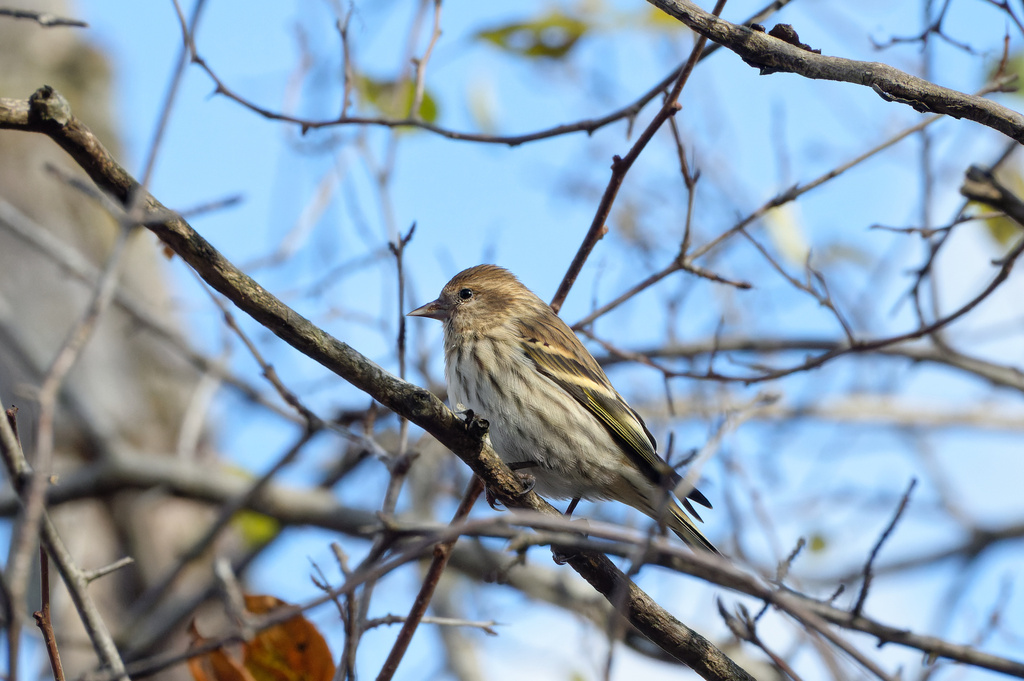
Pine Siskin
Photo © Donald Davesne
Photo © Donald Davesne — CC BY 4.0 — Source: iNaturalist photo #337926019Identification
The pine siskin is a small finch, roughly the same size as an American goldfinch, measuring 11–14 cm in length with a wingspan of 18–22 cm and weighing just 12–18 g. Both sexes display brown upperparts and pale underparts with heavy streaking throughout. They are distinguished by their short, forked tails and notably elongated, slender conical bills—more delicate than those of other co-occurring finches.
A key field mark is the variable yellow patches on the wings and tails, often accompanied by white streaks on the wings. Most pine siskins display a drab plumage, though a small green morph representing about 1% of the population exists. Their combination of heavy streaking, small size, slender bills, notched tail, and yellow or whitish wing patches helps separate them from similar finches and sparrows.
Range & Habitat
Pine siskins breed across nearly all of Canada and Alaska, extending southward into the western mountains and northern regions of the United States with variable density. Their migration patterns are highly irregular and irruptive, driven largely by seed crop availability. In some years, large populations move south; in others, few migrate at all, earning them the designation "irruptive winter finches."
The species favors open conifer forests, particularly northern pine forests where they breed. However, they show remarkable habitat flexibility, nesting in ornamental conifers and deciduous trees in suburban parks and cemeteries, and foraging in deciduous forests, thickets, meadows, grasslands, weedy fields, roadsides, and backyard gardens. They are also attracted to salted winter roadsides and readily visit bird feeders.
Behaviour & Diet
Pine siskins are highly social birds, often feeding in mixed flocks with American goldfinches and redpolls, particularly in winter. They forage actively in trees, shrubs, and weeds, searching for their preferred foods: small seeds from thistle, red alder, birch, and spruce. They supplement their diet with young buds from willows, elms, and maples, soft stems and leaves of weeds, and insects.
An adaptation for survival in harsh conditions is their ability to store up to 10% of their body weight in seeds overnight within their crop, providing crucial energy reserves during cold days. They also glean seeds from grass, dandelions, chickweed, sunflowers, and ragweed, and readily visit bird feeders, where they pick at seed fragments and remains.
Best Time & Places to See It
Pine siskins are year-round residents in breeding areas across Canada, Alaska, and the western United States, though winter sightings in any location are unpredictable due to their irruptive migration patterns. Birders hoping to encounter them should focus on conifer forests, particularly during breeding season, and monitor local birding reports for winter irruption events.
Backyard feeders stocked with small seeds—particularly thistle—are reliable attractants where pine siskins are present. Mixed flocks of finches at feeders and in open forest canopies offer the best opportunities for observation and photography, especially during periods when seed crops have failed in their primary range.
Photography Tips
Photograph pine siskins at feeders during feeding activity, when their characteristic behavior and field marks are most visible. Their small size and preference for dense flocking means patience and fast shutter speeds are essential. Capture the yellow wing patches and white wing streaks in good light, as these are crucial identification features.
During breeding season, observe nests well-hidden on horizontal conifer branches from a distance to avoid disturbance. The birds' active foraging in trees and shrubs provides dynamic shooting opportunities. Winter flock scenes with mixed finch species create compelling compositions that showcase the pine siskin's social nature and seasonal abundance variations.
Tombstone Territorial Park
Acadia National Park
Alaska Maritime National Wildlife Refuge
Algonquin Provincial Park
Alligator River National Wildlife Refuge
Arches National Park
Arctic National Wildlife Refuge
Badlands National Park
Banff National Park
Nothing matches these filters.
No community photos yet. Log in to add the first one.
No community observations of this species yet.