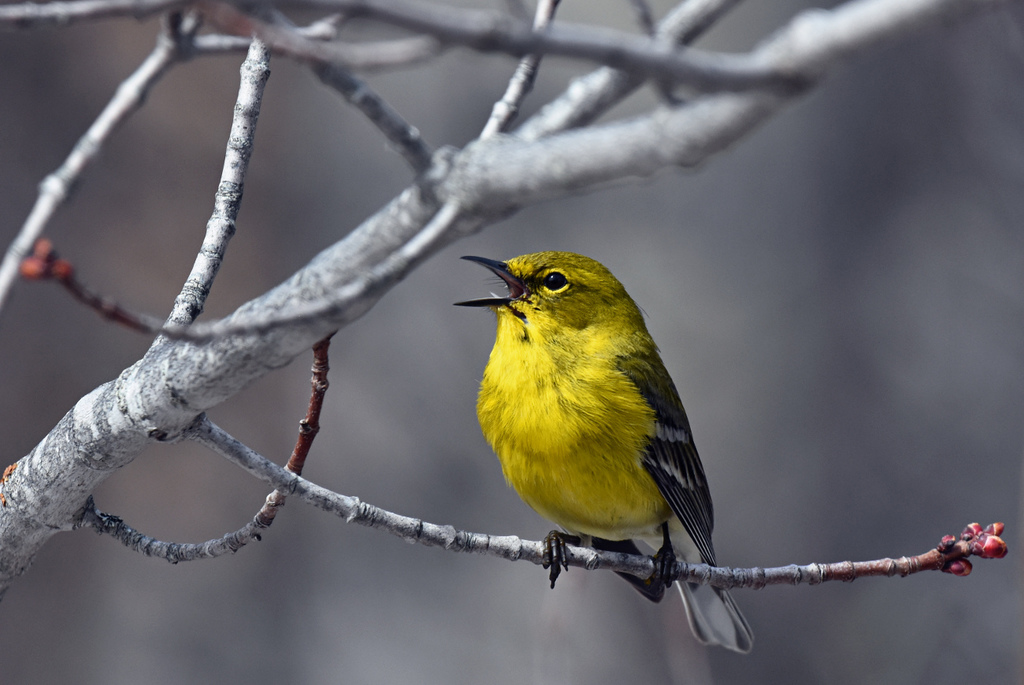
Pine Warbler
Photo © Jimmy Dee
Photo © Jimmy Dee — CC BY-SA 4.0 — Source: iNaturalist photo #35477883Identification
The Pine Warbler is a small songbird with distinctive field marks that aid identification. Males display olive upperparts with bright yellow throats and breasts, while females and immatures show olive-brown upperparts and paler yellow underparts. All birds share white bellies, two white wing bars, dark legs, and thin, relatively long pointed bills. A particularly useful feature is the yellowish 'spectacles' around their eyes. Males may be confused with the Yellow-throated Vireo, requiring careful observation of these subtle differences. The bird's song is a musical trill, and its calls consist of slurred chips.
Range & Habitat
The Pine Warbler breeds in open pine woods of eastern North America, from southeastern Canada through the northeastern United States and into the Southeast. It is a permanent resident in southern Florida, while populations in more northern regions migrate seasonally. Some individuals winter in northeastern Mexico and the Caribbean islands, including Bermuda. The species shows a strong preference for pine forests and wooded areas with suitable nesting habitat.
Behaviour & Diet
Unlike most warblers, Pine Warblers have a notably varied diet that sets them apart from their relatives. They forage deliberately on tree trunks and branches, methodically poking their bills into pine cones to extract food. They also search for sustenance on the ground. Their diet comprises mainly insects, seeds, and berries—the inclusion of seeds being particularly unusual among wood-warblers. Breeding birds construct deep, open-cup nests positioned near the end of tree branches, typically in pine trees. Females lay three to five blotched white eggs per clutch.
Best Time & Places to See It
Birders seeking Pine Warblers should focus on open pine woodlands in the eastern United States. Southern Florida offers year-round opportunities to observe these birds as permanent residents. During breeding season, northeastern and southeastern pine forests are reliable locations. Spring and fall migration periods may offer sightings in transitional areas, though the species' partial migration pattern means some populations remain in place throughout the year.
Photography Tips
The Pine Warbler's slow, deliberate foraging behavior on tree trunks and branches provides excellent photography opportunities. Position yourself to capture the characteristic yellow spectacles and bright yellow throat of males against the olive-green foliage. The bird's methodical pine-cone probing offers dynamic action shots. Early morning light will best reveal the subtle differences between males and females, particularly the olive versus olive-brown tones of their upperparts. Patience is rewarded, as these birds forage predictably within their territories.
Acadia National Park
Algonquin Provincial Park
Alligator River National Wildlife Refuge
Bic National Park
Big Bend National Park
Biscayne National Park
Blackwater National Wildlife Refuge
Bombay Hook National Wildlife Refuge
Cape May Point State Park
Nothing matches these filters.
No community photos yet. Log in to add the first one.
No community observations of this species yet.