Pink-footed Shearwater
Photo © Christoph Moning
Photo © Christoph Moning — CC BY 4.0 — Source: iNaturalist photo #384397565Identification
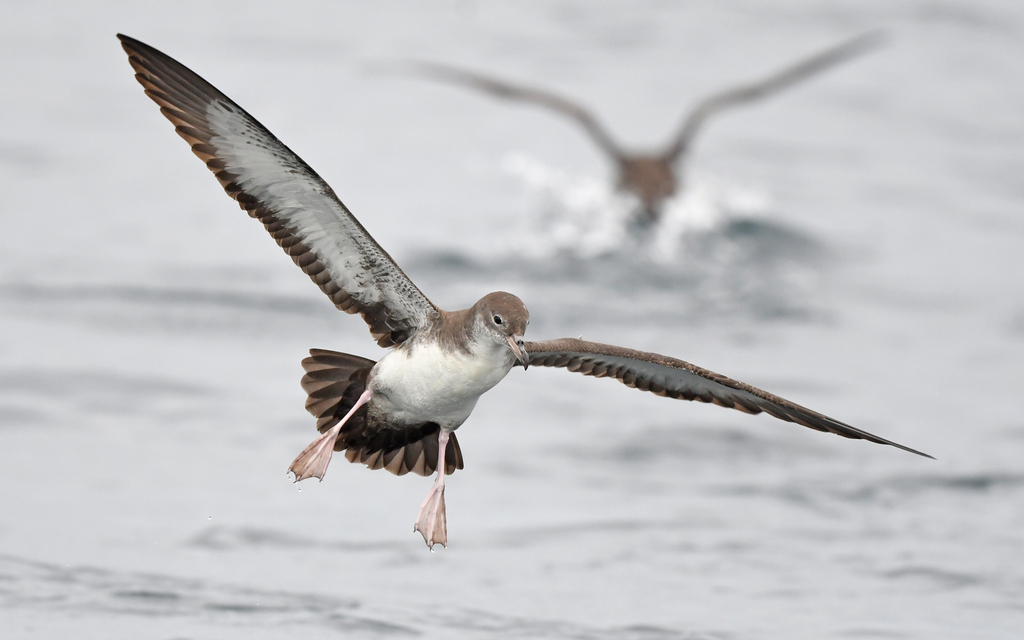
The pink-footed shearwater is a large seabird measuring 48 cm in length with a wingspan of 109 cm. It has distinctive sooty-brown upperparts contrasting with white underparts, and most notably, a pale pink bill with a dark tip and pink legs. The species is polymorphic, occurring in both darker- and lighter-phase populations. Its plumage is characteristically dull with little colour variation, which helps distinguish it from similar species such as the black-vented shearwater. Male pink-footed shearwaters are on average larger than females, though morphological features such as bill size, tail length, and body size can also vary between breeding colonies, likely reflecting adaptations to local environmental conditions and food availability.
Range & Habitat
The pink-footed shearwater is a pelagic species found throughout the Pacific Ocean. It predominantly nests on offshore islands off Chile, notably on Mocha Island, where it breeds in burrows on forested slopes as a colonial nester. After raising its young, the species undertakes a remarkable transequatorial migration, moving toward subarctic waters of the Pacific. During the warmer months of the year, it is fairly common well off the West Coast of the United States, making it accessible to observers in North American waters during this period.
Behaviour & Diet
Pink-footed shearwaters are colonial nesters that breed in burrows on forested slopes. They are not particularly vocal birds but may produce a distinctive horse-like whinny when feeding. The species is an impressive long-distance migrant, traveling vast distances between its Southern Hemisphere breeding grounds and subarctic feeding areas. Their diet consists mainly of fish, squid, and crustaceans, which they pursue while at sea. The species is closely related to the flesh-footed shearwater, with which it forms a superspecies group, though recent genetic studies have found very little difference between the two taxa.
Best Time & Places to See It
The best opportunity to observe pink-footed shearwaters for most nature travellers and photographers is along the West Coast of the United States during the warmer months, when the species is fairly common in offshore waters following its transequatorial migration from Chilean breeding grounds. Those visiting Chile itself may encounter the species near its breeding colonies on offshore islands such as Mocha Island, though access to these remote sites may be limited. The species' long-distance pelagic habits mean that dedicated seabird watching trips offshore offer the most reliable viewing opportunities.
Photography Tips
Photographing pink-footed shearwaters presents the typical challenges of seabird photography at sea. Their characteristic pale pink bill with dark tip and pink legs are diagnostic field marks worth capturing in clear detail to aid identification and distinguish them from similar shearwater species. The contrast between sooty-brown upperparts and white underparts provides good compositional potential when birds are visible in flight or resting on the water. Given that these are pelagic birds found well offshore, successful photography will require boat-based seabird watching trips, where stable positioning and patience are essential for obtaining quality images of these dynamic ocean dwellers.
Chile: Fuegian Snipe & Juan Fernandez
Redwood National Park
Humboldt County, United States
+343 birds+43 mammals
Where the Pacific fog rolls deep into northern California's coastal valleys, some of the tallest trees on Earth rise from a landscape shaped by tectonic forces…
VIEW NATIONAL PARKOlympic National Park
Jefferson County, United States
+263 birds+35 mammals
Where temperate rainforest meets alpine wilderness, Olympic National Park sprawls across nearly 11,000 square kilometers of the Pacific Northwest's most pristine landscape. The park's three distinct…
VIEW NATIONAL PARKParque Nacional de Galápagos
Santo Tomás, Ecuador
+139 birds+23 mammals
Volcanic peaks and weathered lava fields dominate this remote archipelago in the Pacific, where the interplay of cold ocean currents and tropical latitude creates an ecological…
VIEW ISLAND & ARCHIPELAGOCoiba National Park
Montijo, Panama
+260 birds+10 mammals
An archipelago of volcanic and sedimentary islands rises from the Pacific waters off Panama's southwestern coast, its densest rainforest canopy unbroken for millennia. Coiba National Park…
VIEW NATIONAL PARKChiloé National Park
Dalcahue, Chile
+122 birds+6 mammals
Temperate rainforest cloaks the Chiloé archipelago's northwestern reaches, where granite ridges thrust through dense, moisture-laden canopy and freshwater streams carve ravines toward the Pacific. Across approximately…
VIEW NATIONAL PARKPan de Azúcar National Park
Chañaral, Chile
+74 birds+4 mammals
Where the Atacama Desert plunges toward the Pacific, Pan de Azúcar National Park sprawls across 727 square kilometres of one of Earth's most extreme transitions—a landscape…
VIEW NATIONAL PARKArchipiélago Juan Fernández National Park
San Juan Bautista, Chile
+31 birds+2 mammals
Granite peaks rise abruptly from the South Pacific off the Chilean coast, their weathered slopes studded with native woodland and sweeping down to coves where seabirds…
VIEW NATIONAL PARKEl Vizcaíno
Laguna San Ignacio, Mexico
+317 birds+29 mammals
Where the Baja California peninsula thins into a tapestry of salt lagoons and coastal desert, one of Mexico's most biodiverse reserves sprawls across half a million…
VIEW BIOSPHERE RESERVEParque Nacional Isla Isabel
Santiago Ixcuintla, Mexico
+107 birds+2 mammals
A volcanic island sanctuary rises from the Pacific waters off Nayarit's coast, where three dormant cones define a landscape of sharp ridges, coastal cliffs, and sheltered…
VIEW NATIONAL PARKChannel Islands National Park
Santa Barbara County, United States
+330 birds+15 mammals
A chain of eight volcanic islands rises from the cold Pacific waters off the California coast, their rugged sea cliffs and windswept terrain shaped by millions…
VIEW NATIONAL PARKKodiak National Wildlife Refuge
United States
+221 birds+22 mammals
Where temperate rainforest meets subarctic coast, Kodiak National Wildlife Refuge sprawls across Alaska's largest island, a sanctuary defined by steep valleys carved by tidewater glaciers and…
VIEW WILDLIFE SANCTUARYAlaska Maritime National Wildlife Refuge
Alaska, United States
+391 birds+58 mammals
Where the North Pacific collides with Alaska's rugged coastline, a sprawling archipelago of islands, rocky outcrops, and coastal headlands forms one of North America's most remote…
VIEW WILDLIFE SANCTUARYFarallon National Wildlife Refuge
San Francisco, United States
+384 birds+16 mammals
Windswept granite peaks rising abruptly from the Pacific, the Farallon Islands form a wildlife sanctuary of extraordinary seabird abundance and ecological significance just twenty-seven miles west…
VIEW WILDLIFE SANCTUARYMarino Ballena National Park
Bahía Ballena, Costa Rica
+336 birds+8 mammals
Where mangrove forests meet coral-fringed shorelines along Costa Rica's southern Pacific coast, Marino Ballena National Park encompasses a marine and terrestrial mosaic that ranks among Central…
VIEW NATIONAL PARKNo community photos yet. Log in to add the first one.
No community observations of this species yet.