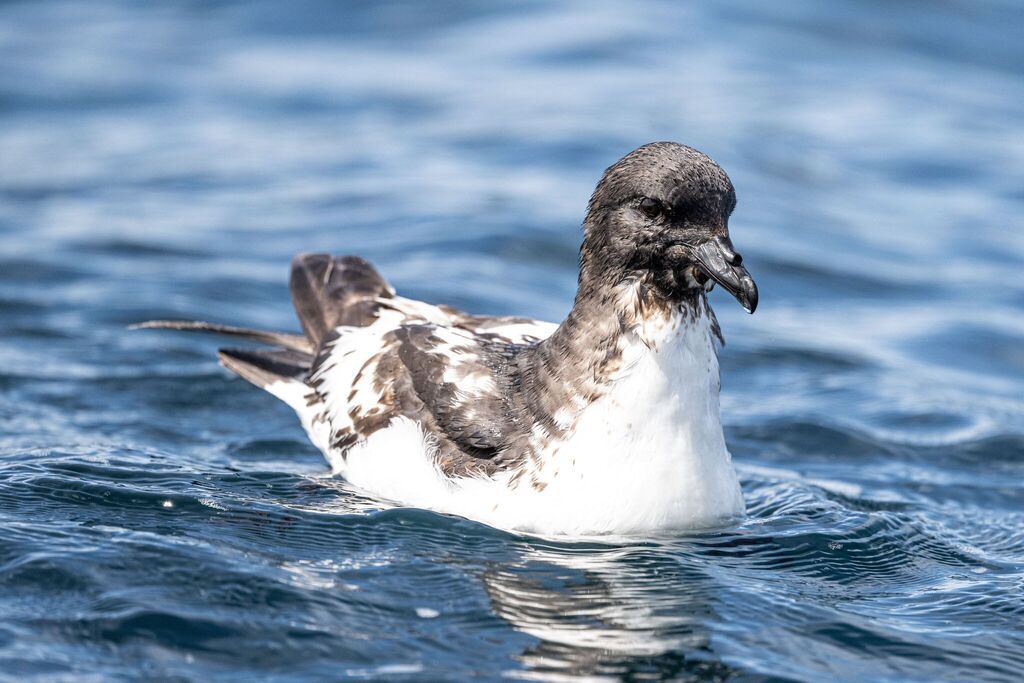
Pintado Petrel
Photo © Alan Bell
Photo © Alan Bell — CC BY 4.0 — Source: iNaturalist photo #478132040Identification
The pintado petrel is a striking and relatively small seabird, measuring 35–40 cm in length with a wingspan of 80–90 cm. Its most distinctive feature is its bold pied plumage: a black head and neck contrasts sharply with a white belly and breast, while the underwing is predominantly white with a black border. The back and upperwings display characteristic black and white speckles, as does the tail, which bears a band of black. Two subspecies are recognized—the northern D. c. capense has a white back with black spots, while the southern D. c. australe is smaller with a solid blackish-brown back. As a member of the order Procellariiformes, pintado petrels share distinctive anatomical features including naricorns (nasal passages attached to the upper bill) and a unique ability to produce and spray stomach oil as both a defense mechanism and energy source.
Range & Habitat
This abundant seabird is endemic to the Southern Ocean, with a global population estimated at around 2 million individuals. Pintado petrels breed on circumpolar subantarctic and Antarctic islands, including the Antarctic Peninsula, South Georgia, the Kerguelen Islands, the Balleny Islands, and islands in the Scotia Sea, extending as far north as the Auckland Islands, Chatham Islands, and Campbell Island. During breeding season they feed at sea around Antarctica, but in winter they range considerably further north, reaching as far as Angola and even the Galapagos Islands near the Equator in cold currents. They nest colonially on cliffs or level ground within a kilometer of the ocean, constructing nests from pebbles and shells and sheltering them under overhanging rocks or in crevices.
Behaviour & Diet
Pintado petrels are highly gregarious birds, famous among mariners for following ships and scavenging edible waste and carcasses thrown overboard. Their diet comprises approximately 80% crustaceans, with krill being their preferred food, which they obtain both by surface seizing and by diving and filtering underwater. They also feed on fish and squid. These petrels are notably aggressive while feeding and will spit their potent stomach oil at competitors, even members of their own species, in defense of food resources.
Breeding occurs from November, when pairs lay a single clear white egg incubated for 45 days by both sexes. Chicks are brooded for ten days after hatching, then fledge approximately 45 days later around March. Like other fulmars, adults vigorously defend their nests by spitting stomach oil, though skuas remain a significant predatory threat to eggs and chicks.
Best Time & Places to See It
Pintado petrels are most reliably observed during breeding season (November to March) on subantarctic and Antarctic islands, particularly at major breeding colonies on the Antarctic Peninsula, South Georgia, and the Kerguelen Islands. Ship-based expeditions to these regions offer the best opportunities for sightings. Outside breeding season, they are widespread across Southern Ocean waters and can be encountered during seabird-watching cruises to high southern latitudes, particularly in cold-current systems.
Photography Tips
The pintado petrel's striking black-and-white plumage provides excellent contrast for photography. From ships, photograph birds in flight against open ocean to capture their distinctive pied pattern, particularly the white underwings with black borders and speckled back. When at breeding colonies, patient observers can document nesting behavior and the birds' characteristic defensive postures. Early morning and late afternoon light will best illuminate the sharp contrast between their dark and light plumage, making these abundant seabirds highly photogenic subjects for wildlife photographers working in polar regions.
Parque Nacional de Galápagos
Santo Tomás, Ecuador
+139 birds+23 mammals
Volcanic peaks and weathered lava fields dominate this remote archipelago in the Pacific, where the interplay of cold ocean currents and tropical latitude creates an ecological…
VIEW ISLAND & ARCHIPELAGOSydney Harbour National Park
Sydney, Australia
+203 birds+26 mammals
Where Sydney Harbour's sheltered waters meet the sandstone headlands of New South Wales, a mosaic of coastal heathland, eucalyptus woodland and rocky shores creates one of…
VIEW NATIONAL PARKSea Lion Island
Sealion Island Settlement, Falkland Islands
+74 birds+3 mammals
Windswept tussock grasslands roll across volcanic terrain where Southern Ocean swells crash against rocky shores, creating one of the Falkland Islands' most dramatic wildlife theatres. This…
VIEW ISLAND & ARCHIPELAGOCape Dolphin
falskland islands, Falkland Islands
+54 birds+1 mammals
Where windswept grasslands meet dramatic coastal cliffs, the Falkland Islands' northern reaches reveal one of the Southern Hemisphere's most compelling seabird sanctuaries. The terrain here is…
VIEW NATURE RESERVEWest Point Island
West Point, Falkland Islands
+67 birds+3 mammals
Windswept cliffs plunge dramatically into the South Atlantic, their rust-coloured rock faces sculpted by millennia of gales and spray. This northwestern outpost of the Falkland Islands…
VIEW ISLAND & ARCHIPELAGOCabo de Hornos National Park
Cape Horn, Chile
+88 birds+9 mammals
Where the Andes plunge into the Southern Ocean and the Drake Passage churns between two continents, Cabo de Hornos National Park sprawls across one of Earth's…
VIEW NATIONAL PARKArchipiélago Juan Fernández National Park
San Juan Bautista, Chile
+31 birds+2 mammals
Granite peaks rise abruptly from the South Pacific off the Chilean coast, their weathered slopes studded with native woodland and sweeping down to coves where seabirds…
VIEW NATIONAL PARKDeception Island
Gabriel de Castilla Base, Antarctica
+26 birds+10 mammals
Steaming geothermal vents pierce a landscape of blackened volcanic sand and ice, where the earth's raw power still trembles beneath your feet. This horseshoe-shaped caldera, flooded…
VIEW ISLAND & ARCHIPELAGOCuverville Island
Cuverville Island, Antarctica
+19 birds+10 mammals
Granite peaks and sculpted ice define this windswept archipelago off the Antarctic Peninsula, where steep rocky shores plunge into waters thick with drifting brash ice. Cuverville…
VIEW ISLAND & ARCHIPELAGONeko Harbour
Neko Harbour, Antarctica
+18 birds+10 mammals
Towering peaks of fractured ice rise abruptly from gunmetal waters, their faces scarred by millennia of glacial advance and retreat. This pocket of the Antarctic Peninsula…
VIEW PROTECTED LANDSCAPEParadise Bay
Brown Station, Antarctica
+18 birds+9 mammals
Where the Antarctic Peninsula's rugged coastline meets the Southern Ocean, Brown Station stands sentinel over Paradise Bay—a protected landscape of ice-carved inlets, towering glacial faces, and…
VIEW PROTECTED LANDSCAPEBrown Bluff
Brown Bluff, Antarctica
+23 birds+9 mammals
Where rust-colored volcanic peaks pierce the Antarctic Peninsula's icy realm, a geologist's dreamscape unfolds beneath towering cliffs of iron oxide and ancient lava. Brown Bluff rises…
VIEW PROTECTED LANDSCAPEPort Lockroy
Port Lockroy, Antarctica
+19 birds+9 mammals
Towering peaks of black rock pierce through Antarctic pack ice on the Gerlache Strait, where one of the continent's most accessible harbors cradles a living microcosm…
VIEW PROTECTED LANDSCAPEHalf Moon Island
Cámara Base, Antarctica
+25 birds+8 mammals
Jagged volcanic peaks rise from the cobalt waters of the South Shetland Islands, their slopes carpeted in moss and lichen where hardy vegetation clings to windswept…
VIEW ISLAND & ARCHIPELAGOPetermann Island
Petermann Island, Antarctica
+16 birds+9 mammals
Icebound cliffs rise dramatically from the Bellingshausen Sea, their weathered faces sculpted by millennia of Antarctic wind and tide. This slender wedge of rock and ice,…
VIEW ISLAND & ARCHIPELAGOPaulet Island
Paulet Island, Antarctica
+20 birds+6 mammals
Windswept ice and weathered rock converge at this remote Antarctic outcrop, where jagged peaks pierce through perpetual pack ice and glacial moraines descend toward cobalt waters.…
VIEW ISLAND & ARCHIPELAGODanco Island
Danco Island, Antarctica
+17 birds+10 mammals
Dramatic black rock pierces the Antarctic Peninsula's icy waters, crowned with permanent snow and ringed by calving glaciers that thunder into the sea. This volcanic outcrop…
VIEW ISLAND & ARCHIPELAGOWilhelmina Bay
Wilhelmina Bay, Antarctica
+20 birds+10 mammals
Sheer cliffs of black volcanic rock plunge into waters so pristine they reflect the Antarctic sky like polished obsidian. This remote western Antarctic inlet, ringed by…
VIEW PROTECTED LANDSCAPELemaire Channel
Orne Harbour, Antarctica
+25 birds+13 mammals
Where granite peaks plunge into steel-grey waters, the Lemaire Channel carves one of Antarctica's most dramatic passages. This narrow strait, squeezed between the Antarctic Peninsula and…
VIEW PROTECTED LANDSCAPESalisbury Plain
South Georgia, South Georgia and the South Sandwich Islands
+33 birds+4 mammals
Where tussock grasses bow to relentless Antarctic winds and glacial meltwater carves braided channels through obsidian volcanic soil, one of Earth's most remote wildlife sanctuaries reveals…
VIEW PROTECTED LANDSCAPESt. Andrews Bay
South Georgia, South Georgia and the South Sandwich Islands
+34 birds+6 mammals
Where windswept tundra dissolves into obsidian beaches, one of the planet's most extraordinary wildlife theaters unfolds across St. Andrews Bay. This remote corner of South Georgia…
VIEW PROTECTED LANDSCAPEFortuna Bay
Stromness, South Georgia and the South Sandwich Islands
+37 birds+5 mammals
Where tussock grasslands sweep down to black-sand beaches and elephant seals haul out in thunderous colonies, the raw sub-Antarctic landscape reveals itself in its most dramatic…
VIEW PROTECTED LANDSCAPEPrion Island
Prince Olav Harbour, South Georgia and the South Sandwich Islands
+36 birds+2 mammals
Windswept tussock grasslands rise sharply from boulder-strewn beaches where the Southern Ocean hurls its grey swells against black volcanic rock. This remote speck in South Georgia's…
VIEW ISLAND & ARCHIPELAGOCooper Bay
Cooper Bay, South Georgia and the South Sandwich Islands
+28 birds+5 mammals
Where black-sand beaches meet towering cliffs striped with cascading meltwater, one of the Southern Ocean's most dramatic amphitheaters reveals itself. Cooper Bay cuts a deep indent…
VIEW PROTECTED LANDSCAPEElsehul Bay
Bird Island Station, South Georgia and the South Sandwich Islands
+33 birds+4 mammals
Granite peaks rise sheer from the Southern Ocean, their weathered faces streaked with cascading meltwater and cloaked in tussock grass that bends beneath relentless winds. This…
VIEW PROTECTED LANDSCAPEGreat Otway National Park
Australia
+255 birds+42 mammals
Temperate rainforest and wet eucalyptus woodland cloak the ridges and gullies of Victoria's Great Otway National Park, where persistent moisture and mild year-round temperatures sustain a…
VIEW NATIONAL PARKNo community photos yet. Log in to add the first one.
No community observations of this species yet.