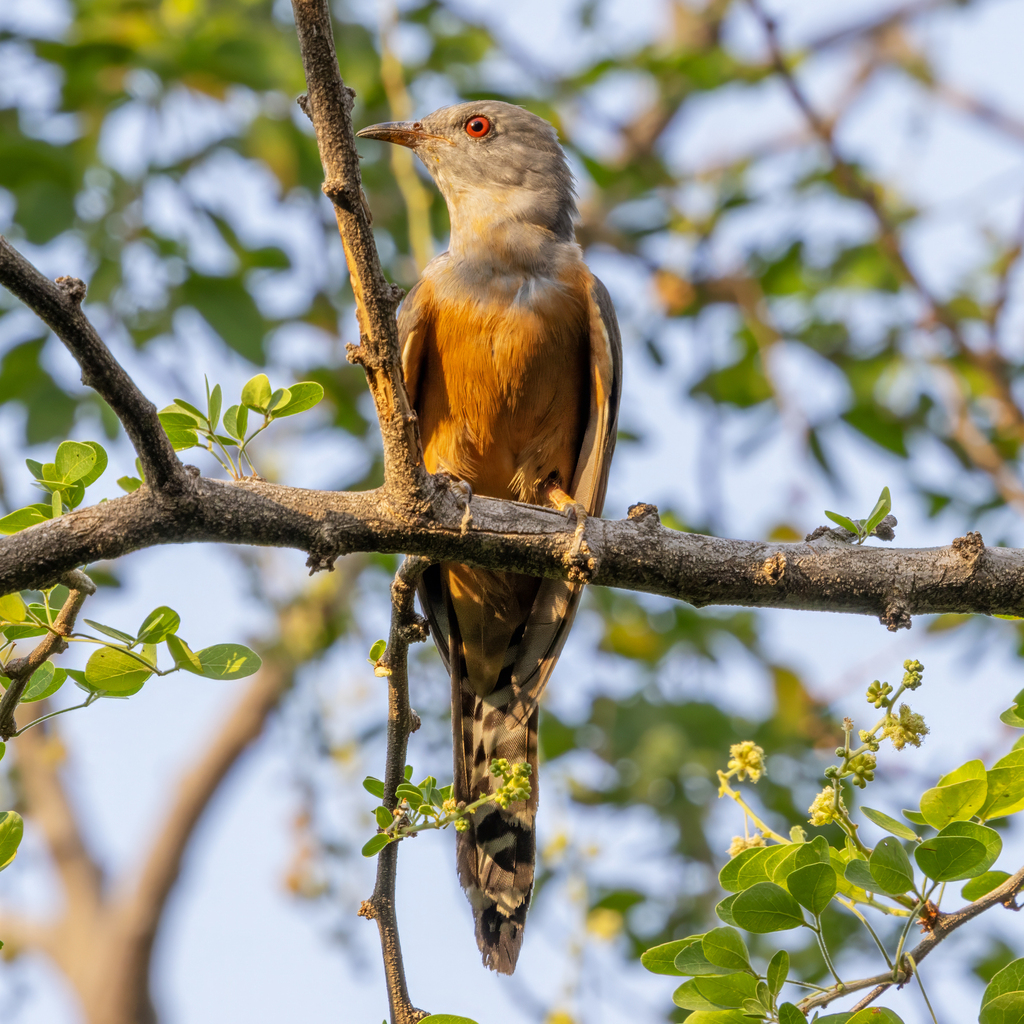
Plaintive Cuckoo
Photo © Dan Vickers
Photo © Dan Vickers — CC BY 4.0 — Source: iNaturalist #341872650Identification
The plaintive cuckoo is a fairly small cuckoo, measuring about 21–24 cm long. The adult male is distinctive, with a grey head, throat and upper breast contrasting with grey-brown upperparts and orange underparts. The tail feathers have white tips, and the bird has yellow legs and feet, a red eye, and a black bill with a yellow lower mandible. The female is often markedly different, occurring in a "hepatic" morph with reddish-brown upperparts heavily barred with dark markings, paler underparts with fainter barring, a pale eyebrow stripe, and dark bars running the full length of the tail. Juvenile birds resemble hepatic females but are paler, with dark streaks rather than bars on the crown and throat.
Range & Habitat
The plaintive cuckoo is native to Asia, ranging from India, Nepal and China to Indonesia. Four subspecies are recognized across this broad range: the nominate form is common in the Philippines, the most widespread subspecies occurs across northeast India, Bangladesh, southern China, and much of Southeast Asia, another inhabits the Malay Peninsula, Sumatra and Borneo, and a fourth is found in Java, Bali and Sulawesi. In most of its Chinese range, the species is a summer visitor that migrates south for the winter.
This adaptable species favors forest edges, open woodland, scrub, grassland, farmland, parks and gardens—making it accessible across varied landscapes rather than being confined to pristine wilderness.
Behaviour & Diet
The plaintive cuckoo is normally solitary and often difficult to see, though males are vocal with several plaintive whistling calls, including an ascending series of three-note phrases and a series of 11 or 12 descending notes. The species feeds on invertebrates, gleaned from vegetation and foliage.
Like other cuckoos, the plaintive cuckoo is a brood parasite. It lays its eggs in the nests of small birds including cisticolas, prinias and tailorbirds. The cuckoo's eggs are larger than those of the host species but sufficiently similar in appearance to avoid immediate rejection. Small birds often recognize the threat and mob the cuckoo vigorously to drive it away from their nests.
Best Time & Places to See It
The plaintive cuckoo's presence varies seasonally depending on subspecies and location. In most of its Chinese range it is present only during summer months, making timing important for northern travellers. The species' preference for accessible habitats such as farmland, gardens and open woodland means it may be encountered in settled areas as well as wilder landscapes.
The widespread distribution across multiple Asian countries and subspecies offers opportunities throughout the region, particularly in India, Southeast Asia and Indonesia. Its solitary and elusive nature means that patient observation and, above all, listening for the distinctive plaintive calls are essential for successful encounters.
Photography Tips
The plaintive cuckoo's small size and elusive behaviour make it a challenging photographic subject. Dawn hours when males are most vocal offer the best opportunity to locate birds by ear before attempting visual stalking. The contrasting plumages—particularly the striking orange underparts and grey head of males—photograph well in good light, though the bird's preference for dense vegetation often presents compositional challenges.
Since females in hepatic plumage and juveniles may be confusing in the field, photographing diagnostic features such as the tail pattern, eyebrow stripe and overall coloration is valuable for field identification. The bird's tendency to perch quietly in shaded areas demands fast film speeds or high ISO settings and patience for fleeting photographic opportunities.
Orang National Park
Rangagarapathar, India
+298 birds+1 mammals
Where the Brahmaputra's floodplains meet the foothills of Assam, Orang National Park unfolds across a mosaic of riverine grasslands, forests and wetlands that pulse with the…
VIEW NATIONAL PARKPhou Khao Khouay National Protected Area
Thaphabath District, Thailand
+113 birds
Where the Annamite Mountains descend into central Thailand's monsoon forests, Phou Khao Khouay National Protected Area sprawls across rugged limestone terrain interlaced with river valleys and…
VIEW NATIONAL PARKHat Noppharat Thara-Mu Ko Phi Phi National Park
Ao Nang, Thailand
+253 birds+9 mammals
Where limestone karsts rise dramatically from turquoise waters, Hat Noppharat Thara-Mu Ko Phi Phi National Park unfolds across a mosaic of beach, mangrove forest, and island…
VIEW NATIONAL PARKKhao Yai National Park
Prachantakham District, Thailand
+377 birds+46 mammals
Evergreen dipterocarp forest blankets the rolling terrain of this national park in eastern Thailand, where limestone hills rise abruptly from the forest floor and seasonal streams…
VIEW NATIONAL PARKKhao Laem Ya-Mu Ko Samet National Park
Mueang Rayong District, Thailand
+159 birds+3 mammals
Where limestone hills meet the Gulf of Thailand, Khao Laem Ya–Mu Ko Samet National Park stitches together a mosaic of terrestrial and marine worlds that few…
VIEW NATIONAL PARKKhao Laem National Park
Sangkhla Buri District, Thailand
+197 birds
Where the Vajiralongkorn Reservoir sprawls across the forested valleys of Kanchanaburi's northern borderlands, Khao Laem National Park protects a landscape where limestone ridges rise dramatically from…
VIEW NATIONAL PARKGiant Panda National Park
Mianyang, China
+447 birds+47 mammals
Where the eastern slopes of China's Sichuan plateau descend into cloud-wrapped valleys, one of Asia's most biodiverse landscapes unfolds across more than 350,000 square kilometres. This…
VIEW NATIONAL PARKMount Nanling Forest Park
Ruyang Forest Farm, China
+179 birds+3 mammals
Granite ridges and weathered peaks rise through a canopy of subtropical montane forest where Ruyang Forest Farm anchors one of southern China's most biodiverse landscapes. Across…
VIEW FOREST & JUNGLEKaziranga National Park
Kohora, India
+422 birds+26 mammals
Dawn breaks over the floodplains of the Brahmaputra, where tall grasslands stretch endlessly beneath monsoon-heavy skies. This sprawling wilderness of northeastern Assam is a mosaic of…
VIEW NATIONAL PARKBako National Park
Kuching, Malaysia
+210 birds+17 mammals
Weathered sandstone cliffs rise dramatically from the South China Sea, their ochre faces sculpted by millennia of wind and tide into a landscape of extraordinary geological…
VIEW NATIONAL PARKKuching Wetlands National Park
Kuching, Malaysia
+103 birds+4 mammals
Where brackish waters meet mangrove stilts and freshwater swamps blend into coastal mudflats, one of Southeast Asia's most dynamic wetland ecosystems unfolds across Sarawak's northwestern coast.…
VIEW NATIONAL PARKTaman Negara National Park
Kampong Samas, Malaysia
+393 birds+48 mammals
Where ancient rainforest meets limestone peaks, one of Southeast Asia's oldest protected wilderness preserves sprawls across 4,343 square kilometers of primordial landscape. Dipterocarp giants tower overhead,…
VIEW NATIONAL PARKPenang National Park
Balik Pulau, Malaysia
+107 birds+2 mammals
Granite peaks rise abruptly from the Andaman Sea where tropical rainforest clings to steep slopes in one of Malaysia's oldest protected landscapes. Mangrove forests fringe the…
VIEW NATIONAL PARKTaman Negara Bukit Lambir National Park
Miri, Malaysia
+153 birds+7 mammals
Rainforest cascades down sandstone ridges where crystal streams carve through ancient geology, creating a landscape of profound biological richness in Sarawak's interior. This 68-square-kilometre sanctuary protects…
VIEW NATIONAL PARKGunung Mulu National Park
Long Seridan, Malaysia
+280 birds+39 mammals
Where granite monoliths pierce the rainforest canopy of Sarawak, an ancient limestone karst landscape reveals one of Southeast Asia's most biodiverse strongholds. Soaring peaks cloaked in…
VIEW NATIONAL PARKTaman Nasional Baluran
Situbondo, Indonesia
+189 birds+9 mammals
Across the northeastern tip of East Java, where monsoon winds sweep down from the Bali Strait, a landscape of contrasts unfolds within 374 square kilometres of…
VIEW NATIONAL PARKTaman Nasional Meru Betiri
Jember, Indonesia
+93 birds+1 mammals
Across East Java's southeastern coast, where the Indian Ocean meets a landscape of volcanic soils and monsoon-fed forests, sprawls a national park that epitomizes the ecological…
VIEW NATIONAL PARKWest Bali National Park
Gerokgak, Indonesia
+240 birds+8 mammals
Across West Bali's northwestern reaches, where the Indian Ocean meets volcanic slopes and limestone cliffs plunge toward turquoise shallows, sprawls a protected realm of roughly 325…
VIEW NATIONAL PARKBogani Nani Wartabone National Park
Bolaang Mongondow, Indonesia
+154 birds+4 mammals
Across North Sulawesi's rugged interior, where tectonic uplift has carved steep ridges and deep valleys through ancient volcanic terrain, Bogani Nani Wartabone National Park sprawls across…
VIEW NATIONAL PARKGunung Ciremai National Park
Majalengka, Indonesia
+116 birds+1 mammals
Volcanic slopes rise sharply from West Java's interior, where Gunung Ciremai's 3,078-metre summit dominates a landscape carved by geological upheaval and shaped by equatorial monsoon rainfall.…
VIEW NATIONAL PARKGunung Merbabu National Park
Magelang, Indonesia
+61 birds+2 mammals
Where volcanic slopes rise sharply from the plateau of Central Java, Gunung Merbabu National Park encompasses nearly 200 square kilometers of montane forest that transitions through…
VIEW NATIONAL PARKMount Merapi National Park
Hargobinangun, Indonesia
+150 birds+3 mammals
Where the volcanic slopes of central Java rise into mist and montane forest, Mount Merapi National Park guards one of Indonesia's most dynamic landscapes. Spanning roughly…
VIEW NATIONAL PARKWay Kambas National Park
Lampung Timur, Indonesia
+237 birds+20 mammals
Across the low swamplands of eastern Lampung, where freshwater wetlands merge into tidal mangrove forests along the Sunda Strait, sprawls one of Sumatra's most vital sanctuaries.…
VIEW NATIONAL PARKWolong National Nature Reserve
Wenchuan County, China
+333 birds+17 mammals
Where the Qingyi River cuts through the eastern flanks of the Minshan Range, a temperate montane forest cloaks steep valleys in dense canopy that thins dramatically…
VIEW NATURE RESERVEXishuangbanna National Nature Reserve
Xishuangbanna Dai Autonomous Prefecture, China
+173 birds+2 mammals
Where subtropical monsoon forests meet the margins of the Yunnan plateau, Xishuangbanna National Nature Reserve sprawls across a landscape of dramatic relief—deep river valleys carved by…
VIEW NATURE RESERVEGaoligong Mountain National Nature Reserve
Nujiang Lisu Autonomous Prefecture, China
+443 birds+13 mammals
VIEW NATURE RESERVENo community photos yet. Log in to add the first one.
No community observations of this species yet.