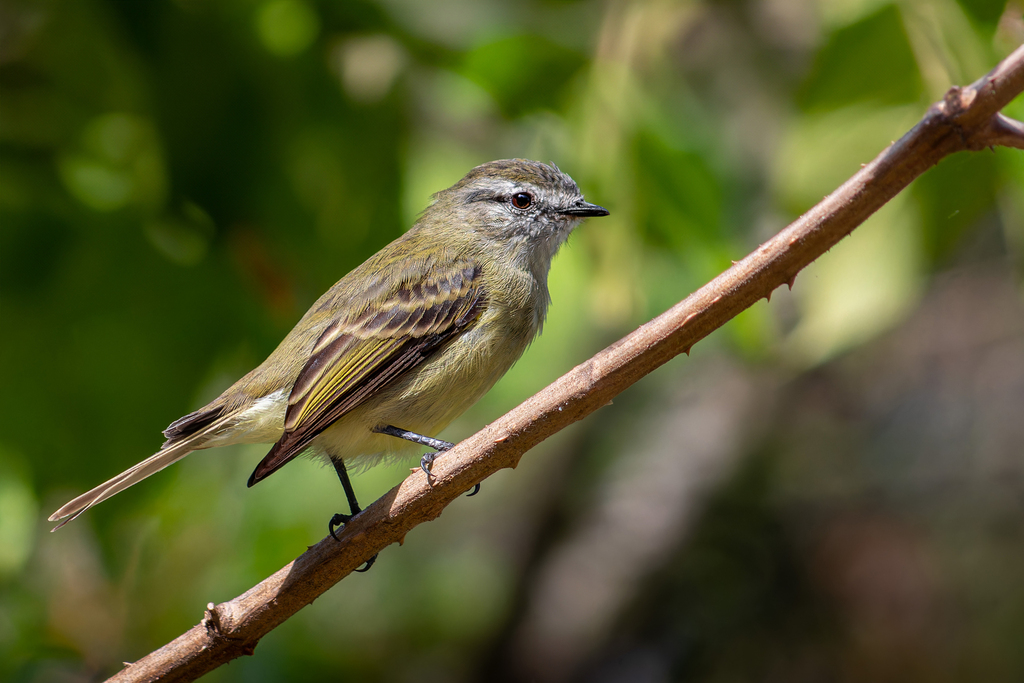
Planalto Tyrannulet
Photo © Enéas V. Gouvêa Junior
Photo © Enéas V. Gouvêa Junior — CC BY-SA 4.0 — Source: iNaturalist photo #532379172Identification
The planalto tyrannulet is a small tyrant flycatcher measuring 11 to 11.5 cm in length. Adults display dull grayish-olive to brownish-olive upperparts, with the crown being the grayest section. A whitish supercilium and partial eyering frame a dark eye-stripe, while the throat is whitish and the underparts are yellow with an olive wash across the breast and sides. The wings are dusky with pale edges to the flight feathers and two pale wing bars visible on the closed wing. Both sexes share identical plumage, and all individuals possess a brown iris, short stubby blackish bill, and gray legs and feet.
The three subspecies show subtle variation. P. f. brevirostris has darker olive upperparts with less prominent wing markings and darker yellow underparts, while P. f. caerae features a darker brown crown and duller overall coloration. These differences require careful observation in the field.
Range & Habitat
The planalto tyrannulet is distributed across southeastern South America, occurring in Argentina, Bolivia, Brazil, and Paraguay. The nominate subspecies inhabits eastern Brazil from eastern Pará south through Bahia, Mato Grosso, and Goiás into extreme northeastern Bolivia. The subspecies brevirostris ranges from Minas Gerais and Espírito Santo south to Rio Grande do Sul, eastern Paraguay, and northeastern Argentina's Misiones Province, while caerae occupies northeastern Brazil from Ceará to Sergipe.
The species is primarily a bird of humid tropical evergreen forest, occurring less frequently in semi-deciduous woodland and gallery forest. It is found from sea level to 1,800 m elevation, though it is most numerous between 500 and 800 m. Most populations are year-round residents, though some evidence suggests Rio Grande do Sul birds migrate northward after the austral summer.
Behaviour & Diet
The planalto tyrannulet is an insectivorous gleaner that also consumes small fruits. It typically forages singly or in pairs within the forest canopy, frequently joining mixed-species feeding flocks. The bird captures prey by gleaning from vegetation while perched and by briefly hovering, employing typical tyrant flycatcher hunting techniques.
Breeding occurs between September and February. A documented nest was a moss cup covered inside and out with lichen, positioned 7 m above ground in a branch crotch and containing two eggs. The species exhibits geographically variable vocalizations: southeastern populations sing a slow series of 3–4 slightly descending, plaintive minor-key notes, while elsewhere birds produce higher-pitched, more distinctly descending major-keyed sequences.
Best Time & Places to See It
The planalto tyrannulet is fairly common to locally common throughout much of its range and occurs in several Brazilian protected areas. The breeding season from September to February offers the best opportunity to locate singing birds. Look for the species in humid evergreen forest at elevations between 500 and 800 m, where it is most numerous, though it may be found anywhere within its altitudinal range.
Search the forest canopy where mixed feeding flocks congregate. In Argentina, Misiones Province provides reliable habitat, while southeastern Brazil's protected areas offer consistent access to this species.
Photography Tips
The planalto tyrannulet's small size, subtle plumage, and canopy-dwelling habits present considerable photographic challenges. Position yourself beneath or within fruiting and flowering trees where feeding flocks concentrate, particularly during breeding season when vocal activity increases bird activity. The species' preference for gleaning makes it predictable in movement, allowing photographers to anticipate perches.
The bird's pale supercilium, facial pattern, and wing bars are diagnostic field marks worth capturing. Morning light on the canopy will illuminate the yellow underparts and olive-tinged upperparts effectively. Patience and a long lens (500 mm or greater) are essential, given the species' typical mid-to-upper canopy foraging height and small stature.
Araucárias National Park
Brasília National Park
Carlos Botelho State Park
Chapada Diamantina National Park
Chapada dos Guimarães National Park
Chapada dos Veadeiros National Park
Encontro das Águas State Park
Ibitipoca State Park
Iguaçu National Park
Nothing matches these filters.
No community photos yet. Log in to add the first one.
No community observations of this species yet.