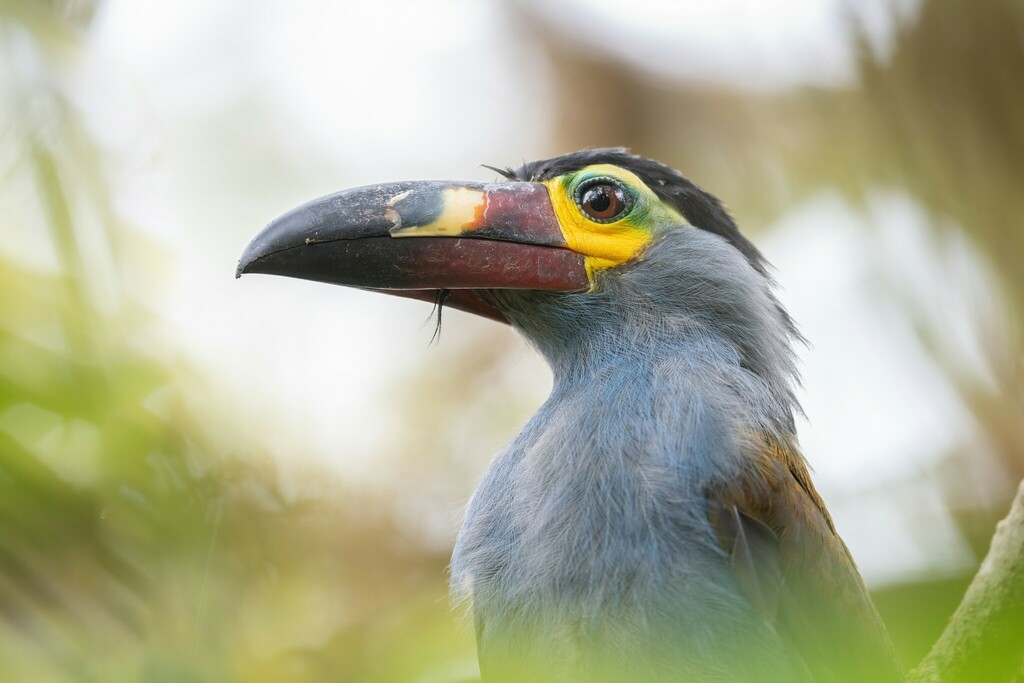
Plate-billed Mountain Toucan
Photo © Adam Jackson
Photo © Adam Jackson — CC0 1.0 — Source: iNaturalist photo #339610881Identification
The plate-billed mountain toucan is a striking and distinctive species, measuring 42 to 53 centimeters in length. Its most characteristic feature is its remarkable bill: the front half is black while the back half is mostly red, crowned by a unique raised yellow plate on the upper mandible—a feature so distinctive it inspired the bird's common name. The bill, despite its impressive size of up to 10 centimeters, is relatively lightweight. Males average 314 grams while females weigh about 303 grams.
The head and upper body display a sophisticated color palette: the crown and nape are black, the upper parts are bronzy olive, and the side of the neck and underparts are blue-gray. A striking yellow patch adorns the flanks, partially hidden by the wings, while the rump is bright yellow and the crissum (area around the vent) is vivid red. The thighs are brownish maroon, and the tail is black with chestnut tips. The bird's eye region is particularly distinctive, with a yellow bare area below and turquoise-green above, complemented by a reddish-brown iris.
Range & Habitat
This species is endemic to the western slopes of the Andes, found only in western Ecuador and the extreme southwestern corner of Colombia. In Colombia, its range extends from Pita Canyon in Nariño southward to the northwestern border of Morona-Santiago Province in Ecuador. The bird inhabits humid montane forests between 1600 and 2600 meters elevation, with occasional sightings as high as 3100 meters in Imbabura, Ecuador.
These lush mountain forests are characterized by abundant epiphytes, bromeliads, and mosses, receiving an average of 14 feet of rainfall annually. The canopy typically ranges from 6 to 10 meters high. Within this ecological niche, the plate-billed mountain toucan shares its habitat with the Andean cock-of-the-rock, with an estimated life area of 14,300 square kilometers.
Behaviour & Diet
The plate-billed mountain toucan is notably the most vocal of the mountain toucans, earning its reputation as a vocal and engaging species. Males produce a loud, repeating "tryyyyyyyk" sound while females make a drier "t't't't't't't't" noise; the sexes often duet together. These birds produce rattles and clicks so loud they can be heard from over a kilometer away, making them unmistakable in their habitat.
Primarily frugivorous, the plate-billed mountain toucan feeds mainly on fruit while occasionally consuming insects and eggs. The bird plays an important ecological role as a seed disperser for plants including the mountain understory shrub Faramea affinis and the palm Prestoea acuminata. Breeding extends from March to October, peaking between May and August, with birds nesting in tree cavities up to 30 meters above ground. Clutches contain 2 or 3 white eggs, incubated for about 16 days, with young fledging at 46 to 60 days. Pairs may raise a second brood after their first young depart.
Best Time & Places to See It
The breeding season from March to October, particularly May through August, offers the best opportunities to observe this vocal species as activity peaks. The La Planada Nature Reserve in Colombia is an exceptional destination, as the plate-billed mountain toucan is the flagship bird of this protected area. The humid montane forests of western Ecuador between 1600 and 2600 meters elevation also provide reliable habitat for viewing this endemic species.
Photography Tips
The plate-billed mountain toucan's striking plumage and distinctive bill make it a rewarding photographic subject. The bird's loud vocalizations can help locate it in the canopy and forest edges. Early morning hours during the breeding season, when vocal activity is high, offer excellent opportunities for observation and photography. The humid montane forest environment requires patience and careful positioning to capture the bird's vibrant colors, particularly the contrasting black and red bill with its distinctive yellow plate, and the yellow patches on flanks and rump that stand out against the blue-gray underparts.
No community photos yet. Log in to add the first one.
No community observations of this species yet.