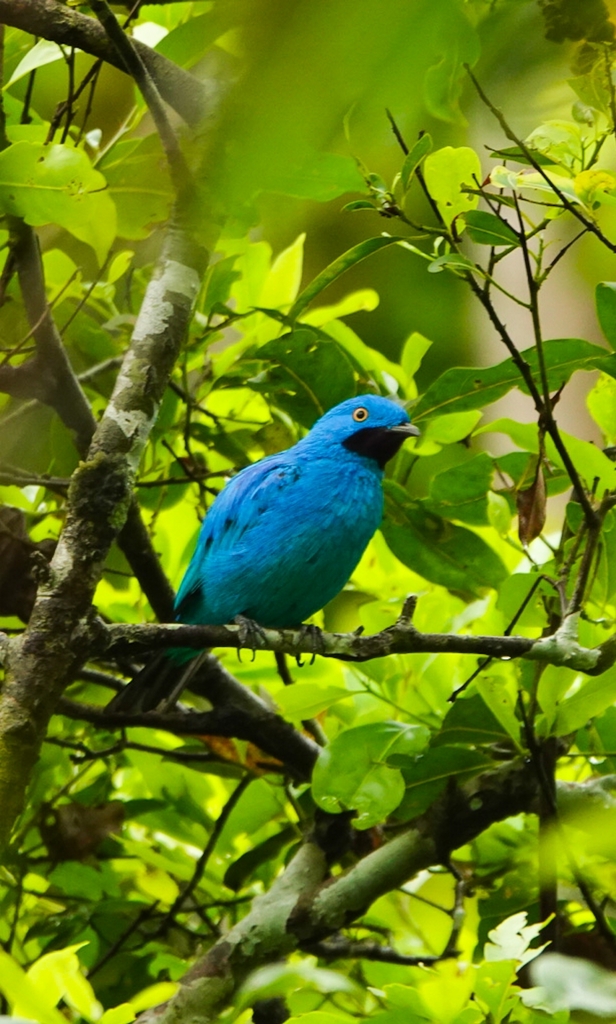
Plum-throated Cotinga
Photo © Harsha Jayaramaiah
Photo © Harsha Jayaramaiah — CC BY 4.0 — Source: iNaturalist photo #448652747The plum-throated cotinga (Cotinga maynana) is a species of bird in the family Cotingidae. It is found in Bolivia, Brazil, Colombia, Ecuador, and Peru. == Taxonomy and systematics == In 1760 the French zoologist Mathurin Jacques Brisson included a description of the plum-throated cotinga in his Ornithologie based on a specimen collected in Maynas Province, Peru. He used the French name Le cotinga des Mayas and the Latin Cotinga Maynanensis. Although Brisson coined Latin names, these do not conform to the binomial system and are not recognized by the International Commission on Zoological Nomenclature. When in 1766 the Swedish naturalist Carl Linnaeus updated his Systema Naturae for the twelfth edition, he added 240 species that had been previously described by Brisson, one of which was the plum-throated cotinga. Linnaeus included a brief description, coined the binomial name Ampelis maynana and cited Brisson's work. This species is now placed in the genus Cotinga that was introduced by Brisson in 1760. The plum-throated cotinga is monotypic. == Description == The plum-throated cotinga is 19 to 20.5 cm (7.5 to 8.1 in) long and weighs about 70 g (2.5 oz). The sexes are dramatically dimorphic. Adult males are mostly shiny turquoise-blue. Their throat…
Yasuní National Park
Aguarico, Ecuador
+601 birds+43 mammals
Where the western Amazon basin converges with Ecuador's Orellana Province, lowland rainforest reaches toward the horizon in an unbroken canopy of staggering botanical density. Yasuní National…
VIEW NATIONAL PARKNatural la Paya National Park
Puerto Leguízamo, Colombia
+262 birds+4 mammals
Where the Amazon's western reaches fold into the Andes foothills, La Paya National Park sprawls across more than 8,500 square kilometers of pristine Amazonian rainforest in…
VIEW NATIONAL PARKAmacayacu National Park
Leticia, Colombia
+567 birds+25 mammals
Where the Rio Amazonas curves through the tri-border region where Colombia, Peru, and Brazil converge, Amacayacu National Park sprawls across more than 5,250 square kilometres of…
VIEW NATIONAL PARKSerra do Divisor National Park
Brazil
+448 birds+10 mammals
Where the western Amazon meets the Andes foothills, Serra do Divisor National Park sprawls across one of South America's most biodiverse and least accessible frontiers. Spanning…
VIEW NATIONAL PARKManu National Park
Manu, Peru
+892 birds+26 mammals
Across the eastern slopes of the Peruvian Andes, tropical rainforest descends into the Amazon basin with a complexity that few terrestrial ecosystems match. Manu National Park…
VIEW NATIONAL PARKSierra del Divisor National Park
Alto Tapiche, Peru
+298 birds+2 mammals
Where the western Amazon meets the Andes foothills, nearly 41,000 square kilometres of pristine rainforest rise across Peru's Alto Tapiche region in a landscape of extraordinary…
VIEW NATIONAL PARKNo community photos yet. Log in to add the first one.
No community observations of this species yet.