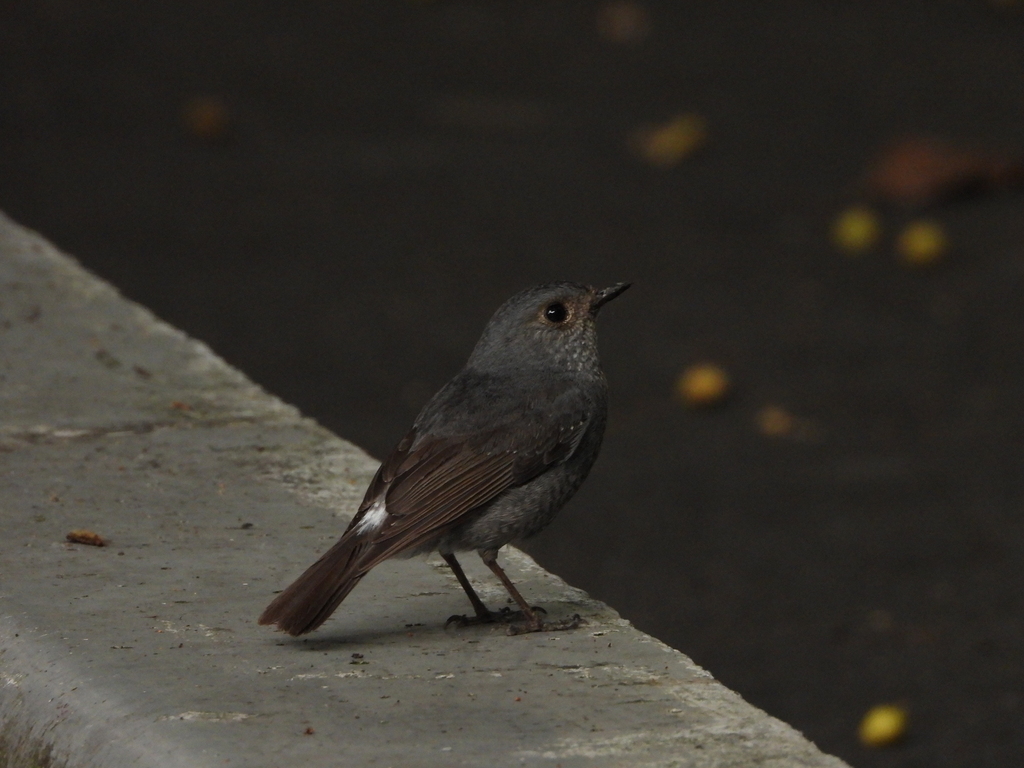
Plumbeous Water Redstart
Photo © Min-Hsuan NI
Photo © Min-Hsuan NI — CC BY 4.0 — Source: iNaturalist #159819057Identification
The plumbeous water redstart is a small passerine, typically 14 centimetres long and weighing around 22 grams in males and 18.8 grams in females. The species displays striking sexual dimorphism: males are slate blue overall with a distinctive rusty-red tail, while females are pale grey with a white rump. The bird's common name derives from its plumbeous (lead-like) coloration. In China, some female and first-year male birds appear more brown on the crown, suggesting possible subspecific variation.
Range & Habitat
This species is distributed across South Asia, Southeast Asia, and China, occurring in Afghanistan, Bangladesh, Bhutan, China, India, Laos, Myanmar, Nepal, Pakistan, Thailand, and Vietnam. It shows a strong preference for fast-moving streams and rivers with boulders and riverside vegetation, particularly in shaded settings. The bird favours waterways with high insect populations, especially mayflies. In the Himalayas, plumbeous water redstarts typically inhabit elevations between 2,000 and 4,100 metres, though they descend to lower altitudes during winter months. The species maintains a stable population across its extensive range of over 5.1 million square kilometres and is classified as Least Concern by the IUCN.
Behaviour & Diet
The plumbeous water redstart is highly territorial and aggressively confrontational toward intruders in its domain. It employs a distinctive hunting technique for capturing flying insects: the bird launches vertically from the water until reaching a height of at least 20 feet, then glides back down in a spiral motion to its original perch. This specialised foraging behaviour makes it well-adapted to capturing insects over flowing water.
Best Time & Places to See It
Observers should focus on streams and rivers with rocky substrates and overhanging vegetation, particularly in montane regions of the Himalayas and Southeast Asia. Visiting during breeding season when birds are most active and territorial will increase sighting chances. Lower-altitude sites become accessible during winter months when birds descend from higher elevations. The species' preference for shaded, boulder-strewn waterways with high insect activity makes such habitats priority locations for finding this water redstart.
Photography Tips
Position yourself carefully along riverbanks to observe the bird's spectacular vertical hunting flights without disturbing its territory. Early morning light often highlights the male's slate-blue plumage beautifully against flowing water. Use a fast shutter speed to capture the characteristic spiral descent hunting behaviour. The contrasting rusty-red tail of males and white rump of females provides strong compositional elements. Work quietly and patiently, as the species' territorial vigilance means sudden movements will cause it to retreat upstream.
Langtang National Park
Helambu, Nepal
+364 birds+14 mammals
Where the southern slopes of the Himalayan highlands descend toward the subtropical valleys of central Nepal, Langtang National Park sprawls across one of the subcontinent's most…
VIEW NATIONAL PARKGangotri National Park
Bhatwari, India
+119 birds+1 mammals
Where the Bhagirathi River carves through the western Himalayas in northern Uttarakhand, Gangotri National Park rises across steep alpine terrain that defines the boundary between temperate…
VIEW NATIONAL PARKSagarmatha National Park
Khumjung, Nepal
+219 birds+7 mammals
Soaring peaks and deep glacial valleys define this alpine wilderness in northeastern Nepal, where the terrain rises from forested foothills into a realm of high-altitude tundra…
VIEW NATIONAL PARKKhangchendzonga National Park
Sakkyong, India
+290 birds+1 mammals
Where the eastern Himalayas surge toward their crowning peaks, Khangchendzonga National Park embraces a landscape of almost overwhelming vertical drama. Rising from subtropical river valleys into…
VIEW NATIONAL PARKWulingyuan
Jundiping, China
+97 birds+3 mammals
Sandstone peaks erupting from forested valleys define this sprawling 993-square-kilometre national park in Hunan Province, where vertical cliffs rise dramatically above lush subtropical woodland. The landscape—a…
VIEW NATURAL MONUMENTGiant Panda National Park
Mianyang, China
+447 birds+47 mammals
Where the eastern slopes of China's Sichuan plateau descend into cloud-wrapped valleys, one of Asia's most biodiverse landscapes unfolds across more than 350,000 square kilometres. This…
VIEW NATIONAL PARKMount Nanling Forest Park
Ruyang Forest Farm, China
+179 birds+3 mammals
Granite ridges and weathered peaks rise through a canopy of subtropical montane forest where Ruyang Forest Farm anchors one of southern China's most biodiverse landscapes. Across…
VIEW FOREST & JUNGLEJiuzhai Valley
Jiuzhaigou County, China
+226 birds+7 mammals
Where crystalline alpine streams cascade through limestone gorges and karst terrain rises in dramatic vertical walls, Jiuzhai Valley unfolds across nearly 1,300 square kilometers of southwestern…
VIEW NATURAL MONUMENTHuanglong Scenic and Historic Interest Area
Ngawa Tibetan and Qiang Autonomous Prefecture, China
+194 birds+7 mammals
Across the high plateau of northwestern Sichuan, a geological wonder unfolds where limestone terraces and mineral-rich springs have sculpted one of China's most distinctive natural monuments.…
VIEW NATURAL MONUMENTKaziranga National Park
Kohora, India
+422 birds+26 mammals
Dawn breaks over the floodplains of the Brahmaputra, where tall grasslands stretch endlessly beneath monsoon-heavy skies. This sprawling wilderness of northeastern Assam is a mosaic of…
VIEW NATIONAL PARKNanda Devi National Park
Garpak, India
+218 birds+5 mammals
Where the Himalayas surge into their most dramatic alpine amphitheater, a wilderness of raw geological power unfolds across 624 square kilometers of pristine terrain. Nanda Devi,…
VIEW NATIONAL PARKValley of Flowers National Park
Ghangaria, India
+117 birds+1 mammals
Where alpine meadows explode with color each monsoon season, the Himalayan slopes of Uttarakhand rise to create one of Earth's most extraordinary floral displays. Perched between…
VIEW NATIONAL PARKSanjiangyuan National Park
Nagqu, China
+187 birds+25 mammals
Where the headwaters of three great Asian rivers emerge from a high alpine plateau, the landscape unfolds in tundra and dwarf shrubland—a world of austere beauty…
VIEW NATIONAL PARKWuyishan National Park
Yanshan County, China
+141 birds+2 mammals
Where subtropical monsoon rains sustain a perpetually humid landscape, Wuyishan National Park rises from Fujian's eastern plateau as a realm of forested ridges, cascading streams, and…
VIEW NATIONAL PARKWolong National Nature Reserve
Wenchuan County, China
+333 birds+17 mammals
Where the Qingyi River cuts through the eastern flanks of the Minshan Range, a temperate montane forest cloaks steep valleys in dense canopy that thins dramatically…
VIEW NATURE RESERVEPoyang Lake National Nature Reserve
Shangrao, China
+270 birds+7 mammals
Where the Yangtze River's massive floodplain spreads across central China, Poyang Lake National Nature Reserve encompasses one of the continent's most dynamic and water-rich wetland systems.…
VIEW NATURE RESERVEQinghai Lake National Nature Reserve
Hainan Tibetan Autonomous Prefecture, China
+243 birds+11 mammals
At 3,200 metres above sea level on the Tibetan plateau, where winter temperatures plunge far below freezing and snow blankets the landscape for half the year,…
VIEW NATURE RESERVEGaoligong Mountain National Nature Reserve
Nujiang Lisu Autonomous Prefecture, China
+443 birds+13 mammals
VIEW NATURE RESERVEBaima Snow Mountain National Nature Reserve
Diqing Tibetan Autonomous Prefecture, China
+204 birds+3 mammals
High-altitude ridges and steep-sided valleys define this reserve in northwestern Yunnan, where elevations surge from around 3,000 metres to peaks above 4,100 metres. The terrain supports…
VIEW NATURE RESERVENo community photos yet. Log in to add the first one.
No community observations of this species yet.