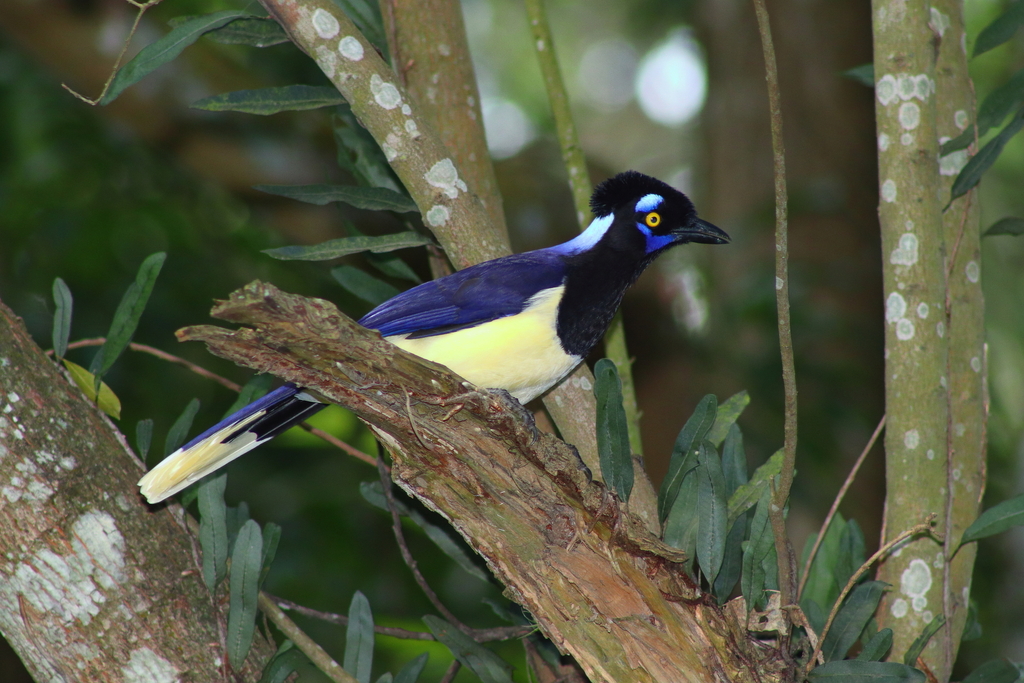
Plush-crested Jay
Photo © Carlos Alexandre Mattos Raposo
Photo © Carlos Alexandre Mattos Raposo — CC BY-SA 4.0 — Source: iNaturalist photo #364545250Identification
The plush-crested jay is a medium-sized corvid with striking plumage that makes it relatively easy to identify in the field. Its most distinctive feature is the rounded crest on its head, which gives the species its common name. The bird's overall coloration is dark blue, but several key markings help distinguish it: the upper breast, neck, and head are mostly black, while the underbelly, undertail coverts, underwings, and tail tip are cream-yellow. A lighter blue appears on the cheeks and nape, fading gradually into the darker blue of the body. Yellow spots appear above the eyes, and the bill is dark blue to black.
Range & Habitat
The plush-crested jay is found in central-southern South America, with a range extending across southwestern Brazil, Bolivia, Paraguay, Uruguay, and northeastern Argentina. The bird's distribution is complex, with populations occurring in the southern regions of the Amazon Basin, particularly around river systems that border the Pantanal. The range extends inland from the South Atlantic coast for approximately 3,500 kilometers, stretching from São Paulo south to Rio Grande do Sul along the Brazil-Uruguay border. Additional populations occur in northwestern Bolivia and at the headwaters of major Amazon tributaries including the Tapajós and Xingu rivers, with some localized populations along the Amazon and Madeira rivers themselves.
Behaviour & Diet
The plush-crested jay is a non-migratory, highly social bird that forms flocks varying in size by season. During spring and summer, flocks typically number 5 to 11 individuals, while fall and winter flocks are larger, containing 8 to 15 birds. Breeding is a communal affair, with several flock members serving as "helpers" to raise chicks—they bring food to the brood, dispose of fecal matter, and defend the nest from predators.
These omnivorous jays feed primarily on seeds, nuts, insects, and small invertebrates, supplemented with fruits or maize depending on availability. They forage both on the ground and occasionally in trees, and have been observed following ants back to their nests to feed on the ants themselves or other insects in the vicinity. When food is scarce, they may also take eggs from other species and small animals such as frogs or snakes.
Best Time & Places to See It
The plush-crested jay is non-migratory, meaning it can be encountered year-round within its range. The bird is social and often seen in noisy flocks, making it relatively conspicuous despite its forest and woodland habitat. Travellers visiting the Pantanal region, southern Brazil, Paraguay, and Bolivia have good opportunities to observe this species. The larger winter flocks (8 to 15 individuals) may make sightings more likely during the colder months, though the bird remains present throughout the year.
Photography Tips
The plush-crested jay's striking blue and black plumage with cream-yellow accents provides excellent photographic opportunities. The rounded crest is most prominent when the bird is alert, so watch for moments when the jay is scanning its surroundings or interacting with flock members. The yellow spots above the eyes and the contrasting cream-yellow undertail coverts and tail tips are key field marks worth capturing. Since these jays forage on the ground as well as in trees, photographers should be prepared to shoot at various heights. The birds' social nature means they often occur in groups, offering chances to photograph interesting behavioural interactions and cooperative activities within the flock.
Tijuca National Park
Brazil
+317 birds+13 mammals
Where the Atlantic forest rises steeply from Rio de Janeiro's urban edge, Tijuca National Park encompasses a landscape of dramatic granite peaks, cascading waterfalls, and closed-canopy…
VIEW NATIONAL PARKSerra do Cipó National Park
Brazil
+379 birds+5 mammals
Where granite escarpments rise above the Atlantic Forest transition zone in southeastern Brazil, Serra do Cipó National Park unfolds across a landscape of dramatic ridges, cascading…
VIEW NATIONAL PARKItatiaia National Park
Brazil
+519 birds+12 mammals
Where granite peaks pierce the Atlantic rainforest canopy in southeastern Brazil, Itatiaia National Park rises as one of the country's oldest and most ecologically vital protected…
VIEW NATIONAL PARKSaint-Hilaire/Lange National Park
Brazil
+225 birds
Subtropical Atlantic forests rise and fall across the plateaus of inland Paraná, where Saint-Hilaire/Lange National Park protects nearly 578 square kilometres of Brazil's most biodiverse woodland…
VIEW NATIONAL PARKIguaçu National Park
Brazil
+387 birds+17 mammals
Where the Paraná Plateau plunges toward the Atlantic watershed, six thousand square kilometers of subtropical rainforest cling to steep gorges and river valleys in this corner…
VIEW NATIONAL PARKIlha Grande National Park
Brazil
+233 birds
Across the subtropical plateaus and Atlantic forest remnants of southern Brazil, a vast protected landscape spanning nearly 4,600 square kilometers safeguards one of the continent's most…
VIEW NATIONAL PARKChapada Diamantina National Park
Brazil
+346 birds+5 mammals
Where granite peaks and sandstone cliffs rise abruptly from the Brazilian interior, Chapada Diamantina National Park sprawls across 4,215 square kilometers of some of Brazil's most…
VIEW NATIONAL PARKAraucárias National Park
Brazil
+231 birds+3 mammals
Where the southern Brazilian highlands rise into cool temperate forest, Araucárias National Park protects one of the Atlantic Forest's most distinctive ecosystems across 506 square kilometres…
VIEW NATIONAL PARKCampos Gerais National Park
Brazil
+143 birds
Where rolling plateaus rise above the Atlantic forest escarpment in Paraná's interior, Campos Gerais National Park unfolds across 539 square kilometers of highland grassland and forest…
VIEW NATIONAL PARKCampos Amazónicos National Park
Amazonas, Brazil
+434 birds+7 mammals
Sprawling across the southwestern Amazon basin in Amazonas state, this 27,263-square-kilometre national park encompasses some of the region's most pristine lowland rainforest, where terra firme forest…
VIEW NATIONAL PARKEl Palmar National Park
Distrito Sexto, Argentina
+244 birds+14 mammals
Across the Paraná River floodplain in northeastern Argentina, palms rise from wetland and grassland in a landscape shaped by water and time. El Palmar National Park…
VIEW NATIONAL PARKRío Pilcomayo National Park
Argentina
+271 birds+13 mammals
Where the Río Pilcomayo cuts through northeastern Argentina's subtropical lowlands, a sprawling mosaic of wetlands, grasslands, and seasonally flooded forests creates one of South America's most…
VIEW NATIONAL PARKIguazú National Park
Puerto Iguazú, Argentina
+346 birds+15 mammals
Where the Paraná Plateau plunges toward the Atlantic watershed, nearly 800 square kilometers of subtropical rainforest drape across Misiones Province in a landscape carved by millennia…
VIEW NATIONAL PARKEl Rey National Park
Municipio de Las Lajitas, Argentina
+317 birds+4 mammals
Where the eastern slopes of the Andes descend into northwestern Argentina's subtropical transition zone, El Rey National Park unfolds across 841 square kilometers of dramatically varied…
VIEW NATIONAL PARKCalilegua National Park
Municipio de Calilegua, Argentina
+288 birds+8 mammals
Where the eastern Andean slopes plunge into northwestern Argentina's humid subtropics, nearly 2,645 square kilometers of steep terrain and luxuriant forest compose one of South America's…
VIEW NATIONAL PARKBaritú National Park
Argentina
+81 birds+2 mammals
Where the eastern slopes of the Serranías del Hornocal descend into cloud forest and subtropical ravines, Baritú National Park protects one of northwestern Argentina's most biodiverse…
VIEW NATIONAL PARKParque Provincial Pampa del Indio
Laguna Limpia, Argentina
+231 birds+4 mammals
Across the flat horizons of Chaco Province, where the Paraná River system spills into vast wetlands and grasslands, Parque Provincial Pampa del Indio protects one of…
VIEW NATURE RESERVEChaco National Park
Municipio de Presidencia de la Plaza, Argentina
+258 birds+7 mammals
Across the humid subtropical lowlands of northeastern Argentina, where the Paraná River basin feeds vast seasonal wetlands and gallery forests, Chaco National Park protects one of…
VIEW NATIONAL PARKNo community photos yet. Log in to add the first one.
No community observations of this species yet.