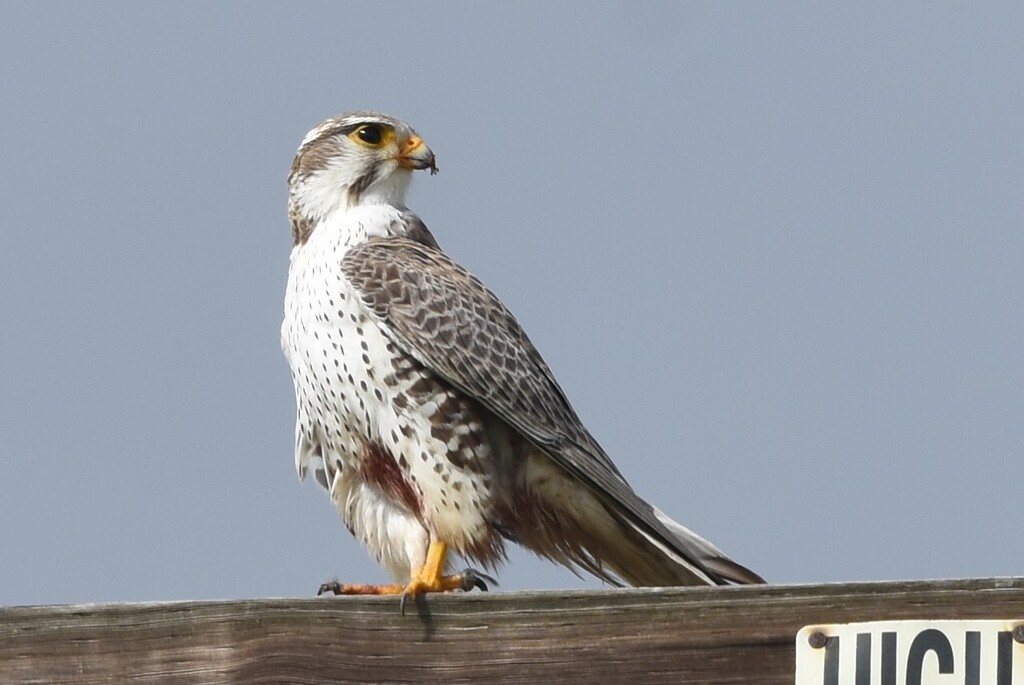
Prairie Falcon
Photo © Guy Babineau
Photo © Guy Babineau — CC BY 4.0 — Source: iNaturalist photo #608916772Identification
The prairie falcon is a medium-sized falcon with warm gray-brown plumage above and pale, mottled underparts. Males measure 37–38 cm and weigh 500–635 g, while larger females reach 45 cm and 762–970 g, with wingspans to 1.1 meters. Like the peregrine falcon, it bears a narrow "moustache" mark and white eyebrow line, but its most distinctive feature is the black axillars (wingpits) and underwing coverts, creating dark "struts" along each wing. The rump and tail are noticeably lighter than the dark primary feathers.
Juveniles differ from adults in several ways: they show less vertical breast streaking, have more uniformly colored shoulder and back feathers (versus barred in adults), and possess grayish skin around the eyes and legs rather than the yellow or orange-tinged cere and feet of breeding adults. The prairie falcon's longer tail, more tubular body, and stiffer, more mechanical wingbeats distinguish it from the similar peregrine falcon in flight.
Range & Habitat
The prairie falcon is the only large falcon species native strictly to North America. It is resident from Canada (mainly Alberta, British Columbia, and Saskatchewan) through the western United States west of the Mississippi River and south into northern Mexico. This species has evolved to thrive in arid and desert environments with typically low prey density, representing an early divergence from peregrine falcon lineage adapted to harsher conditions.
Behaviour & Diet
An aggressive and opportunistic hunter, the prairie falcon takes a wide range of mammalian and avian prey, occasionally reptiles, and prey sizes ranging from small songbirds like sparrows and finches to birds approaching its own weight and occasionally much larger. This more varied and meager diet reflects its adaptation to resource-scarce environments. Calls heard near the nest are repetitive and high-pitched—kree kree kree or kik kik kik—similar to but higher than the peregrine's vocalizations. The species is highly valued in falconry, regarded as equally skilled as the peregrine when properly trained and cared for.
Best Time & Places to See It
Look for prairie falcons throughout western North America in open, arid landscapes where they hunt over deserts, grasslands, and scrublands. Their year-round resident status means they can be encountered in suitable habitat across their range in any season, though activity and visibility may vary with local prey availability and breeding cycles. The species' opportunistic hunting strategy means sightings are often sudden and dramatic.
Photography Tips
Capture the prairie falcon's distinctive dark wingpit "struts" in underwing shots—a key identification feature. When photographing perched birds, look for the contrasting pale rump and tail against darker upperwings. In flight, photograph the longer tail proportions and stiffer wingbeat cadence compared to peregrine falcons. Breeding adults with yellow-tinged ceres and cere-skin offer color contrast; note that juveniles appear grayer overall. Close-ups of the narrow moustache mark and white eyebrow line highlight this species' subtle facial features against its sandy-brown plumage.
Arizona in Winter
Nothing matches these filters.
Arches National Park
Badlands National Park
Banff National Park
Bear River Migratory Bird Refuge
Big Bend National Park
Bitter Lake National Wildlife Refuge
Black Canyon of the Gunnison National Park
Bosque del Apache National Wildlife Refuge
Bryce Canyon National Park
Nothing matches these filters.
No community photos yet. Log in to add the first one.
No community observations of this species yet.