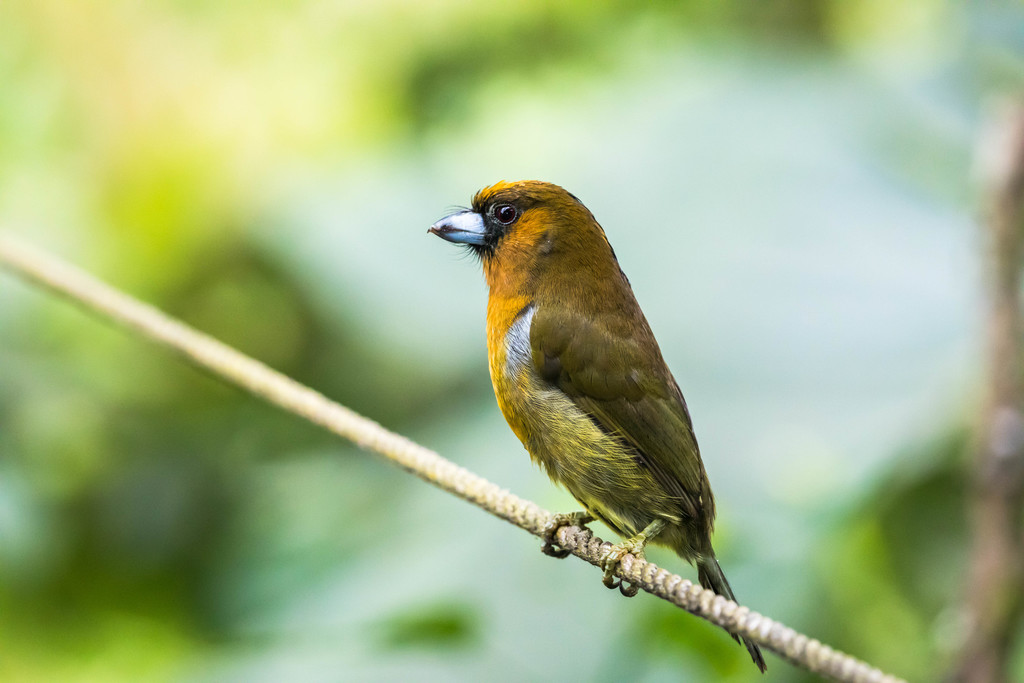
Prong-billed Barbet
Photo © Melissa McMasters
Photo © Melissa McMasters — CC BY 4.0 — Source: iNaturalist photo #177292897Identification
The prong-billed barbet is a distinctive, relatively large-billed bird measuring 17 to 18.5 cm long and weighing about 60 to 70 grams. Its most striking feature is its silvery gray to bluish bill with a dark tip; a notch on the tip of the mandible gives the species its English name. The maxilla is hooked with a notch on the side. Adults display a dull golden brown crown and brownish olive nape and upper back, transitioning to olive green on the lower back, rump, and uppertail coverts. Males are distinguished by a glossy black tuft of feathers at the rear of the crown, which females lack.
Both sexes share dull slaty black lores, cheeks, and chin, with buffy olive sides of head and neck that become yellowish on the lower breast. The belly's center is pale yellow and the flanks are dull grayish with a pale yellowish wash. Immatures are overall duller than adults, with grayer rather than black facial areas, making them easier to distinguish from the more contrasting adults in the field.
Range & Habitat
The prong-billed barbet is found in the mountains from Costa Rica's Cordillera de Tilarán to western Panama's Veraguas Province. Elevational range varies by location: between 750 and 2,450 meters on the Caribbean side of Costa Rica, between 1,500 and 1,450 meters on the Pacific side, and between 1,500 and 2,250 meters in Panama, though it occasionally occurs at lower elevations in both countries. The species is common within its range and occurs in several parks and reserves in Costa Rica.
The barbet inhabits the interior and edges of extremely humid montane evergreen forest, a landscape characterized by abundant epiphytes and mosses and frequent fog. This specialized habitat preference makes it a sought-after species for birders visiting Central America's highland forests.
Behaviour & Diet
The prong-billed barbet is non-migratory and highly social outside the breeding season, foraging in flocks of up to 12 individuals and roosting communally in tree cavities with up to 16 birds in close association. During breeding season, pairs become monogamous and territorial, with courtship beginning in March and nest cavity excavation commencing about mid-month. Nests are sited between 3 and 18 meters above ground, and clutches typically contain four or five eggs. Both parents share incubation duties lasting 14 to 15 days and care for nestlings and fledglings.
The diet is almost entirely fruit, though young nestlings are fed insects. Barbets forage usually in the forest canopy but sometimes at lower levels near forest edges, swallowing small fruits whole or squeezing out their interiors, while tearing apart larger fruits. The species is highly vocal, with both sexes singing frequently in duets or group choruses. The song is described as a deep, resonant, far-carrying "cwa-cwa-cwa-cwa" repeated many times, complemented by various calls including low rattling notes, nasal squalls, and bark-like chucks.
Best Time & Places to See It
The prong-billed barbet is common within its range and can be encountered year-round, as the species is non-migratory. The breeding season, beginning in March, is an excellent time to locate birds, as their loud, distinctive vocalizations—particularly duetting pairs and group choruses—make them easier to detect despite their preference for the forest canopy.
Several parks and reserves in Costa Rica protect populations of this species, offering the best opportunities for observation. Visiting the humid montane evergreen forests of the Cordillera de Tilarán region in Costa Rica or the highland forests of western Panama provides the best chance of encountering this distinctive barbet. Early morning birding sessions, when vocalization is most frequent, will maximize your chances of locating these engaging highland forest residents.
Photography Tips
The prong-billed barbet's preference for the forest canopy presents the primary challenge for photographers. Position yourself in the understory or at forest edges where barbets sometimes forage at lower levels, increasing opportunities for clear shots. The distinctive silvery-gray bill with its characteristic notch and the males' glossy black crown tuft are key field marks worth emphasizing in your images.
Early morning light filtering through the mist-laden montane forest can create atmospheric conditions ideal for photography. The bird's buffy olive underparts and olive-green back blend readily with surrounding foliage, so patience and careful scanning of the canopy are essential. Recording the species' distinctive "cwa-cwa-cwa-cwa" vocalizations alongside images will enrich your documentation of this engaging highland specialist.
Arenal Volcano National Park
Peñas Blancas, Costa Rica
+551 birds+21 mammals
Straddling the border between Alajuela and Guanacaste in northwestern Costa Rica, this national park rises dramatically around one of Central America's most active volcanic systems. The…
VIEW NATIONAL PARKChirripó National Park
Rivas, Costa Rica
+274 birds+6 mammals
Where the volcanic spine of Costa Rica's Central Cordillera reaches its apex, Chirripó National Park encompasses a landscape that shifts dramatically with elevation, from montane cloud…
VIEW NATIONAL PARKBraulio Carrillo National Park
Las Horquetas, Costa Rica
+547 birds+18 mammals
Where the Caribbean slope descends from the central volcanic cordillera toward the humid lowlands of Heredia, Braulio Carrillo National Park preserves one of Costa Rica's most…
VIEW NATIONAL PARKVolcán Poás National Park
Toro Amarillo, Costa Rica
+237 birds+4 mammals
Where volcanic slopes rise sharply from the Central Valley floor, Volcán Poás National Park protects one of Costa Rica's most active and accessible volcanic systems. The…
VIEW NATIONAL PARKBaru Volcano National Park
Cerro Punta, Panama
+402 birds+6 mammals
Where the land rises sharply toward the Caribbean's western spine, Baru Volcano National Park sprawls across roughly 220 square kilometres of southwestern Panama, anchored by the…
VIEW NATIONAL PARKGeneral de División Omar Torrijos Herrera National Park
La Pintada, Panama
+401 birds+2 mammals
Across the highlands of central Panama, where the continental divide funnels moisture-laden trade winds into steep river valleys, the terrain rises and falls in a landscape…
VIEW NATIONAL PARKParque Internacional la Amistad
Teribe, Panama
+325 birds+11 mammals
Where the continental divide rises between the Caribbean and Pacific watersheds, a wilderness of extraordinary biological richness unfolds across the Talamanca Range and into lowland rainforest—a…
VIEW NATIONAL PARKLos Quetzales National Park
Copey, Costa Rica
+232 birds+3 mammals
Cloud forest sweeps across the upper slopes of the Central Valley watershed, where elevation and persistent moisture forge an ecosystem unlike any other in Costa Rica.…
VIEW NATIONAL PARKTapantí Macizo de la Muerte National Park
Orosi, Costa Rica
+503 birds+18 mammals
Where montane cloud forest rises steeply from the Orosi Valley, Tapantí Macizo de la Muerte National Park enfolds a landscape of perpetual moisture and emerald complexity.…
VIEW NATIONAL PARKLa Amistad International Park
Crorina, Costa Rica
+532 birds+20 mammals
Where the Caribbean slopes of Costa Rica's Talamanca Mountains rise steeply inland from Limón, the boundary between two nations dissolves into an unbroken expanse of rainforest.…
VIEW NATIONAL PARKNo community photos yet. Log in to add the first one.
No community observations of this species yet.