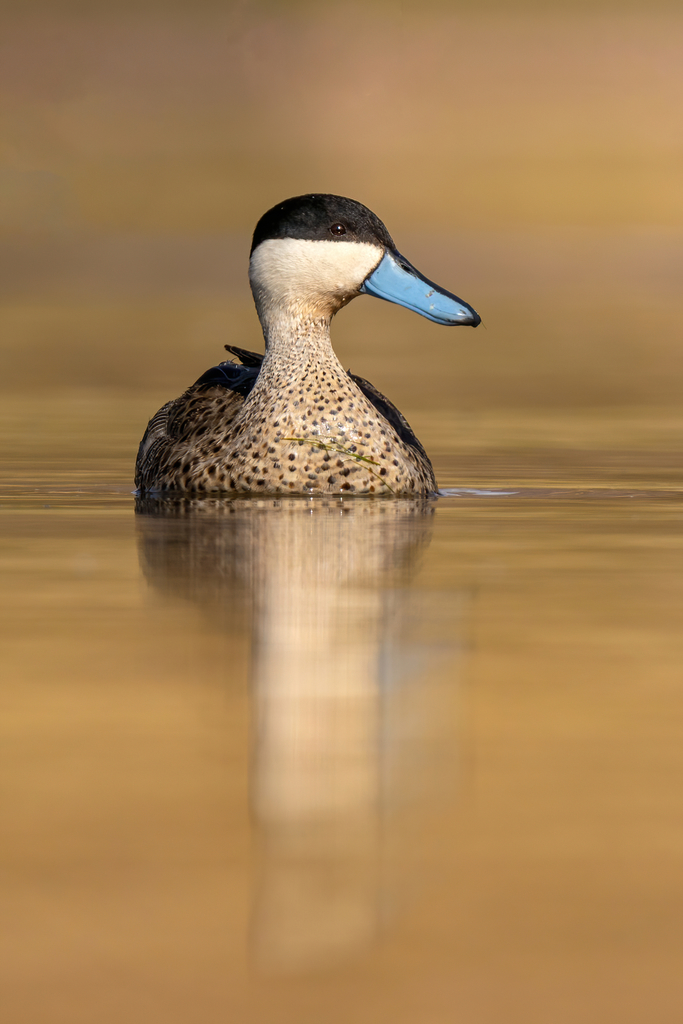
Puna Teal
Photo © Luciano Massa
Photo © Luciano Massa — CC BY 4.0 — Source: iNaturalist photo #171997079Identification
The Puna teal is a dabbling duck measuring about 48 cm (19 inches) long, comparable in size to a wood duck. Males are distinctive and unmistakable in plumage: they sport a blackish-brown cap extending below the eyes, contrasting with a creamy white lower face and neck. The back, chest, and flanks are coffee-colored with fine dark brown spotting that develops into barring on the back and flanks. The rump is gray, and the wings display dull blue upper coverts with an iridescent green speculum bordered by black and white bars. The bill is characteristically light blue with a black nail and culmen. Females are noticeably duller with less distinct barring, while juveniles show reduced iridescence and less contrasting head patterns. All ages possess gray legs and feet.
Range & Habitat
The Puna teal is a non-migratory resident of the Andes Mountains in South America, with a range extending from central Peru southward through western Bolivia, northern Chile, and into extreme northwestern Argentina. This species is confined to the high-altitude Puna zone, typically found at elevations up to 4,600 meters (15,100 feet).
They inhabit various freshwater wetland environments, particularly favoring weakly alkaline lakes, swamps, and bogs abundant in floating vegetation, especially plants from the genus Chara. The species has evolved remarkable physiological adaptations to high-altitude living, including enlarged lungs with greater gas-exchange capacity and increased blood vessel density, enabling efficient oxygen uptake in the thin mountain air.
Behaviour & Diet
As dabbling ducks, Puna teals feed by tipping forward until nearly upside down to access food from the water bottom. Their specialized bills, equipped with lamellae—filtering plates of varying length along the bill edges—are perfectly adapted for extracting food from water. Their diet consists mainly of plants and seeds, supplemented with invertebrates.
These ducks are mostly monogamous, though some males engage in extra-pair copulations. They breed starting at one year of age, nesting on the ground in rough vegetation such as long grass, not necessarily near water. Females lay creamy pink eggs between April and June, with clutch sizes ranging from 5 to 8 eggs. Both parents rear the ducklings, with males defending the family during fledging. While primarily sedentary, Puna teals make altitudinal shifts outside the breeding season, descending to lower elevations when high-altitude resources become scarce.
Best Time & Places to See It
The Puna teal is a resident species throughout its range, making it potentially observable year-round on the larger lakes and pools of the altiplano. April through June is the breeding season, offering chances to observe pair behaviors and nesting activity. Outside breeding season, altitudinal movements mean birds descend to lower elevations, so timing and elevation choice will affect your likelihood of sightings.
Photography Tips
The Puna teal's striking male plumage—particularly the contrasting head pattern, blue bill, and iridescent wing speculum—makes for rewarding photography in good light. Position yourself near weakly alkaline lakes and bogs with floating vegetation where they congregate. Early morning light will best render the iridescent green speculum on the wings. The birds' dabbling behavior, when they tip forward into the water, creates dynamic compositional opportunities. High-altitude environments present bright, intense sunlight; use this to your advantage to capture detail in plumage patterns, but watch for harsh shadows on the face. Females and juveniles require patience and careful identification, but they offer opportunities to showcase the species' sexual dimorphism and age variation.
Huascarán National Park
Independencia, Peru
+201 birds+5 mammals
Where granite peaks pierce the Andean sky above 6,000 metres, Huascarán National Park sprawls across more than 11,500 square kilometres of Peru's Cordillera Blanca, a landscape…
VIEW NATIONAL PARKSalar del Huasco National Park
Pica, Chile
+75 birds+2 mammals
High above the Atacama's shimmering flats, where the Andes grip the sky, lies a landscape of stark geological drama and surprising biological richness. Salar del Huasco…
VIEW NATIONAL PARKLauca National Park
Putre, Chile
+139 birds+17 mammals
Where the Andes rise toward the altiplano in Chile's far north, Lauca National Park sprawls across more than 3,000 square kilometres of some of South America's…
VIEW NATIONAL PARKReserva Nacional las Vicuñas
Putre, Chile
+87 birds+6 mammals
High desert plateaus interlace with volcanic ridges across this 4,204-square-kilometre expanse at the border between Chile and Bolivia, where altitudes exceed 3,500 metres and the climate…
VIEW NATIONAL PARKSalar de Surire Natural Monument
Putre, Chile
+61 birds
High across the Altiplano of northern Chile, where the Andes push toward 4,300 metres and the air thins to a crystalline clarity, lies a vast shallow…
VIEW NATURAL MONUMENTLos Cardones National Park
Argentina
+193 birds+6 mammals
Where the Andes descend into northwestern Argentina, Los Cardones National Park sprawls across nearly 1,200 square kilometres of one of South America's most distinctive high-altitude desert…
VIEW NATIONAL PARKNo community photos yet. Log in to add the first one.
No community observations of this species yet.