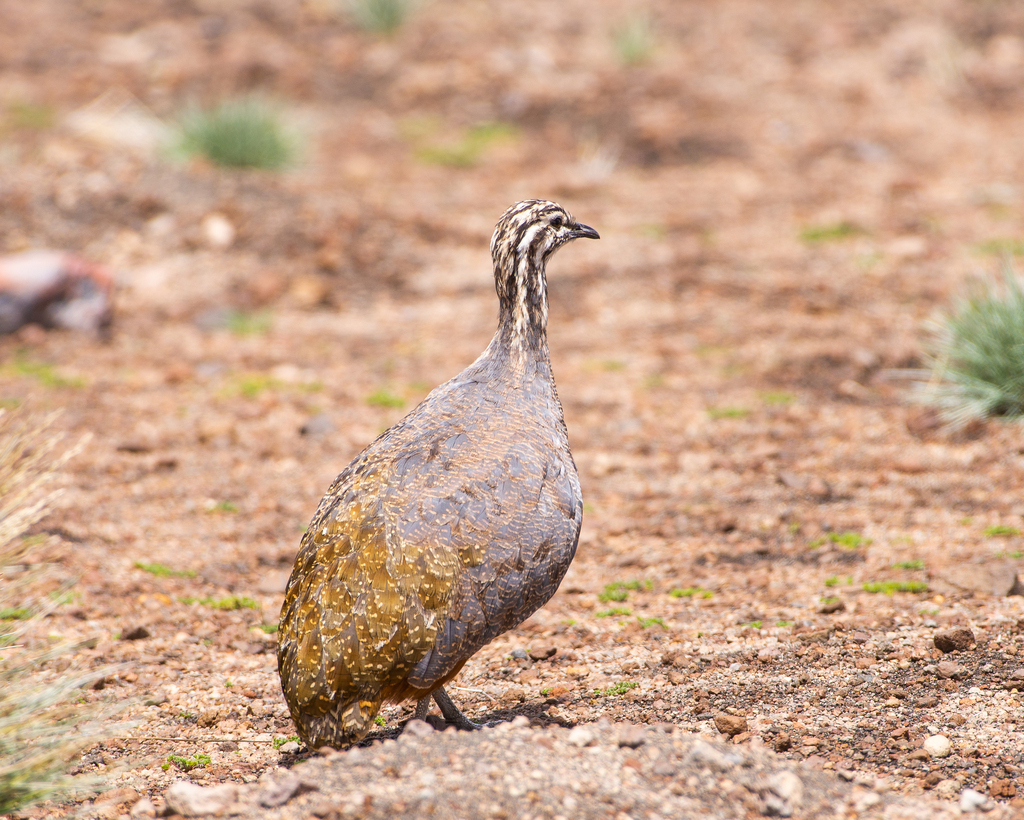
Puna Tinamou
Photo © Nicolás Villaseca Merino
Photo © Nicolás Villaseca Merino — CC BY-SA 4.0 — Source: iNaturalist photo #355827942The puna tinamou (Tinamotis pentlandii), also known as Pentland's tinamou, is a member of the tinamou family. This species is native to the Andes Mountains in South America. The binomial name of the species commemorates the Irish natural scientist Joseph Barclay Pentland (1797–1873) by Nicholas Aylward Vigors in 1837. The IUCN list this species as Least Concern, with an occurrence range of 590,000 km2 (230,000 sq mi). == Taxonomy == This is a monotypic species. == Description == The puna tinamou is approximately 41 cm (16 in) in length. Its upper parts are brown spotted with white, and its breast is blue-grey, and its belly is rufous. Its head is white with black streaks. == Distribution and habitat == The puna tinamou inhabits high-altitude grassland, and to a lesser extent, brushland at altitude 4,000 to 4,700 m (13,100–15,400 ft) of subtropical and tropical regions. Its range is Peru, northern Bolivia, northern Chile and northwestern Argentina. == Footnotes ==
Salar del Huasco National Park
Pica, Chile
+75 birds+2 mammals
High above the Atacama's shimmering flats, where the Andes grip the sky, lies a landscape of stark geological drama and surprising biological richness. Salar del Huasco…
VIEW NATIONAL PARKLauca National Park
Putre, Chile
+139 birds+17 mammals
Where the Andes rise toward the altiplano in Chile's far north, Lauca National Park sprawls across more than 3,000 square kilometres of some of South America's…
VIEW NATIONAL PARKReserva Nacional las Vicuñas
Putre, Chile
+87 birds+6 mammals
High desert plateaus interlace with volcanic ridges across this 4,204-square-kilometre expanse at the border between Chile and Bolivia, where altitudes exceed 3,500 metres and the climate…
VIEW NATIONAL PARKSalar de Surire Natural Monument
Putre, Chile
+61 birds
High across the Altiplano of northern Chile, where the Andes push toward 4,300 metres and the air thins to a crystalline clarity, lies a vast shallow…
VIEW NATURAL MONUMENTNo community photos yet. Log in to add the first one.
No community observations of this species yet.