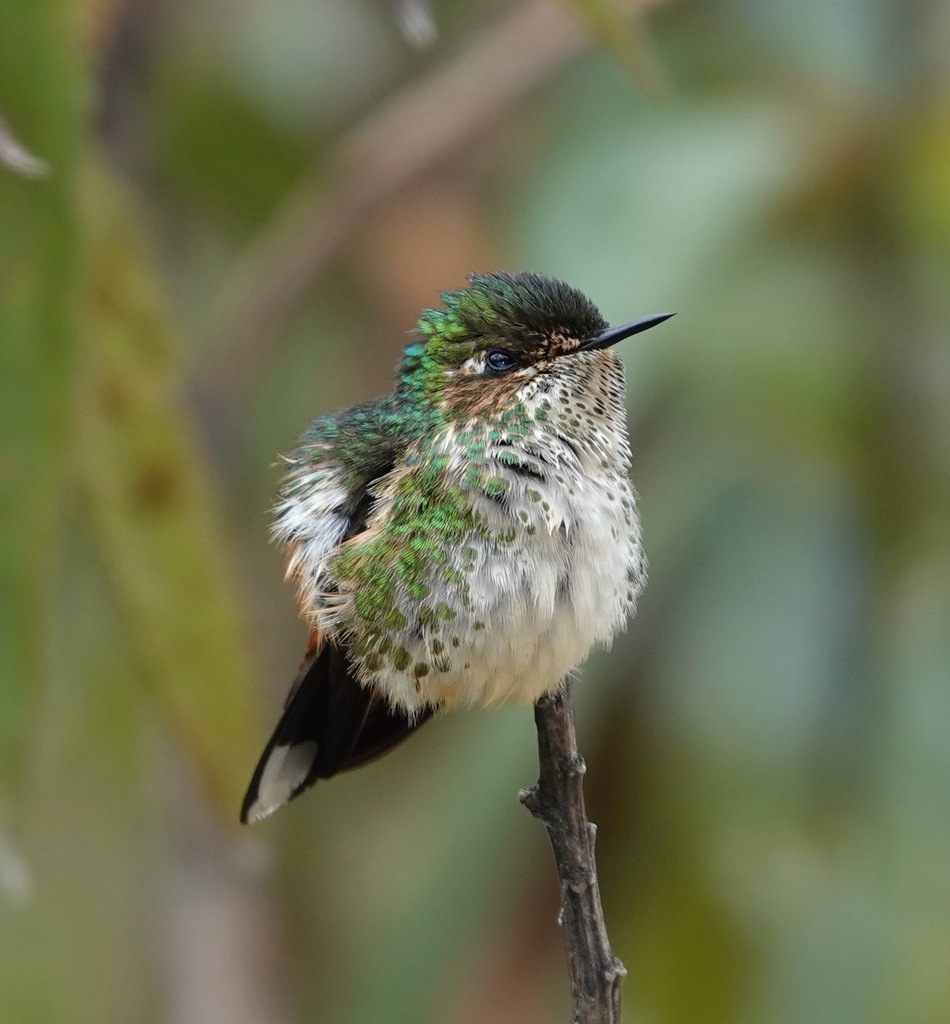
Purple-backed Thornbill
Photo © desertnaturalist
Photo © desertnaturalist — CC BY 4.0 — Source: iNaturalist #139279953Identification
The purple-backed thornbill is a tiny hummingbird, measuring just 8 to 9 cm in length and weighing approximately 3.5 g, making it one of the smallest members of its family. It is instantly recognizable by its exceptionally short black bill—the shortest of any hummingbird species. Males of the nominate subspecies display metallic violet-purple upperparts with a distinctive white spot behind the eye, an iridescent golden-green gorget, bronzy-green underparts, and dark purple tail feathers that are moderately long and forked. Females have shining green upperparts, also with the characteristic white eye-spot, white underparts dotted with green, and a shorter, less deeply forked tail with white-tipped outer feathers. Subspecific variation occurs across the species' range, with some males showing green-bordered gorgets or darker underparts depending on their geographic origin.
Range & Habitat
The purple-backed thornbill is endemic to the Andes mountains, with four subspecies distributed across Colombia, Ecuador, Peru, Bolivia, and Venezuela. The nominate subspecies occurs in the Andes of Colombia, Ecuador, and northwestern Peru, while other subspecies inhabit the western Venezuelan Andes, the eastern Andean slopes of Peru, and the central Bolivian highlands. The species occupies a narrow elevational band between 1,700 and 3,600 m, frequenting the edges of humid montane forest, Polylepis (queñoa) woodland, páramo grassland, and transitional zones between these habitats. One subspecies also ranges into shrubby areas well below the treeline.
Behaviour & Diet
The purple-backed thornbill employs a trap-lining feeding strategy, moving methodically between flowering plants to harvest nectar from mid-level to canopy heights. It opportunistically exploits feeding holes created by Diglossa flowerpiercers, a behavior known as nectar robbing, and also takes insects both in flight and by gleaning from flowers. The species exhibits altitudinal migration, moving from lower to higher elevations during the wet season. Breeding occurs from May through December, with pairs constructing delicate cup nests of fine plant fibers decorated with moss and lichen on horizontal branches. Each clutch comprises two eggs with an incubation period of 16 days. Males produce a distinctive song described as a continuous series of quiet scratchy notes interspersed with short buzzes and dry trills, complemented by various calls including sharp rattles and twittering notes.
Best Time & Places to See It
The purple-backed thornbill is generally uncommon throughout its range, though more regularly encountered at higher elevations during the breeding season from May onwards. The wet season movement to higher elevations offers the best viewing opportunities in montane forest edges and páramo transitions. Several protected areas within its range provide habitat for this species, though populations outside protected zones face severe deforestation pressures. Visiting the appropriate elevations (1,700–3,600 m) during the breeding season in the Venezuelan, Colombian, Ecuadorian, or Peruvian Andes offers the most reliable chance of encounters.
Photography Tips
Photographing this diminutive thornbill requires patience and fast shutter speeds, as the species feeds actively and moves with typical hummingbird agility. The white eye-spot provides a useful identification feature and point of focus for portraits. The iridescent gorget of males responds dramatically to light angle—position yourself to capture side-lighting that illuminates the golden-green throat display. The bird's preference for mid-canopy feeding means positioning yourself at appropriate elevations and watching flowering plants and trees for visiting birds. Early morning light in montane forest edges yields the best color saturation of the male's metallic purple upperparts.
Podocarpus National Park
Zamora, Ecuador
+496 birds+6 mammals
Where the Andes descend toward the Amazon basin, Podocarpus National Park sprawls across nearly 2,800 square kilometres of the most biodiverse terrain in Ecuador's southern highlands.…
VIEW NATIONAL PARKAntisana National Park
Quijos, Ecuador
+432 birds+21 mammals
Where the eastern Andean slopes descend into the Amazon basin, Antisana National Park sprawls across roughly 2,500 square kilometers of some of South America's most dramatic…
VIEW NATIONAL PARKCotopaxi National Park
Mulaló, Ecuador
+211 birds+6 mammals
High in Ecuador's volcanic corridor, where the páramo transitions into cloud forest along the slopes of Cotopaxi volcano, the national park unfolds across nearly 500 square…
VIEW NATIONAL PARKCajas National Park
Cuenca, Ecuador
+190 birds+7 mammals
High in the Andes above Cuenca, where elevation ranges from 3,100 to 4,200 metres, the páramo landscape dominates—a windswept realm of cushion plants, alpine grasses, and…
VIEW NATIONAL PARKNatural Munchique National Park
El Tambo, Colombia
+194 birds
Where the Western Cordillera rises steeply from the Pacific plains of southwestern Colombia, Natural Munchique National Park sprawls across 1,078 square kilometers of montane forest that…
VIEW NATIONAL PARKNatural Farallones de Cali National Park
Buenaventura, Colombia
+733 birds+27 mammals
Where the Pacific coastal plain meets the western slopes of the Andes, Farallones de Cali National Park sprawls across nearly 3,500 square kilometers of dramatic topography…
VIEW NATIONAL PARKNatural Chingaza National Park
Junín, Colombia
+285 birds+6 mammals
Where the Andes rise above three thousand metres in the Cundinamarca region, high-altitude grasslands and cloud forests converge in a landscape shaped by both geology and…
VIEW NATIONAL PARKNatural Pisba National Park
Socotá, Colombia
+95 birds
High-altitude grasslands and páramo ecosystems sweep across the Andean terrain of this national park, where thin soils and cool, windswept conditions define a landscape shaped by…
VIEW NATIONAL PARKNatural el Cocuy National Park
Güicán, Colombia
+313 birds+3 mammals
Where the Andes rise to their highest peaks in Colombia's eastern cordillera, El Cocuy National Park sprawls across more than 6,600 square kilometers of some of…
VIEW NATIONAL PARKPuracé National Natural Park
Puracé, Colombia
+327 birds+2 mammals
Where the Andes thrust upward across southwestern Colombia, Puracé National Natural Park spans nearly 2,631 square kilometers of some of South America's most dramatic montane terrain.…
VIEW NATIONAL PARKNatural Sumapaz National Park
Cubarral, Colombia
+368 birds+1 mammals
Where the Andes descend toward the Amazon basin, the high páramo grasslands of Sumapaz National Park sprawl across more than five thousand square kilometers of Meta…
VIEW NATIONAL PARKEl Tamá National Park
Toledo, Colombia
+435 birds
Where the Andes descend toward the Caribbean coastal lowlands of northern Colombia, El Tamá National Park sprawls across nearly 3,800 square kilometres of montane forest, cloud…
VIEW NATIONAL PARKNo community photos yet. Log in to add the first one.
No community observations of this species yet.