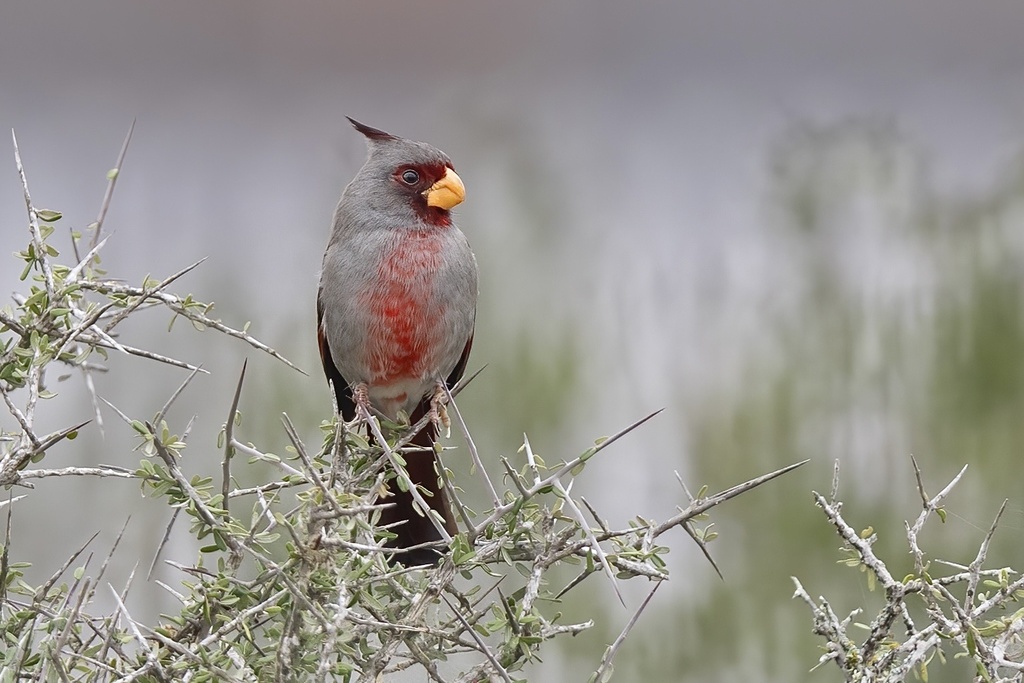
Pyrrhuloxia
Photo © Matt Felperin
Photo © Matt Felperin — CC BY 4.0 — Source: iNaturalist photo #353508699Identification
The pyrrhuloxia or desert cardinal is a medium-sized songbird measuring about 8.3 inches (21 cm) in length and weighing 0.8–1.5 oz (24–43 g). Males are distinctive with predominantly brownish-gray plumage, a bright red breast, red mask, and striking yellow, parrot-like bill that is notably stout and rounded. Both sexes retain the characteristic long, pointed red crest typical of all cardinals in the genus. Females resemble northern cardinals closely, but the bill shape is diagnostic. The desert cardinal's song is similar to the northern cardinal's but noticeably softer and less loud.
Range & Habitat
This year-round resident inhabits the American southwest and northern Mexico. In the United States, it occupies the southwestern half of Texas, roughly the southern third of New Mexico, and the southeastern region of Arizona. In Mexico, its range extends across areas north of the Sierra Madre del Sur, Trans-Mexican Volcanic Belt, and Isthmus of Tehuantepec, though it excludes the Sierra Madre Occidental. The pyrrhuloxia prefers desert scrub, mesquite thickets, woodland edges, and particularly habitat along stream beds. Though relatively nonmigratory, individuals occasionally stray north of their usual range. In areas where ranges overlap with the northern cardinal, hybridization may occur.
Behaviour & Diet
During breeding season, males establish and defend territories through song, producing distinctive calls including a sharp "wha-cheer, wha-cheer" and a metallic "quink." Females also sing but with softer, duller notes. Both sexes use short "cheep" or "chip" calls while foraging. The pyrrhuloxia's diet consists of seeds, fruits, and insects. It snatches insects from trees, picks seeds from grass stalks and similar plants, and feeds on cactus fruit. This species benefits cotton fields by consuming cotton worms and weevils. In winter, desert cardinals forage in enormous flocks sometimes numbering in the thousands and regularly visit bird feeders.
Best Time & Places to See It
The breeding season runs from mid-March through mid-August, making spring and early summer ideal for observing territorial males singing from exposed vantage points. Desert scrub habitats in southeastern Arizona, southern New Mexico, and southwestern Texas offer the best opportunities for sightings. Stream beds and mesquite thickets are particularly productive locations. Winter months are excellent for observing large foraging flocks, especially at bird feeders in suitable habitat.
Photography Tips
The pyrrhuloxia's striking red coloration and distinctive yellow bill make it highly photogenic. Males are more colorful and easier to identify than females. Early morning light best renders the red breast and crest. Position yourself near water sources or feeding areas where birds congregate predictably. During breeding season, males singing from prominent perches offer excellent photo opportunities. In winter, concentrate efforts where large flocks gather to feed. The bird's relatively small size requires appropriate focal length lenses to capture detail effectively.
Big Bend National Park
Bitter Lake National Wildlife Refuge
Bosque del Apache National Wildlife Refuge
Cabeza Prieta National Wildlife Refuge
Carlsbad Caverns National Park
Cave Creek Canyon
Chiricahua Mountains
El Vizcaíno
Guadalupe Mountains National Park
Nothing matches these filters.
No community photos yet. Log in to add the first one.
No community observations of this species yet.