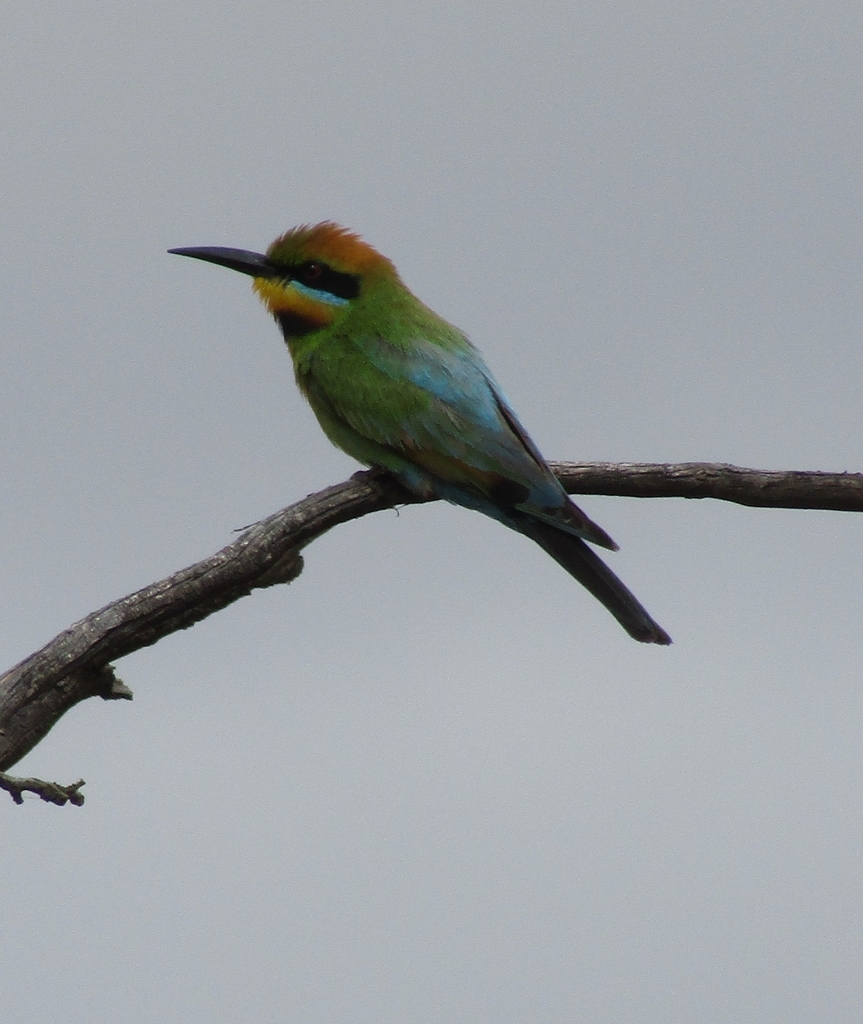
Rainbow Bee-eater
Photo © Heath Hunter
Photo © Heath Hunter — CC BY 4.0 — Source: iNaturalist #147384563Identification
The rainbow bee-eater is a brilliantly coloured bird measuring 23–28 cm in length, including distinctive elongated tail feathers. It displays a striking combination of plumage: a green upper back and wings, bright blue lower back and under-tail coverts, and rufous to copper undersides of the wings tipped with black. The tail is black to deep violet, with the two central feathers noticeably elongated, particularly in males. The head crown, throat, stomach and breast are pale yellow-orange, contrasted by a distinctive black crescent-shaped gorget and a black stripe edged with blue that extends through the bird's bright red eye. Juveniles are overall duller with a greener crown and lack the throat bands and elongated tail feathers of adults.
Range & habitat
The rainbow bee-eater is Australia's only bee-eater species and is monotypic with no recognized subspecies. During summer, it is common throughout forested areas of most of southern Australia, except Tasmania. These birds are migratory, moving north during winter into northern Australia, New Guinea, and southern Indonesian islands, with occasional vagrants recorded as far as Japan and Taiwan. They inhabit open woodlands, beaches, dunes, cliffs, mangroves, farmlands, and regularly visit parks and gardens.
Behaviour & diet
Rainbow bee-eaters are highly social birds that roost together in large groups when not breeding. They communicate through loud, melodious 'pir-r-r' calls characterized by rapid vibration and high pitch, typically given in flight, and exchange softer calls while perched. These ground-nesting birds breed before and after the rainy season in the north, and from November to January in the south. Pairs are believed to mate for life, with males providing insects to females as they excavate their narrow burrow nests using their bills and feet—females can dig 7–8 cm daily. Clutches of 3–7 white eggs are incubated for 21–24 days, with young fledging after 28–31 days and fed by both parents and communal group members.
As their name suggests, rainbow bee-eaters have a particular appetite for bees, though they eat a variety of flying insects. They can spot prey from up to 45 metres away, swooping down to catch insects in their long, slender black bills before returning to a perch to subdue their catch. Remarkably, they are immune to bee and wasp stings; upon capturing a bee, they carefully rub out the stinger against their perch while closing their eyes to avoid poison spray. They can consume several hundred bees daily, which occasionally puts them in conflict with beekeepers, though their role in controlling locusts and hornets generally balances any impact.
Best time & places to see it
Summer is the prime season to observe rainbow bee-eaters throughout southern Australian forests, woodlands, and coastal areas. During winter months, birders should look for them in northern Australia, particularly in open habitats and wetlands. Their conspicuous plumage, active hunting behaviour, and preference for open perches make them relatively approachable and rewarding to find in suitable habitat.
Photography tips
The rainbow bee-eater's brilliant colours and acrobatic hunting behaviour offer excellent photographic opportunities. Position yourself near known perching sites in open woodlands or coastal areas where these birds hunt. Fast shutter speeds are essential to capture them in flight during their characteristic swooping hunts for insects. Early morning light will best showcase their vibrant plumage—particularly the emerald wings, blue lower back, and yellow-orange underparts. Patient waiting near active nest sites during breeding season can yield intimate family group shots, though care should be taken not to disturb nesting birds.
Aketajawe Lolobata National Park
Annan River (Yuku Baja-Muliku) National Park
Bald Rock National Park
Barrington Tops National Park
Blue Mountains National Park
Bogani Nani Wartabone National Park
Boodjamulla National Park
Bribie Island National Park
Bunya Mountains National Park
Nothing matches these filters.
No community photos yet. Log in to add the first one.
No community observations of this species yet.