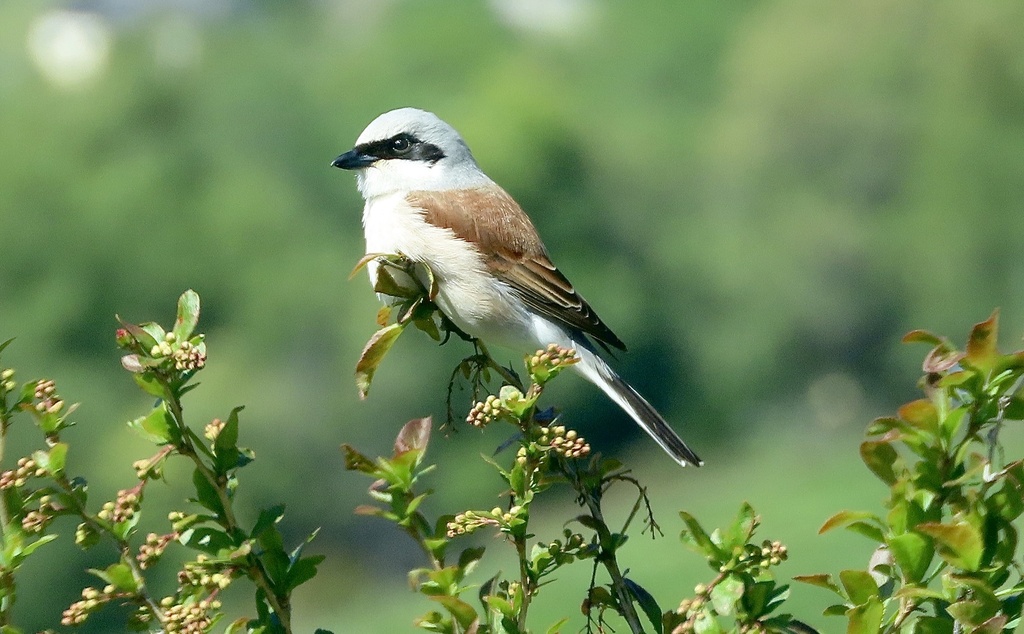
Red-backed Shrike
Photo © Karsten Rohweder
Photo © Karsten Rohweder — CC BY 4.0 — Source: iNaturalist photo #664662269Identification
The red-backed shrike is a compact passerine measuring 16–18 cm in length. Males are unmistakable, featuring reddish upper parts, a grey head, and the characteristic black eye-stripe typical of all shrikes. The underparts are tinged pink, and the tail displays a distinctive black and white pattern reminiscent of a wheatear. Females and juveniles are considerably duller, with brown and vermiculated upper parts and buff, vermiculated underparts, making them more challenging to identify in the field.
Range & Habitat
The red-backed shrike's breeding range stretches from Western Europe eastward to central Russia. The species is highly migratory, vacating its breeding grounds to winter in the eastern and southern regions of tropical Africa. Once a common migratory visitor throughout Europe, the species is now classified as a "least concern" globally, though populations have declined sharply in some areas, particularly in Great Britain, where it is listed as a UK 'Red List' species.
In Britain, the bird's dramatic decline saw it nearly vanish entirely—by 1989, no nests were recorded in the entire country. However, sporadic breeding has resumed since then, primarily in Scotland and Wales, with unexpected recent returns to south-western England, particularly Dartmoor, where successful breeding was confirmed in 2011, 2013, and sporadically thereafter. A warming climate may be assisting the species in re-colonising former territories.
Behaviour & Diet
This carnivorous species hunts from prominent perches, employing a characteristic sit-and-wait hunting strategy. Its diet consists of large insects, small birds, frogs, rodents, and lizards. The red-backed shrike has earned the nickname "butcher bird" due to its distinctive and notorious feeding habit of impaling prey corpses on thorns or barbed wire, creating a cached larder of food for later consumption.
Best Time & Places to See It
The red-backed shrike is a summer breeding visitor to Europe, arriving to breed during the warmer months before migrating to Africa for winter. For birdwatchers in Britain, the species is extremely rare and unpredictable, with the most reliable locations in recent years being Dartmoor in Devon and Shetland, though sightings remain sporadic and require patience and local knowledge.
Photography Tips
Males are highly photogenic subjects with their striking red backs and grey heads providing excellent contrast. Position yourself to capture the characteristic black eye-stripe and the distinctive tail pattern. Since the bird hunts from prominent perches, patience and a long lens will reward you with opportunities to photograph hunting behaviour. Early morning light will best showcase the male's rich red coloration. Female and juvenile plumage is more subtle, requiring careful exposure metering to render the vermiculated patterns effectively.
Bwindi Impenetrable National Park
Lake Mburo National Park
Mabamba Swamp
Murchison Falls National Park
Queen Elizabeth National Park
Aberdare National Park
Abruzzo, Lazio and Molise National Park
Addo Elephant National Park
Aggtelek National Park
Nothing matches these filters.
No community photos yet. Log in to add the first one.
No community observations of this species yet.