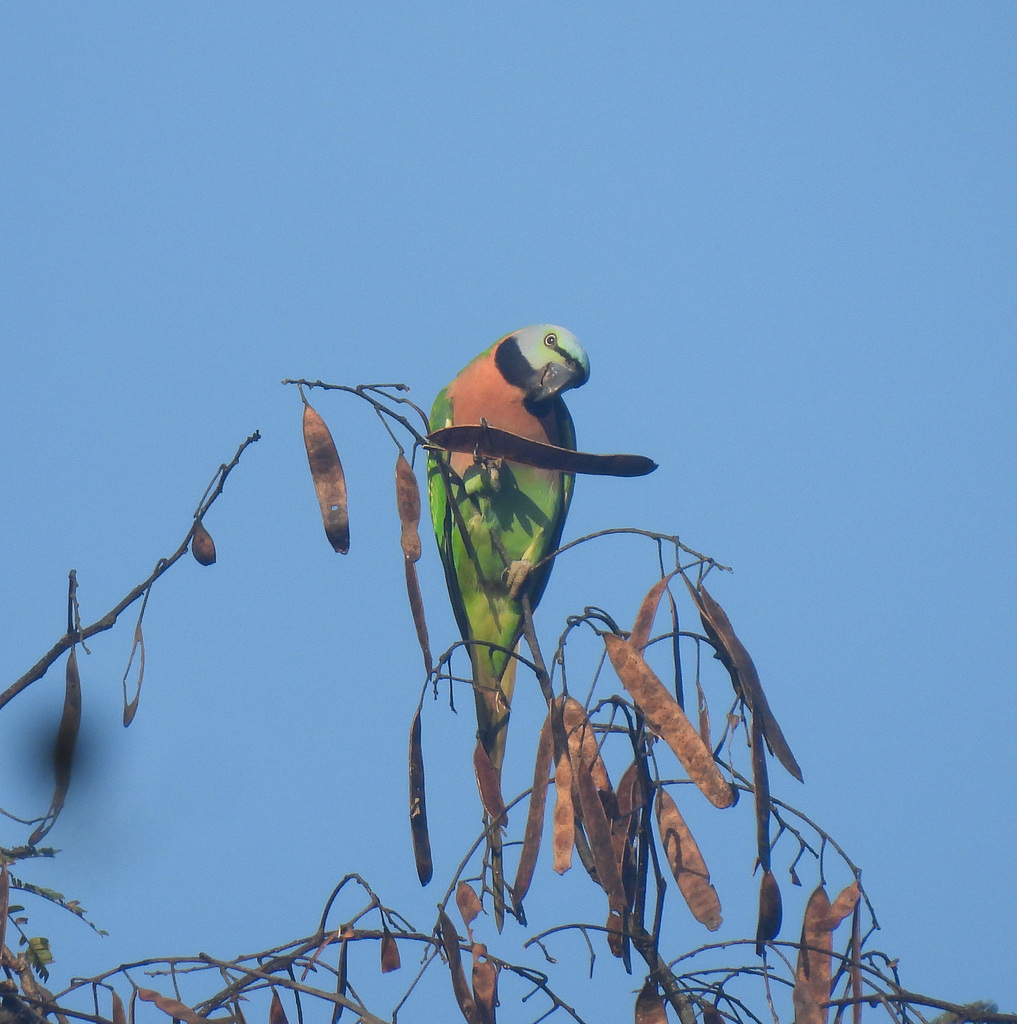
Red-breasted Parakeet
Photo © Rejoice Gassah
Photo © Rejoice Gassah — CC BY 4.0 — Source: iNaturalist #298595813Identification
The red-breasted parakeet is unmistakable in the field, easily identified by the large red patch adorning its breast—a striking feature that gives the species its common name. Depending on the subspecies encountered, this parrot may alternatively be referred to as the moustached parakeet. As a member of the genus Psittacula, it belongs to the Old World parrots, and its compact size and distinctive coloration make it a rewarding subject for birdwatchers and photographers exploring Southeast Asian forests.
Range & Habitat
The red-breasted parakeet is native to Southeast Asia and ranks among the more widespread species within its genus, though it exhibits remarkable geographical variation across eight recognised subspecies. The nominate race occurs in Java, Bali, and south Borneo, while other subspecies are largely confined to small island clusters in Indonesia, including the Simeulue, Nias, Lasia, Babi, Karimunjawa, and Kangean Islands. One subspecies is found in the Andaman Islands, and another inhabits continental Southeast Asia, extending into the northeastern foothills of the Himalayas across South Asia.
Beyond its native range, the species has adapted to urban environments, with feral populations now established in cities including Mumbai and Singapore. Smaller populations have also appeared in Indian cities such as Chennai and Bangalore, demonstrating the species' ability to thrive in human-modified landscapes.
Behaviour & Diet
Though detailed behavioral and dietary information is limited in available sources, the red-breasted parakeet shares characteristics typical of Psittacula species. Like other parakeets, it is likely an active, social bird, though specific foraging preferences and social structures would benefit from closer field observation in its native habitats.
Best Time & Places to See It
Travelers seeking the red-breasted parakeet should focus on Southeast Asian locations, particularly the Indonesian islands where most subspecies occur. Java provides the best opportunity to encounter the nominate race, though birders should be aware that this population is close to extinction. The Andaman Islands offer access to the abbott subspecies. For those unable to travel to remote island locations, feral populations in Mumbai and Singapore provide a more accessible alternative, though these birds represent introduced rather than native populations.
Photography Tips
The red-breasted parakeet's vivid breast coloration and small, compact frame make it an engaging photographic subject. The striking red patch provides excellent color contrast against forest foliage, particularly during morning light when birds are most active. Patience and a telephoto lens are essential when photographing wild birds in their native forest habitats, while urban feral populations in cities like Mumbai and Singapore may offer closer, more predictable opportunities for photography in parks and gardens.
L’Albufera Natural Park
València, Spain
+321 birds+18 mammals
Where shallow lagoons meet Mediterranean coastal marshland, L'Albufera Nature Park unfolds as one of Spain's most vital wetland complexes. This protected landscape, designated under IUCN Category…
VIEW NATURAL PARKOrang National Park
Rangagarapathar, India
+298 birds+1 mammals
Where the Brahmaputra's floodplains meet the foothills of Assam, Orang National Park unfolds across a mosaic of riverine grasslands, forests and wetlands that pulse with the…
VIEW NATIONAL PARKHat Noppharat Thara-Mu Ko Phi Phi National Park
Ao Nang, Thailand
+253 birds+9 mammals
Where limestone karsts rise dramatically from turquoise waters, Hat Noppharat Thara-Mu Ko Phi Phi National Park unfolds across a mosaic of beach, mangrove forest, and island…
VIEW NATIONAL PARKKhao Yai National Park
Prachantakham District, Thailand
+377 birds+46 mammals
Evergreen dipterocarp forest blankets the rolling terrain of this national park in eastern Thailand, where limestone hills rise abruptly from the forest floor and seasonal streams…
VIEW NATIONAL PARKKhao Laem National Park
Sangkhla Buri District, Thailand
+197 birds
Where the Vajiralongkorn Reservoir sprawls across the forested valleys of Kanchanaburi's northern borderlands, Khao Laem National Park protects a landscape where limestone ridges rise dramatically from…
VIEW NATIONAL PARKKaziranga National Park
Kohora, India
+422 birds+26 mammals
Dawn breaks over the floodplains of the Brahmaputra, where tall grasslands stretch endlessly beneath monsoon-heavy skies. This sprawling wilderness of northeastern Assam is a mosaic of…
VIEW NATIONAL PARKTaman Nasional Baluran
Situbondo, Indonesia
+189 birds+9 mammals
Across the northeastern tip of East Java, where monsoon winds sweep down from the Bali Strait, a landscape of contrasts unfolds within 374 square kilometres of…
VIEW NATIONAL PARKWest Bali National Park
Gerokgak, Indonesia
+240 birds+8 mammals
Across West Bali's northwestern reaches, where the Indian Ocean meets volcanic slopes and limestone cliffs plunge toward turquoise shallows, sprawls a protected realm of roughly 325…
VIEW NATIONAL PARKGunung Ciremai National Park
Majalengka, Indonesia
+116 birds+1 mammals
Volcanic slopes rise sharply from West Java's interior, where Gunung Ciremai's 3,078-metre summit dominates a landscape carved by geological upheaval and shaped by equatorial monsoon rainfall.…
VIEW NATIONAL PARKNo community photos yet. Log in to add the first one.
No community observations of this species yet.