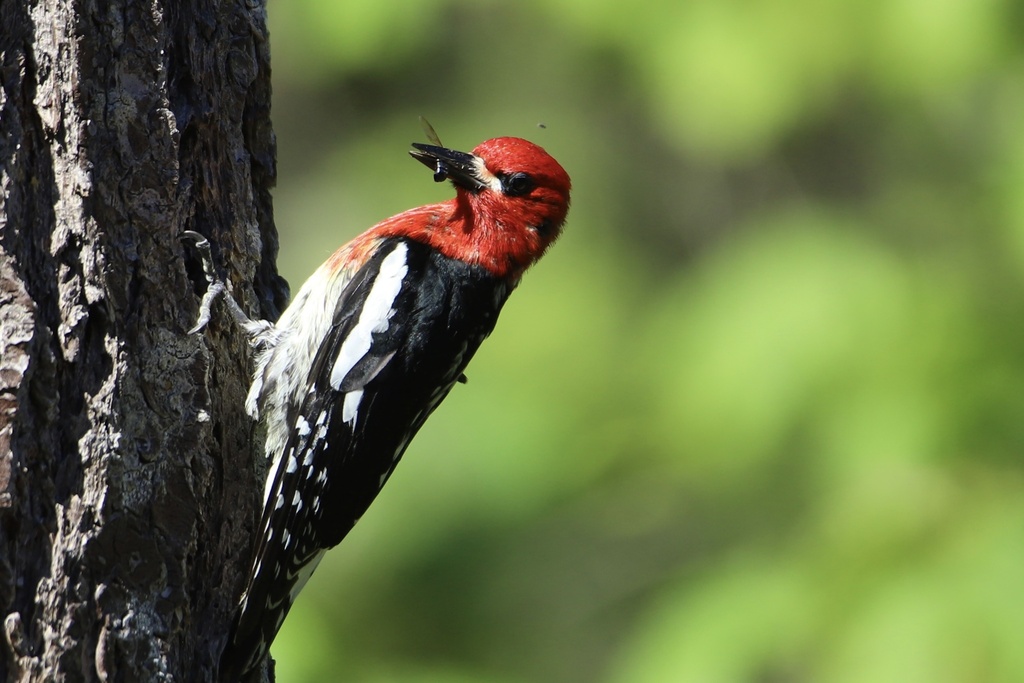
Red-breasted Sapsucker
Photo © Aitor
Photo © Aitor — CC BY 4.0 — Source: iNaturalist photo #208408950Identification
The red-breasted sapsucker is a medium-sized woodpecker easily recognized by its distinctive red head and upper chest contrasting sharply with a white lower belly and rump. The back and wings are black with white wing bars and a prominent white wing patch. Two subspecies show subtle differences: the northern subspecies (S. r. ruber) displays yellow bars on the back and a yellow upper belly, while the southern subspecies (S. r. daggetti) has white bars on the back and a paler overall belly.
Range & Habitat
Red-breasted sapsuckers breed along the Pacific Coast from southeast Alaska and British Columbia southward through the Pacific Coast Ranges of western Washington, Oregon, and northern California. They favor old-growth forest dominated by pine, hemlock, Douglas fir, and spruce, though they adapt to other woodland habitats. These birds require living trees as a food source. Northern populations migrate south in winter, and inland breeders often descend to milder coastal lowlands during colder months. Their winter range extends as far south as Baja California in Mexico, where they inhabit deciduous or coniferous woodland.
Behaviour & Diet
Red-breasted sapsuckers are specialized feeders, using their uniquely adapted tongues with stiff hairs to collect sap. They methodically drill holes in neat horizontal rows on tree trunks, then return repeatedly to harvest the flowing sap—a pattern that can eventually kill the host tree over extended periods. They also consume insects attracted to the sap wells. These active woodpeckers are vocal and produce varied chatter, squeals, and scream-like calls, along with characteristic drumming sounds that establish territory and attract mates. They nest in tree cavities, typically excavating nest holes in dead deciduous trees beginning in April or May, producing a single brood per season with clutches of four to seven white eggs.
Best Time & Places to See It
Spring and early summer offer the best opportunities to observe red-breasted sapsuckers in their breeding range along the Pacific Coast, particularly in old-growth forest habitat from British Columbia through California. Listen for their distinctive vocalizations and drumming sounds, which often reveal their presence before you spot them. Winter birders may encounter them in lowland coastal woodlands from Washington south to Baja California, where migrant and wintering populations congregate in milder climates.
Photography Tips
The red-breasted sapsucker's striking red and white plumage offers excellent photographic contrast, especially in morning or late afternoon light. Look for individuals actively foraging on tree trunks, where their horizontal drilling patterns create compelling compositional elements. Patience near known sap wells or old-growth stands in spring increases your chances of capturing behavioral shots, including the bird's distinctive posture as it works the holes. The white wing patch and wing bars are best highlighted from side angles, and capturing the bird with its tongue extended or visiting multiple holes in sequence provides dynamic action photography opportunities.
Alaska Maritime National Wildlife Refuge
Cave Creek Canyon
Channel Islands National Park
Chiricahua Mountains
Crater Lake National Park
Death Valley National Park
Don Edwards San Francisco Bay National Wildlife Refuge
Farallon National Wildlife Refuge
Glacier Bay National Park
Nothing matches these filters.
No community photos yet. Log in to add the first one.
No community observations of this species yet.